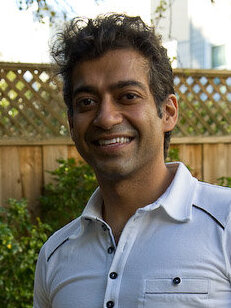
At nine years old, a boy from New Delhi arrived in New York with his mother and younger brother. His father's pharmacy degree wasn't recognized in the US; the man ended up working at a hardware store. The boy's mother worked. The library became childcare. He read everything - science fiction, philosophy, biographies, mathematics. It wasn't escapism. It was inventory.
That boy, Naval Ravikant, grew up to back Twitter before it was Twitter, Uber before it had a single driver, and over two hundred other companies - not by reading pitch decks, but by reading people, markets, and first principles. His net worth sits somewhere north of $700 million. His most-shared asset is free: a book of his thinking, available for download with no purchase required.
He attended Stuyvesant High School - one of New York City's most selective specialized schools - then Dartmouth College, graduating in 1995 with degrees in Computer Science and Economics. The double major was a tell. He has never been quite one thing.
His first company, Genoa Corp, was acquired by Finisar. His second, Epinions.com, raised $8 million in seed funding in 1999 and eventually became part of Shopping.com - which IPO'd in 2004. That should have been the clean success story. It wasn't. Ravikant and his co-founders discovered they had been effectively cut out of the value they created, through a merger structure they hadn't fully understood. They sued Benchmark Capital and August Capital. They settled in December 2005.
The VC community responded by labeling Ravikant "radioactive mud." He was thirty years old, technically successful, and professionally blacklisted. Most people in that position find a way to make peace with the system. Ravikant decided the system was the problem.
In 2007, with his friend and collaborator Babak Nivi, he started Venture Hacks - a blog that did something almost nobody in venture capital had done before: it explained, plainly, how term sheets worked and what founders were actually agreeing to. The audience was entrepreneurs. The subtext was: stop trusting people who haven't earned your trust.
Three years later, in 2010, they launched AngelList - a platform connecting startups with angel investors, with no fees, no gatekeepers, and no pretense. For the first time, a founder in a city without a strong VC network could find investment from someone on the other side of the country. The platform eventually facilitated billions of dollars in startup funding and launched thousands of companies that would never have found capital through the old boys' network.
As a direct investor, Ravikant backed Twitter, Uber, Stack Overflow, Notion, Postmates, Yammer, Opendoor, and dozens of others before they became the companies the world knows. His edge, by his own account, wasn't privileged access. It was pattern recognition built through compulsive reading - and a willingness to say yes before anything was proven.
In 2014 he co-founded MetaStable Capital, a cryptocurrency hedge fund, when the idea of institutional crypto investing was still treated as eccentric at best. In 2017 he launched Spearhead, which gave promising founders capital to invest as angels - essentially passing forward the thing he'd spent a decade building himself. In 2023, with a co-founder, he launched Airchat, a voice-first social platform, betting that the next shift in how humans communicate online would be spoken, not typed.
By 2025, he was at a new company called Impossible, exploring whether AI could manage an entire business - not assist a business, but run one. The question is characteristically Naval: what would happen if we removed the last unnecessary middlemen?
Beyond the investments and the companies, Ravikant has built a second, stranger kind of influence. His Twitter account (@naval) reads like a commonplace book: aphorisms on wealth, attention, freedom, happiness, and the nature of desire. Not motivational content - something more unsettling. He has called desire "a contract to be unhappy." He has argued that status and wealth are different games, that most people play the wrong one, and that the confusion is the source of most adult misery. These ideas circulate constantly in startup culture, in philosophy podcasts, in self-improvement forums, and in arguments between people who have never agreed on anything else.
The book that captures this thinking - The Almanack of Naval Ravikant, curated by Eric Jorgenson from 17,000 tweets, dozens of interviews, and multiple podcasts - is freely available online. Ravikant insisted. He's said the purpose of wealth is freedom, and the purpose of freedom is peace. Charging for the philosophy would have been a contradiction.
His podcast continues to run in 2026, with recent episodes including "Sell the Truth" on persuasion and dealmaking, "A Return to Code" on AI coding agents, and "A Motorcycle for the Mind" on cognition and artificial intelligence. He is not chasing listeners. He posts when he has something to say.
He practices what he calls "rational Buddhism" - applying the rigor of scientific skepticism to ideas borrowed from Eastern philosophy. He meditates. He works out in the mornings, by his own admission partly to prevent himself from staying up too late. He reads everything. He trusts almost nothing at face value. He has, at various points, been dismissed as naively optimistic, dangerously skeptical of institutions, and annoyingly right about the future.
The most useful summary of Naval Ravikant may be this: he is a man who got burned by a system he didn't fully understand at 30, and spent the next 25 years systematically dismantling every part of it he could reach - while writing down what he learned in language simple enough that anyone with a library card could follow.