The short version
- Castbox is a freemium podcast player and creator platform, built for listeners who want discovery and podcasters who want distribution, analytics and paid channels.
- Renee Wang released the first Android version in four days. One million downloads in two months made her stop the other experiments.
- Its sharpest distinction is In-Audio Search: speech becomes text, text becomes an index, and a query can point into an episode.
- The company learned that software could travel globally more cheaply than exclusive shows. Its edge is utility, not a Spotify-sized content budget.
On the last day of 2015, Renee Wang was listening to a lecture when a friend offered the sort of observation that usually evaporates before breakfast. Apple had a podcast app. Android, then the unruly half of the smartphone world, did not have a native equivalent. Listening involved downloads, files and enough manual organization to make leisure feel like clerical work.
Wang knew the irritation personally. She used podcasts for news and to study Japanese, often while commuting or exercising. She also knew Android unusually well. She had studied psychology and mathematical statistics at Peking University, taught herself to code, worked at mobile analytics startup Umeng and then joined Google, where she helped thousands of developers with products, operations and monetization.
On New Year's Day, she found an open-source foundation and started building. Four days later, the first Castbox was live. It was not a grand launch. It was a probe. Then came the answer: one million downloads in two months. Wang shut down the other app ideas her young company was testing and put its attention on the odd little audio player.
The useful part of the origin story is not the four days. It is what happened after the data arrived: the founder stopped doing everything else.
The filing cabinet inside the sound
Every podcast app can put a triangle on a screen and make sound come out. Castbox chose the moment before that one. Which episode should you play? Where, inside an hour-long conversation, is the five-minute passage you actually need?
Audio had a filing problem. A title, a show note and an RSS description could be searched; the spoken sentences remained sealed inside the file. Castbox used automatic speech recognition and natural-language processing to transcribe and index those sentences. In-Audio Search, introduced in 2017, could return episodes where a term was spoken and direct a listener toward the relevant moment. The company's recommendation system tackled the adjacent problem: finding the show you did not yet know to request.
That does not make the machine infallible. Accents, crosstalk, names and poor recordings remain hostile terrain for automated transcripts. Nor does a relevant word guarantee a worthwhile discussion. The feature's value is humbler: it makes a vast, opaque medium a little less opaque.
Company-reported scale figures vary by page and period. A 2022 profile put users above 30 million; storefronts provide the firmer current signals.
A player for the listener, a workbench for the host
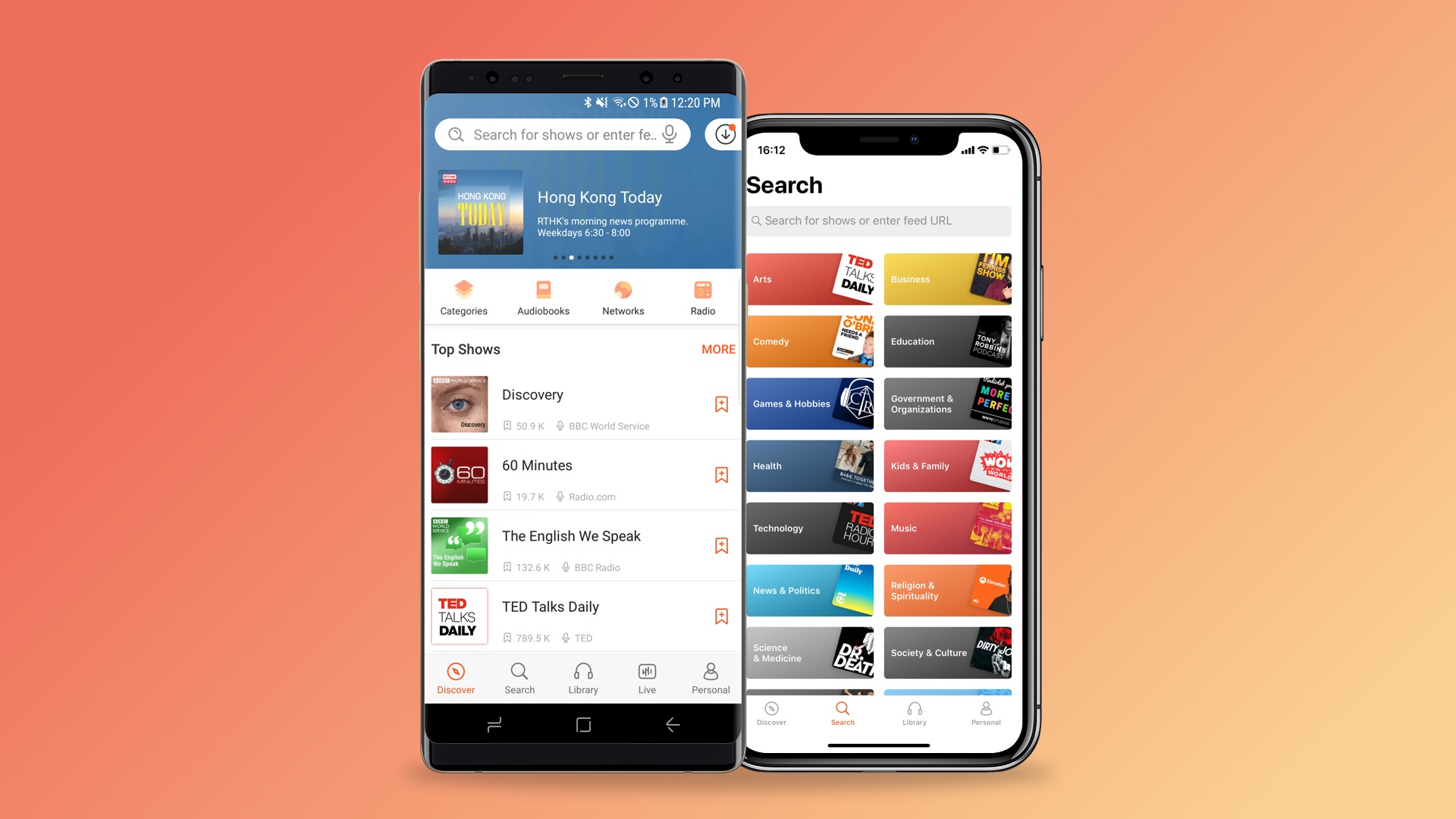
For listeners, Castbox spans Android, iOS, web, watches, cars and smart speakers. The familiar tools are all present: downloads for flights and tunnels, cross-device synchronization, OPML import, sleep timers, variable speed, volume boost and silence trimming. Google Play currently shows more than 10 million Android downloads; the US App Store carries roughly 199,000 ratings. The advertised library includes podcasts, radio and audiobooks in dozens of languages.
For podcasters, Creator Studio is the other half of the platform. A creator can claim an existing RSS show or host one on Castbox, manage episodes, see Castbox play and subscriber counts, connect social profiles and operate a paid channel. Premium channels may charge once, monthly or annually, and may mix free episodes with subscriber-only work.
The business sits between those groups. Free listening carries visual or video advertising and limits subscriptions to 100 channels. Castbox Premium removes visual ads, lifts that limit and adds per-show playback settings, priority support and hosting allowances. Past original-show partnerships added host-read advertising and revenue sharing. The exact present-day revenue mix is private, but the architecture is legible: a large free audience, paid convenience and tools that help creators monetize.
The first thing that became too expensive
In 2018, nearly every podcast company wanted to be called the Netflix of audio. Castbox raised $13.5 million, launched original programming and worked with Studio71 on creator-led shows. A show featuring Christine Sydelko reportedly drew 75,000 to 100,000 audio listens per episode, plus more than 250,000 YouTube views. With Wondery, Castbox also introduced a native paywall that replaced the fiddly ritual of buying elsewhere and pasting a private RSS feed.
But original content exposed the industry's brutal arithmetic. Wang later described American programming costs as beyond Castbox's financing capacity. Spotify could spend $100 million on a single show and billions across content. An independent app could not make that its chosen duel. Castbox's wider company responded by reusing its data, growth, monetization and operations capabilities in games and utility apps. It was less a glamorous pivot than a practical act of self-preservation.
A four-day Android release reaches one million downloads in two months.
In-Audio Search launches alongside a $12.8 million Series A.
Originals, Studio71 advertising and a Wondery paywall expand the platform.
Wang explains why premium US content could not be the company's spending contest.
The storefront pitch still centers on search, recommendations, control and reach.
This is where Castbox sits in the market now. Apple Podcasts owns the convenience of being installed. Spotify and YouTube Music bundle spoken audio with enormous music and video habits. Pocket Casts, Overcast, Podcast Addict and AntennaPod court people who care about control. Castbox occupies the busy intersection: a broad global catalog, consumer playback, creator infrastructure and search technology in one product.
Its weakness is also visible there. Discovery earns the download; playback reliability earns the tenth year. Recent public reviews praise Castbox as a capable podcatcher while complaining about intrusive ads, synchronization, Bluetooth controls and interrupted playback. Those complaints are not side notes. A search engine for speech is clever, but a podcast app still has to play the podcast.
The part worth copying
The founder's story contains plenty of cinema. Wang quit Google and sold her Beijing home, reportedly for about $500,000, to finance the company. Within months, investors arrived; by 2018, publicly announced rounds totaled $29.5 million, followed by a reported $15 million Series C in 2021. Yet the more portable lesson costs much less.
Find a platform the incumbents have neglected. Use existing infrastructure to test the smallest complete product. Watch behavior rather than applause. When one experiment produces an abnormal signal, stop the others. Only then invest in the technically difficult advantage. For Castbox, that sequence ran from an absent Android default, to an open-source prototype, to one million downloads, to transcription and indexing.
Conditions attached
This playbook fails when the gap is temporary, when distribution belongs to an operating-system owner, when the differentiated technology is easy to copy, or when the basic experience is not dependable. It also fails if winning requires exclusive content that a much larger rival can price beyond reason.
Castbox did not turn every podcast into a perfect database, nor did it become the industry's Netflix. It did something more specific. It noticed that audio discovery was stuck somewhere between a radio dial and a filing cabinet, then built a search box into the cabinet. Ten years later, that remains the most interesting thing about the company: not the size of the shelf, but the conviction that the shelf should answer questions.