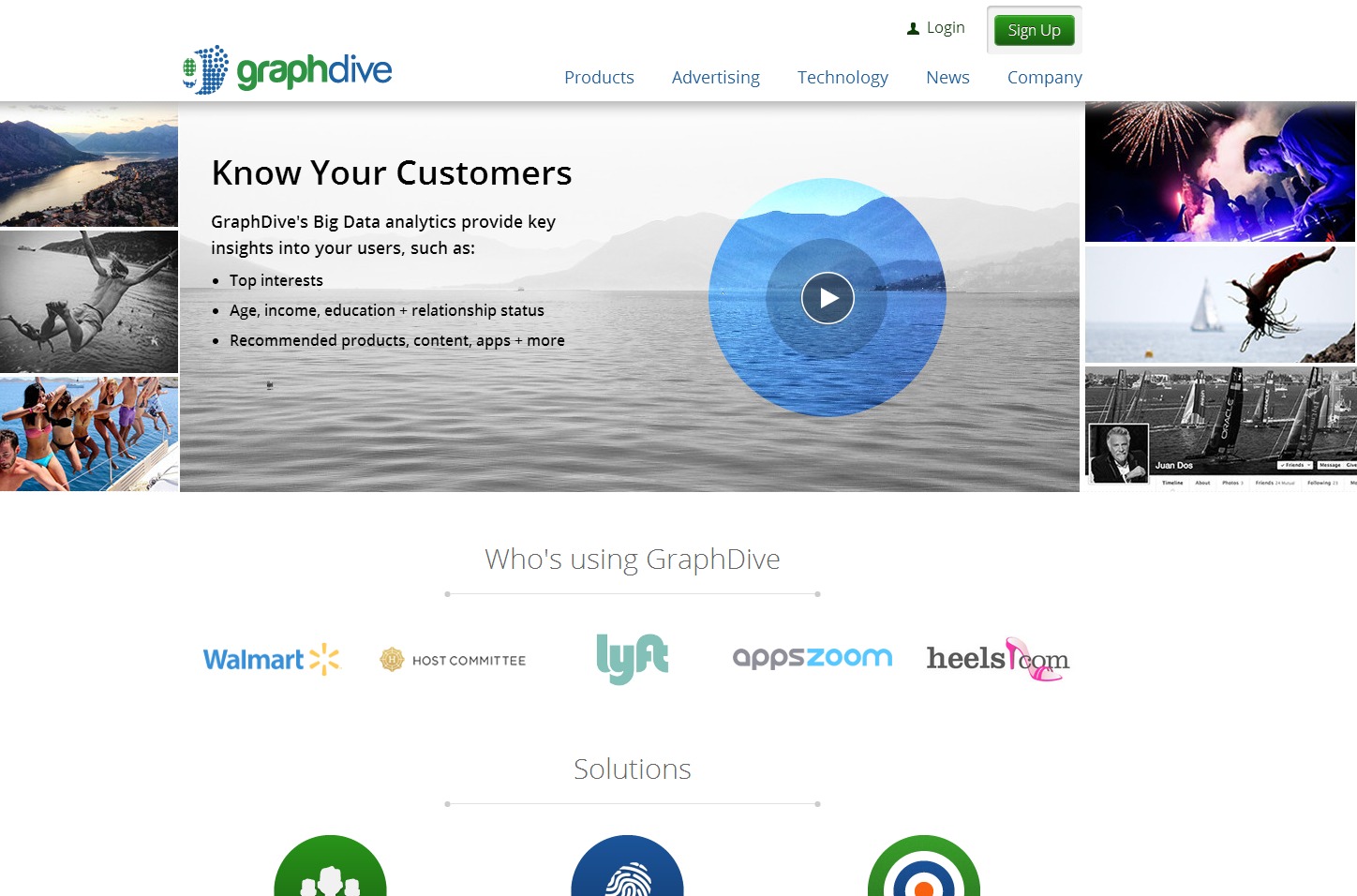
- GraphDive turned opt-in Facebook Connect data into audience segments, recommendations and lookalike advertising.
- It served dozens of businesses, including Walmart and Lyft, and reported more than 10,000 daily API calls in 2013.
- Public reports put its funding at about $3 million before Sociable Labs acquired it in 2014.
- Its reusable lesson: in enterprise software, test harder, pay only for productive distribution, and charge for valuable work.
In September 2013, a TechCrunch reporter let a startup inspect his Facebook trail. The software correctly inferred three out of four biographical facts. It missed the fourth. GraphDive decided he was married. He was not. This was a charming error because it captured the entire proposition in miniature: the machine knew enough to be useful, not enough to be trusted blindly, and just enough to make a person wonder what his clicks had been saying behind his back.
GraphDive was built for the moment when Facebook Connect buttons were appearing across the web and every online business was asking the same question: now that people have arrived, can we know what they actually want? Founders Shahram Seyedin-Noor and Sina Sohangir believed the answer was hiding in social data. Their system parsed account activity, mapped related interests and inferred attributes such as age, income, education and relationship status. Businesses received the result through an API.
The founders did not want another dashboard that merely counted likes. They wanted an intelligence layer. Retailers could group customers into useful segments. Publishers could rearrange content. A merchant could recommend one product instead of another. An advertiser could search for new prospects who resembled its best existing customers. The web page, in this telling, would stop being a brochure and begin behaving like a clerk who remembered you.
A genome scientist walks into an ad stack
The origin makes more sense if you know Seyedin-Noor's previous company. At NextBio, he had helped build software that analyzed enormous collections of genomic data for personalized medicine. GraphDive carried the same conceptual move into commerce: take a pile of signals too large and unruly for a person, find patterns, then make the experience specific to one individual. Sohangir, a Stanford-trained computer scientist, supplied the semantic and behavioral machinery.
Opt-in social login activity and Facebook data
Ranked interests, demographics and behavioral patterns
Segments, recommendations and lookalike ads
GraphDive called this consent-based approach an antidote to irrelevant marketing. Users had chosen to sign into a particular service with Facebook; GraphDive analyzed the information they shared there, rather than buying a mystery dossier from a broker. Seyedin-Noor described the company, neatly, as “the anti-spam company.” It was still profiling, but the bargain was legible: share data, receive relevance.
The graph grew. So did the bill.
The company opened its Social API on an invitation basis in 2012 and raised roughly $1 million from Crosslink Capital, Correlation Ventures, Plug and Play and angel investors. In September 2013, another $2 million arrived in a round led by Start Capital with angels Pejman Nozad, Ullas Naik and Naguib Sawiris. The money was meant to improve the product, scale infrastructure and expand sales.
The traction was real but early. By late 2013, the founders said dozens of businesses were using GraphDive and sending more than 10,000 API calls each day. Walmart and Lyft were the two customers named in contemporary reporting. The archived homepage also displayed Host Committee, AppsZoom and Heels.com. GraphDive planned to extend beyond Facebook to Twitter and Google+, and beyond English to other languages.
The endpoints reflect the company's reported 10x growth. Intermediate bars are illustrative, not monthly measurements.
The first failures were not mathematical
Asked to name his biggest mistakes, Seyedin-Noor did not complain about venture capital, competitors or an unlucky market. He named three operating choices. They are striking because none required a PhD to avoid.
Features reached enterprises before they were ready
The release-fast habit makes sense when consumers can forgive a rough edge. An enterprise buyer integrates the rough edge into a workflow, then remembers it during renewal.
Some platform memberships were paid, not earned
GraphDive paid to join a few partner ecosystems. The founder's later test was blunt: if a platform creates genuine value, it should be willing to share revenue instead of charging admission.
A famous customer received free work
The company completed a project without charge to borrow a Fortune 500 name. The customer later paid. The free price had not created the value; it had merely hidden it.
Those admissions are more instructive than a tidy success myth. They show what changed the company's mind: customers did. A beta feature misbehaved in an enterprise setting. A paid ecosystem delivered less than promised. A prestigious free account turned out to have a budget. Reality supplied the curriculum.
A business built on rented ground
GraphDive sat in a crowded and quickly changing market. Gravity built interest graphs with an emphasis on publishers. Criteo used intent for advertising. Analytics firms counted behavior, recommendation engines predicted the next item, and internal data teams tried to stitch identities together. GraphDive's distinction was packaging social-login inference as a practical B2B API, with segmentation, recommendations and acquisition in one chain.
Its advantage was also its condition. The system was most useful when users signed in socially, shared enough meaningful data, and the platform continued to expose that data on stable terms. Sparse profiles weakened inference. A business without a large stream of authenticated visitors had little to analyze. Strict privacy rules, shifting platform permissions or customers unwilling to trade data for relevance could narrow the product sharply. And every inferred trait carried the TechCrunch problem: three correct answers did not erase the awkward fourth.
In 2014, Sociable Labs acquired GraphDive. The independent company disappeared into a business focused on social commerce and referrals. The old domain now leads to a marketplace listing, an unusually literal image of startup mortality: the name survived, detached from the thing it once named.
Founded by Shahram Seyedin-Noor and Sina Sohangir.
Social API launches by invitation; roughly $1 million disclosed.
API use rises 10x in three months; $2 million round closes.
Sociable Labs acquires GraphDive.
What a founder can copy
- Build the prototype before raising money; evidence improves both the product and the financing conversation.
- Test enterprise features in real deployments before treating speed as a virtue.
- Ask every partnership to produce distribution, revenue or product value you can measure.
- Charge for valuable work, even when the customer's logo would look excellent on a slide.
- Treat access to another company's platform as a dependency to manage, never as infrastructure you own.
GraphDive's bet did not look foolish. Much of today's internet is an answer to the same question the company asked: how can a service convert scattered behavior into a useful next action? The methods are richer now, the identity layer is more fragmented, and consent is less easily waved away. But the commercial lessons have barely aged. A clever model does not excuse a brittle feature. A famous customer is not payment. A partner badge is not distribution. The graph may be complicated; the invoice should not be.