At Benson, a print proof used to take the scenic route. A designer exported the file. Customer service fetched it, checked it against a printed copy and emailed the client. Comments returned at different times, sometimes pointing in opposite directions. Then the whole exercise began again. In Ziflow’s customer account, Benson reports that its average fell from three or four proofing rounds to 1.6 after clients began marking up work directly in a shared review space.
That small decimal is a useful introduction to Ziflow. The company sells software for the stretch of creative work that rarely makes the portfolio: collecting comments, resolving revisions and securing approval. Its audience includes agencies and internal marketing departments whose campaigns involve several formats and several people with permission to say, “Could we change this?”
The founders had already seen this inbox
Co-founders Anthony Welgemoed and Mat Atkinson arrived with experience unusually close to the problem. They had built ProofHQ, which Workfront acquired in 2015. Welgemoed, now Ziflow’s CEO, had been ProofHQ’s chief technology officer. Their next company began as a creative workflow and automation tool, according to Ziflow’s account of its origins.
Former ProofHQ customers helped pull them back toward proofing. Those customers wanted more advanced features for increasingly complicated review processes. The significant change of direction was therefore a response to people already buying this kind of software. The founders had a working understanding of the market, plus customers describing what still hurt.
The corporate paperwork adds a less polished detail. The British entity was incorporated in October 2015 as Salt and Pepper HQ Limited, becoming Ziflow Limited the following month. Before the vocabulary of creative operations came the sound of a kitchen cupboard.
Capital followed. An April 2021 expansion round brought in $6 million, led by Companyon Ventures with Riverside Acceleration Capital participating. In February 2023, the two investors led a $20 million Series A. Ziflow said the money would support hiring, product development and integrations. That funding underwrote a deliberately specific proposition: make the review process worth paying to improve.

The asset becomes the meeting place
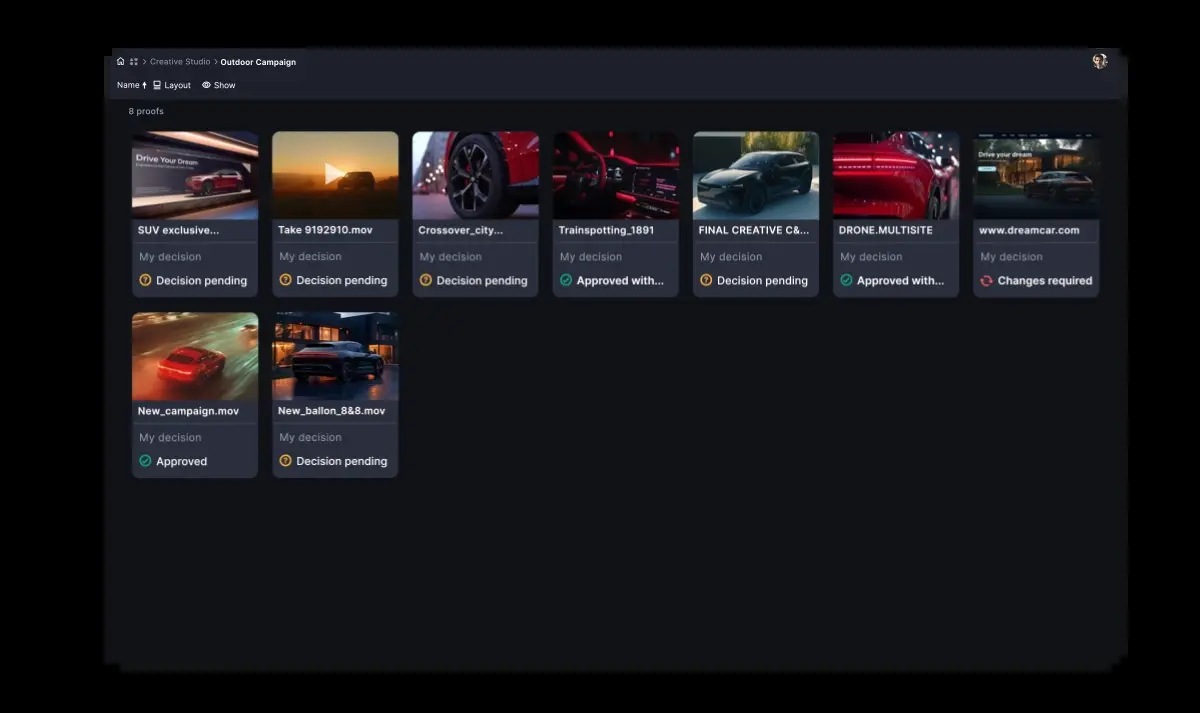
Using Ziflow starts with a proof: a file that needs someone’s attention. Upload it, invite reviewers and collect their feedback in the viewer. Comments, versions and decisions sit together. Reviewers can compare iterations and record whether the work is ready or needs changes. The practical improvement is that a comment has an address inside the work, instead of floating somewhere in a message thread.
The platform advertises support for more than 1,200 file types. That breadth matters when one campaign includes video, a PDF, packaging and a website. A team can organize review across those deliverables without asking each stakeholder to adopt the application that originally made the asset.
Routing adds structure. Work can pass through stages, with different people involved at different points. A designer’s internal check and a client’s final decision need not become one crowded conversation. Version comparison helps reviewers inspect what changed; recorded decisions help managers see where the work is waiting.
Its connections to other applications are part of the product’s usefulness. In monday.com, teams can create and review proofs from a board. Asana can receive status, links and comments through a two-way integration. Creative Cloud plugins bring feedback into designers’ tools. Dropbox and Google Drive connections can turn incoming files into proofs or move assets through a configured process.
Ziflow also offers an API and event-driven automations. These let a team connect approval activity to its existing systems. For an operations manager, the attraction is practical: an approved asset should not require another person to copy its status into another application.
What gave way first: the handoff
The customer stories expose different versions of the same coordination problem. At Haberfeld, a marketing and consulting firm serving banks and credit unions, artwork traveled in physical folders. That method depended on people being in the office. As account executives traveled and covered one another’s clients, knowing where the work had gone became harder.
Haberfeld moved the review into Ziflow and built 12 customized workflows for different parts of its business. In the published account, the team says client feedback and approvals arrived at least a week or two faster. The lesson is less about digitizing a folder than making its contents accessible to the people who need to act.
Darey Brands faced a packaging rebrand across a product line. Senior graphic designer Chantelle Bogue needed reviewers to open a link and respond without a complicated setup. Individual email routing and separate tracking were an awkward fit for the volume. The company reports that packaging approvals became 70 percent quicker after adopting Ziflow.
Bogue also described a surprise: automation removed much of the follow-up work she had expected merely to simplify. That is a telling distinction for buyers. A new interface earns its keep when it removes a recurring task, rather than simply giving that task a tidier screen.
“We had a lot, a lot of touchpoints and a lot of room for confusion or inconsistency.”
Benson representative, in Ziflow’s customer account
These are customer reports published by the vendor, not controlled trials. They identify plausible mechanisms and useful outcomes. They do not establish how much a different team will save. The common factor is that people changed where feedback happened and how it moved.
A subscription to fewer loose ends
Ziflow charges for the people creating and managing proofs while allowing unlimited reviewers. That distinction suits agencies bringing outside clients into a project. The person invited to comment does not automatically become another paid seat.
At the annual-billing prices checked on September 7, 2026, Standard costs $199 a month with 15 users; Pro costs $329 with 20. Those base rates equal $2,388 and $3,948 a year. Enterprise is quoted individually. ReviewAI is offered as an Enterprise add-on.
A free edition includes two users, 2GB of storage and 60 days of review history. Paid plans differ in workflow depth, integrations and retained audit history. A sensible buying decision starts with the actual review sequence and record-keeping needs, then checks which edition covers them.
Ziflow operates in a competitive corner of marketing software. Filestage also organizes feedback, approvals and AI-assisted checks. Frame.io offers review and collaboration with roots in media production, including Camera to Cloud. Ziflow’s case rests on its combination of format coverage, configurable routing and connections to the rest of a marketing team’s tools. A team should test that combination with its own awkward files and reluctant reviewers.
The AI reviewer had notes on its own maker
In its December 2025 retrospective, Ziflow reported more than 6.5 million proofs reviewed and over 150,000 stakeholders during the year. That measures activity across internal and external participants, not the number of paying customers. It also gives the company a substantial workload of repetitive checks to address.
ReviewAI for Checklists entered public preview in November 2025. Teams supply review criteria; the software evaluates content and suggests feedback. Reviewers retain control over whether to accept, reject or edit the recommendations. Ziflow’s Spring 2026 release presentation featured further ReviewAI improvements alongside font inspection, bulk decisions and an expanded ClickUp integration.
“AI doesn’t fix broken creative processes. It just makes the chaos move faster.”
Anthony Welgemoed, announcing ReviewAI, November 2025
A September 2, 2026 company experiment made the limits unusually tangible. Ziflow ran nine appropriate-content checks across four creative assets. Its own fictional headphone brand, groove4U, supplied an awkward result: a revised ad showing a woman running outdoors in headphones triggered a safety flag about reduced awareness of her surroundings.
The experiment also produced a false positive. An ad for a fictional fitness tracker was flagged for distressing imagery because it displayed heart-rate and sleep information. Ziflow acknowledged that the result was inappropriate for the context. Across the test, it reported 36 checks, with 11 failures and 25 passes.
This was a company demonstration, not an accuracy benchmark. Its useful detail is the visible disagreement. A reviewer could inspect the reasoning and dismiss a poor flag. The tool’s job was to raise a question before publication; a person still had to decide whether the question deserved a revision.
Borrow the process before buying the promise
Ziflow describes its global team through values including customer focus, continuous improvement and curiosity. Those are stated intentions. The more observable expression is its attention to configurable workflows and customer onboarding: the product has to fit a process that other people will actually use.

For a reader considering a similar change, the customer accounts suggest a modest experiment. Choose one recurring asset type. Put its feedback in one shared place. Name the people who must approve it. Record the starting number of versions and the time spent chasing responses. Compare the next batch against that baseline.
asset type
approvers
review space
the next batch
The conditions matter. If stakeholders keep issuing private instructions, feedback will still fragment. If nobody owns the final decision, automated routing can circulate indecision. For a solo creator with occasional, straightforward approvals, a paid workflow system may offer little return. And an AI checklist cannot inspect a requirement the team has never articulated.
Ziflow’s proposition is strongest where the volume and the handoffs make those habits expensive. Benson’s 1.6 rounds is a more useful ambition than the fantasy of revision-free creativity. People will still disagree about the work. The opportunity is to spend less time discovering where they disagreed, which version they meant and whose answer comes next.