The troublesome part of an advertisement can be the small print. At DraftKings, a campaign might need different legal language for different states. A change that occupies very little space on screen can generate a considerable amount of work behind it. Someone must make the variations, check the files and get them delivered. Multiply that by formats and sporting events, and the production problem starts to look very different from the creative one.
- EKCS supplies the production capacity behind brands, agencies and publishers.
- Clients can keep creative direction while handing over adaptations and delivery.
- Its Mediaferry platform connects the people, files and approvals.
DraftKings brought in EKCS in 2020 after relying on costly contractors. Its internal team continued to lead the creative work. EKCS supplied adaptable capacity and expertise in areas including print. According to the published case study, batches of roughly ten animated banner updates typically came back within 24 hours. The arrangement made room for the internal team to spend more time on design systems and exploration.
One idea. Then all the versions.
That division of labour explains EKCS better than a list of advertising services does. A creative department can have a good idea and still struggle to produce everything the idea requires. There are presentations, emails, packaging layouts, social assets and videos. Each has its own dimensions, technical specifications and route to approval. The original concept is only the beginning of the workload.
EKCS occupies that space between concept and delivery. It offers on-demand staffing and production across channels, with capabilities extending from image retouching and editorial design to motion graphics, website development and packaging prepress. A client can use it to cover a missing skill or a seasonal surge. The appeal is practical: access to capacity without assembling a new freelance roster every time demand moves.
One concept. Several production paths. A shared approval process.
The partner has to learn the house rules
Penna offers a useful complication. Before choosing EKCS, the London recruitment business had already tried outsourcing. The problem, its case study says, was finding a reliable partner that could work with its methods. Buying outside capacity had not, by itself, solved the organisational problem.
The EKCS relationship began in 2012 with overflow work and lower advertising production costs. It grew into support across print, digital and video, with dedicated resources for digital marketing. Mediaferry brought ordering, tracking, proofing and approval together. The significant detail is the fit: the offshore team learned Penna’s ways of working. EKCS reports that Penna recognised it with vendor awards in 2021 and 2023.
The lesson for a buyer is quite specific. A production partner needs to understand what a complete brief looks like, who can approve changes and what counts as a finished file. If those decisions remain unsettled, adding more people can simply give the confusion more places to travel. That is an operational inference from these cases, and a useful test before signing a contract.
The software follows the work
Robert Berkeley and Tariq Husain founded EKCS, which dates its beginnings to 2002. Berkeley is also the host of Inside Jobs, a podcast about in-house creative agencies. Husain leads the operational and technical side of the business and is the architect of Mediaferry. The combination helps explain why a production services company also built a workflow product.
Express KCS became EKCS in 2021. Its explanation was straightforward: the old identity no longer reflected a business serving agencies and brands as well as publishers. Clients had already been using the shorter name. There is something pleasingly economical about a rebrand that adopts the abbreviation customers have chosen for you.
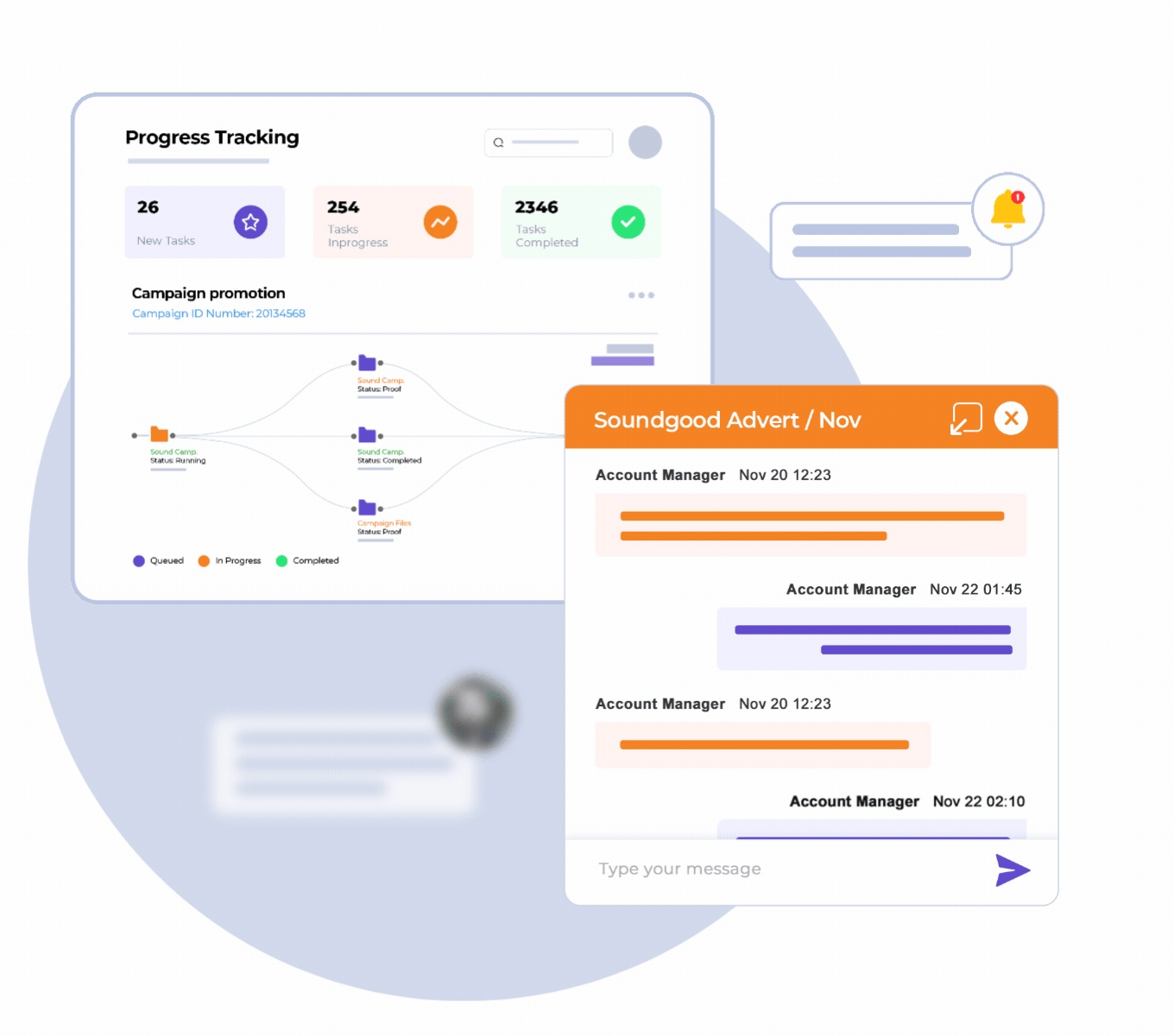
In September 2024, EKCS launched Mediaferry AI for news publishers and broadcast media companies. It added AI-assisted briefing, asset creation and advertiser brand memory to a system connecting production, approval and activation. The ambition was to let sales teams and advertisers do more themselves while retaining a route to professional production support.
Faster requires some teaching
Newsquest’s experience supplies a striking number, with an equally useful footnote. Mediaferry’s customer story reports creative turnaround falling from 48 hours to 15 minutes. Newsquest had already worked with EKCS on trafficking before extending the relationship to SmartDesign AI and connecting artwork with its CRM workflow.
Customer-specific result reported by Mediaferry.
The rollout included remote training, e-learning, reference guides and regional “super users.” The account describes initial scepticism giving way as salespeople saw the output. This matters because software adoption is also a teaching problem. Access to a generation tool does not automatically tell someone how to use it in a customer conversation.
EKCS’s newer partnerships extend that approach. An October 2025 agreement with CHILI publish introduced template creation and support for CHILI GraFx. Packages run from Simple to Custom, covering different production requirements. A September partnership with Xpance connected creative production with proofing, giving publishers access to AI-assisted, human-led and combined workflows.
“This is about flexibility and results.”Tariq Husain / Xpance partnership announcement, 2025
Buy the process, count the cost
The commercial model combines production services, dedicated or flexible staffing and technology. Mediaferry describes pricing based on variables including users, output, platform access and managed AI capacity; integrations and some support are scoped separately. Penna’s case attributes savings to wage differences, flexible resources and process consolidation. Those are several different economic mechanisms, each worth examining in a proposal.
For a buyer, the useful comparison is the cost of getting an approved asset delivered, including briefing and revisions. Repetitive work with clear brand rules is a plausible candidate for templates and automation. A shifting concept with unresolved stakeholders still needs decisions. EKCS’s place in the market is the intersection of people and production systems. Its cases suggest a question every busy creative team can copy: where, exactly, does the work wait?