Imagine selling a campaign that follows a viewer from a television set to a streaming app. The advertiser sees one audience. Inside the media company, the sale can become several different jobs: reserve inventory, prepare orders, coordinate delivery, reconcile results, send an invoice. Each handoff is an opportunity to lose the thread. Operative has built a business around keeping it.
- The job: connect the business processes behind advertising across screens.
- The buyers: broadcasters, streamers and publishers with complicated inventory.
- The catch: adoption depends on integrations, migration scope and shared data definitions.
The sale after the sale
Operative’s AOS, short for Advertising Operating System, is an advertising order management system. It connects the commercial work: products, proposals, inventory, orders and billing. An ad server handles delivery. AOS helps coordinate the business agreement around that delivery. For a reader who has ever watched sales promise something that operations must somehow assemble, the distinction will feel familiar.
Consider a makegood: replacement advertising used to compensate for an unmet commitment. A delivery shortfall becomes a commercial problem that has to travel back through the order. Operative lists makegoods among the workflows AOS supports. The example explains why a dashboard alone cannot do the whole job. Someone must connect the original commitment, the delivered result and the revised agreement without making each department reconstruct the story.
The customers are the companies selling access to audiences. Operative’s September 2026 announcement names Fox, NBCUniversal, Paramount, Disney/ABC, Seven Australia and Sky among more than 300 media brands across 18 countries. Its customer stories also feature Spectrum Reach, DIRECTV, Future and APMC, the company behind Victory+. Their formats differ. The need to connect a sale to its execution travels remarkably well.
- 01Propose
- 02Reserve
- 03Deliver
- 04Reconcile
- 05Bill
Operative connects business workflows to delivery and finance systems.
When television bought digital
The company’s history makes the problem unusually concrete. Operative began in 2000. In November 2016, television software company SintecMedia agreed to acquire it for nearly $200 million, according to AdExchanger. SintecMedia brought television planning, trafficking, billing and content management. Operative brought digital advertising workflows. Francisco Partners backed the buyer; Operative management also invested in the combined business.
That combination expressed a judgment about where television was going. Viewers could cross platforms more easily than a broadcaster’s internal systems could. In a 2017 video interview, founder Lorne Brown described networks needing to bring existing supply and new digital partnerships together. The task demanded a different approach to inventory and workflow. In February 2018, SintecMedia relaunched as Operative. The acquired company’s name ended up on the combined business.

The catalog is the strategy
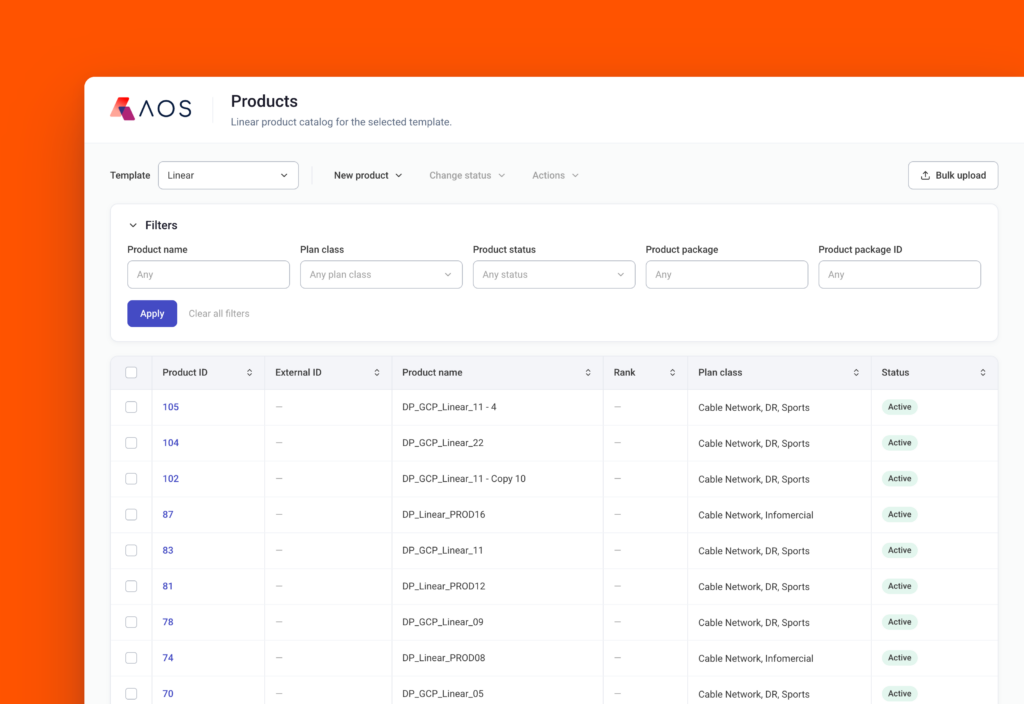
The practical answer begins with something gloriously uncinematic: a product catalog. A media company needs a common account of what it can sell, how it packages inventory and which rules apply. Operative’s 2023 AOS rollout described housing and packaging thousands of products, then bringing them into company-wide proposals. That is where the software’s integration work acquires commercial meaning. A campaign spanning several channels needs a proposal the company can actually fulfill.
“AOS has unlocked multi-product and vertical deals for us.”
Sheelpa Patel / FOX / April 2023
Operative sells several ways into this problem. Operative.One handles digital advertising management. IBMS connects content scheduling and rights across the content lifecycle. OnAir addresses broadcast traffic and billing. Managed Services supplies people for trafficking, staffing and campaign optimization. The expertise includes both software and the operational routines that make a campaign run.
The competitive distinction needs care. WideOrbit also offers cross-media sales, traffic and billing products, including WO Omni. Operative’s argument rests on its combination of digital and television experience, configurable workflows and connections to existing infrastructure. Its partner roster includes AWS, Google Cloud, Imagine Communications and DanAds. Integration is part of the product’s purpose: replacing every surrounding system would be a very different proposition.
Free has a boundary
Operative earns money through enterprise software contracts and services. Its AWS Marketplace listing describes contract pricing with private offers. A revealing detail appears in the March 2026 digital AOS implementation sheet: a standard rollout is included at no additional implementation cost, with a stated three-month timetable. The scope includes two selected integrations, configuration, testing, training for trainers and post-launch support.
Then comes the menu. Extra project weeks cost $5,000 each. Active campaign migration adds $25,000 to $35,000 and three weeks. Historical migration costs $20,000 per year of records. Custom integrations and other work require scoping. Those figures describe implementation extras, separate from the software contract. They make a useful point visible: moving to a common system also means deciding what history and complexity to carry into it.
The lesson a reader can borrow is procedural. Map the handoffs before automating them. Agree on product definitions. Choose which records must migrate. Establish who owns the result when two systems disagree. A small publisher with a simple, single-channel operation may have too little complexity to justify this kind of enterprise deployment. That is a fit judgment, rather than a limitation proven by a customer trial.
The next promise is in beta
The latest expansion extends that logic. In September 2026, Operative announced a unified platform portfolio covering advertising and broadcast management, analytics, integrations and AI automation. New products entered beta that month; general availability across the portfolio was planned by December. The timing matters. Buyers should distinguish capabilities they can deploy from the roadmap they are being invited to help test.
Earlier AI offerings include Adeline, which targets proposal drafting, RFP ingestion and natural-language queries. A February 2026 GraySwan partnership adds operational observability around pricing, pacing and delivery. The ambition is to help teams spot a problem while there is still time to act. Its usefulness will depend on the connected data and workflow underneath it.
Operative’s own values emphasize customer feedback and simplifying complex work. That is an appropriate ambition for a company whose subject is the space between departments. The viewer will never see the order record. The advertiser may never think about the catalog. But the media business needs both to turn an audience into a fulfilled agreement - and, eventually, a paid invoice.