At WAMU 88.5, the problem was hiding in the inventory codes. Sales and Traffic were using different ones. Spots that should have landed automatically on the broadcast log instead needed help from a human. Danielle, the traffic employee in WideOrbit’s customer story, was spending hours each week dragging and dropping thousands of spots. The station had software. What it lacked was agreement about what the software’s entries meant.
- WideOrbit connects advertising sales, inventory, delivery and billing for media companies.
- Its customers include local broadcasters, radio groups, networks and digital publishers.
- The useful lesson: inspect the handoffs and shared definitions before automating them.
The trouble with thirty seconds
A commercial is a small public performance with a large private administration. Somebody sells it. Somebody reserves space for it. Somebody makes sure the right version runs. Somebody tells the advertiser what happened. Somebody sends a bill. A lovely campaign can acquire a surprisingly ugly paper trail.
WideOrbit occupies that trail. Founded by Eric Mathewson in 1999, the company supplies the systems media owners use to conduct the business around their content. Mathewson came from securities and portfolio management, including work at Montgomery Securities and Kidder Peabody. His opportunity was to simplify buying and selling media. The product of that idea was a company concerned with the less photogenic side of broadcasting: inventory, orders, logs and money.
Consider its position today. WideOrbit’s homepage says more than 6,450 stations and networks run on its platform, managing $33 billion in advertising revenue annually. Those are the company’s reported operating figures. The money belongs to the advertising businesses using the software; it is not WideOrbit’s own sales. Customers displayed on the site include Audacy, Hearst, Nexstar, Sinclair, Scripps and Townsquare. The scale matters because errors in ordinary processes can be repeated across an entire station group.
The woman moving spots by hand
WideOrbit consultant Stacy Gilden reviewed WAMU’s database, interviewed employees and examined their working practices. The discrepancy between Sales and Traffic meant the overnight placement system could not do the job people expected. Correcting orders and formats, then retraining the teams on inventory codes, allowed spots to be placed properly. Other changes involved using functions already available in WO Traffic, including different log views and better ways to move spots.
This is a satisfying software story because the villain is so modest. No grand technical collapse was required. Two departments had developed incompatible habits. The system faithfully inherited their disagreement. Buying software had not eliminated the need to decide, together, what the inventory represented.
The case suggests a practical sequence for anyone buying operational software: watch the work, inspect the data, reconcile the definitions, then configure the automation. A team that skips the middle steps may merely make its misunderstanding travel faster. WAMU’s improvement was reported in a vendor customer story, so it is an example rather than a promise of identical results elsewhere.
An invoice is also a user interface
Bonneville International encountered another kind of friction. According to its WideOrbit payments case study, it had tried a general collections management package. The system did not address some media-specific needs. Advertisers found the payment portal complicated and largely abandoned it. Bonneville lacked visibility into the buyer’s experience and returned to processing payments manually.
The change of direction came from that failure in use. Bonneville adopted WO Payments Suite integrated with WO Traffic. The case study reports more than 40 labour hours saved per week. The result belongs to that implementation, with its particular starting conditions. It nevertheless makes a pointed observation: the accounting department is not the only customer of an accounting system. The person trying to pay is also using the product.
WideOrbit’s expertise shows up here in the details of media transactions. A payment tool has to understand the records around the sale as well as the movement of cash. A generic system can be perfectly competent and still leave a broadcaster stitching together the last mile.
- 01Pitch & plan
- 02Book inventory
- 03Run the ad
- 04Reconcile
- 05Collect payment
Each handoff needs the same commercial record to survive.
One campaign, several clocks
Television, radio and digital advertising do not arrive with identical operating rules. Broadcast schedules organise time. Digital campaigns involve ad servers, delivery reporting and impressions. A sales team selling across those channels needs a coherent proposal without pretending the channels are interchangeable.
WideOrbit’s product range distributes that work. WO Traffic handles broadcast inventory, scheduling and billing. WO Network serves cable and broadcast network commercial operations. WO Fusion provides SaaS planning and sales for combined linear and digital campaigns, supporting measurement sources including Nielsen and Comscore. It connects to WO Traffic and WO Digital Hub, so the plan can continue into execution and finance.
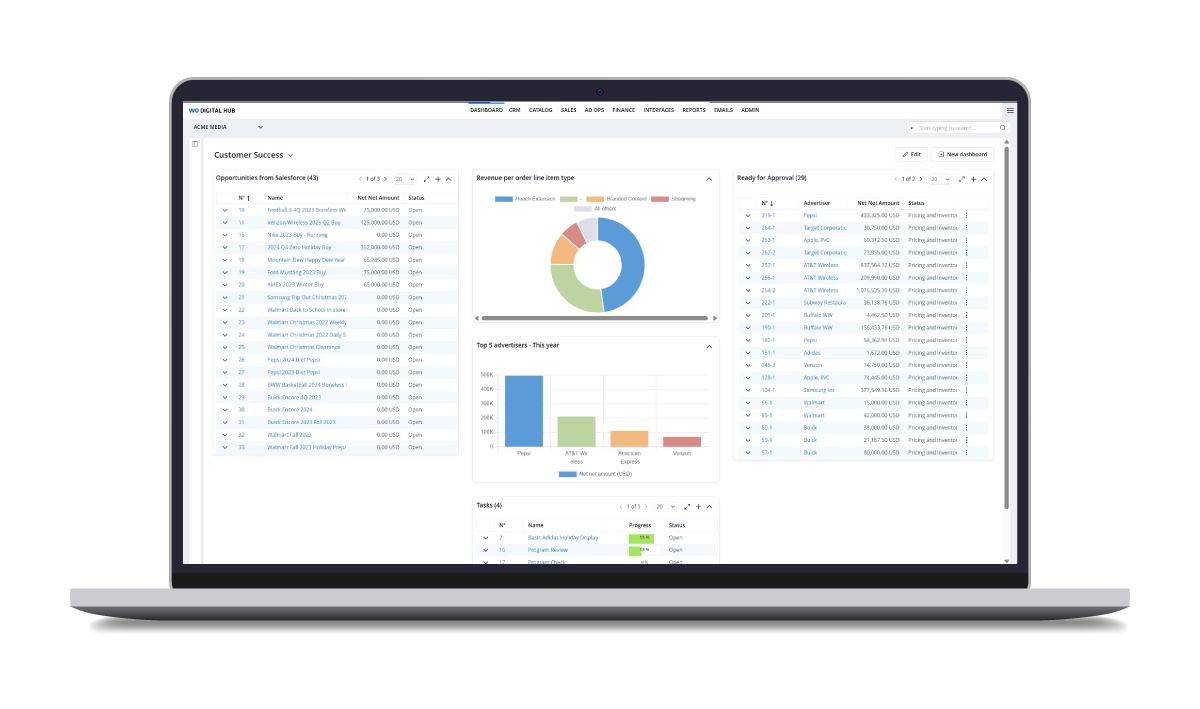
Digital Hub connects sales, operations, execution and finance across properties and ad servers. Its dashboards cover revenue, orders and trafficking; its connections include Google Ad Manager, FreeWheel and AdsWizz. That distinction is useful when evaluating the company. An ad server can deliver an advertisement while a connected business system manages the order, approvals and financial record around it. One need not replace the other.
Nor is WideOrbit alone in wanting connected workflows. Marketron offers radio traffic and billing software, with payments and integration capabilities. Operative’s AOS addresses converged advertising management, including inventory, orders and billing. WideOrbit’s distinctive proposition is the combination of its broadcaster footprint, specialist operational products and connections across sales, playout and finance. A buyer should compare the actual workflow and module requirements, rather than assume every product competes with every other one.
Radio leaves the building
In March 2026, WO Automation for Radio became WO Aurora. WideOrbit explicitly described it as the existing product under a new name, with evolving cloud-powered capabilities. It supports local, cloud and hybrid deployment. Web Studio brings automation functions into the browser; Live Mic lets talent broadcast with a microphone, laptop and internet connection.
A month later, Beasley’s KCYE(FM), 102.7 Coyote Country, broadcast from WideOrbit’s NAB booth. Host and programme director Shawn Stevens used the Web Studio and Live Mic features on the exhibition floor. WideOrbit also reported a Radio World Best of Show award for Aurora. A live programme is an unusually apt demonstration for software whose job is to stay out of the way.
The September 2026 IBC demonstration added Guest Link. As RedTech reported, a presenter can send a guest a time-limited link to join through a browser without installing software. These features address distributed work: presenters, engineers and programming teams need not all occupy the same building. Their usefulness still depends on the broadcaster’s infrastructure and operating requirements. The existence of three deployment options acknowledges that stations will move at different speeds.
The price of being indispensable
WideOrbit sells enterprise software and related services, including SaaS products, licensed modules, implementation and operational help. For a buyer, the cost question therefore begins with scope: which stations, which functions, which integrations and how much assistance? Migration, training and workflow repair belong in that calculation alongside the software agreement. Those are budgeting considerations, not a claim about a universal WideOrbit price.
The company’s own economics have a clearer historical marker. The December 2022 acquisition announcement disclosed approximately US$167 million in gross revenue for 2021. Lumine completed its purchase in February 2023; its later 2024 management report records a US$504.6 million purchase price, combining cash, repayment of WideOrbit debt and Special Shares. WideOrbit became an autonomous business within Lumine, whose majority shareholder is Constellation Software.

Coonce’s route to leadership ran through sales: account executive in 2006, then director, vice president, revenue chief and president before CEO. In her 2025 review, she described more client advisory meetings, Radio Office Hours and expanded services. She also noted a Salesforce integration and a certification programme for connectors. These are the company’s descriptions of its practices, but they fit the operational nature of the product: a workflow business needs to hear where the workflow hurts.
Copy the audit before the automation
Townsquare offers one more useful example. In a 2017 customer story, revenue executive Cristina Cipolla described using WO Analytics to produce reports her team previously compiled manually. She reported cutting the time by at least half.
“WO Analytics helps me get to the ‘Why’ a lot faster than I could before.”Cristina Cipolla, Townsquare customer story, 2017
The transferable idea is quite concrete. Give departments shared definitions. Carry records across handoffs. Make the payment experience usable. Measure the work removed, rather than the number of features installed. Those lessons need no television licence to travel.
For a broadcaster with complicated inventory and repeated manual reconciliation, WideOrbit offers a way to connect work that otherwise lands between desks. For a simple operation, the necessary configuration and integrations may demand more effort than the problem warrants. And if departments cannot agree on their records, WAMU’s story is the warning already sitting in plain sight. Even a good system needs people to settle what they mean. The commercial may be thirty seconds long. That conversation deserves longer.
Explore the working parts
WideOrbit website / Digital Hub / WO Fusion / Company blog / Product webinars
Watch: WO Aurora Guest Link at IBC2026 / RedTech’s demonstration coverage