Forty suppliers in three years. For a commerce media network, that number ought to prompt an awkward meeting. The retailer has shoppers. The suppliers have products. Somewhere between the two sits an advertising business that is taking an awfully long time to let people in.
In an account of an unnamed customer’s technology rebuild, Koddi reports that supplier onboarding reached 95 in six months. Those are different periods, not a controlled experiment. Still, the contrast directs attention to a question that advertising people sometimes overlook: how easy is it to become an advertiser?
- Koddi helps commerce platforms sell ads and helps advertisers buy them.
- Its roots are in hotel advertising and metasearch bidding.
- Its pitch combines configurable software with hands-on operational help.
- The useful test is whether advertising produces additional business, not merely more activity.
The supplier at the door
Koddi’s rebuild account describes coordinated engineering, training, sales support, and simpler activation. Buyers could start on a Zoom call; small advertisers could pay by card. It gives spending examples of $25 and $25,000 a month. These are advertiser budgets, not prices for Koddi’s software.
The interesting mechanism is the cost of serving the little account. If every buyer requires bespoke assistance, the smallest budgets can become uneconomic. Make the routine steps self-service, and a network can reconsider whom it welcomes. An entrance policy quietly becomes a business model.
The hotel that nobody sees
Koddi began in Fort Worth in 2013, co-founded by George Popstefanov and Nicholas Ward. Popstefanov had founded the marketing agency PMG; Ward brought a background in advertising technology. The early company concentrated on helping travel brands buy visibility through hotel metasearch.
Think of the hotel operator’s predicament. A room is perishable inventory. Tonight’s empty room cannot be stored and sold next Tuesday. Yet the person searching for it may encounter several competing offers before reaching the hotel’s own booking page. Advertising becomes a question of timing, price, and the likely value of that particular visit.
The company’s original insight was that managing those decisions needed specialized tools. A 2017 local profile quoted operations director Jarrod Simpson saying, “It was profitable in four months.” That is a historical account, not a statement about today’s margins. It does suggest that the first problem had paying customers relatively quickly.
Later that year, Koddi bought the former HookLogic travel business from Criteo. The deal brought a delivery platform, self-service interfaces, APIs, and a travel team. Ward’s explanation emphasized collaborations dating to 2014 and customers the companies already shared. Familiarity with the machinery, and with one another, made the combination attractive.

Four products, two sides of the counter
A retailer selling advertising and a hotel buying advertising have different jobs. Koddi serves both sides, which helps explain a product lineup that can otherwise sound like four names for the same thing.
Koddi Ads is for the operator: serving ads, providing advertiser tools, measuring activity, and optimizing placements. Its modular architecture lets customers integrate selected components or adopt the fuller system. Koddi markets deployment in a customer’s cloud environment, customizable interfaces, and reporting built around individual events.
Koddi SSP, its supply-side platform, connects commerce inventory with programmatic buyers. The operator’s practical concern is demand: an attractive placement earns little if nobody can conveniently buy it. Connections to existing advertising platforms reduce the distance between a budget and an available impression.
Koddi Enterprise handles advertising investments for large brands across metasearch, paid search, social, and sponsored listings. Customized bidding rules, alerts, local reporting, and account management help teams make decisions across complicated portfolios.
Koddi Demand concentrates on local and franchise advertising. A franchisee needs local control; a corporate team wants coordination. Cooperative budgets, campaign automation, and reporting bring those interests into the same workflow.
An explanatory map, not a claim that every customer uses every product.
Koddi is therefore an enterprise software and services business with substantial implementation work. Its publicly named customers include Booking.com, Fanatics, Cars.com, Neighborly, and Gopuff. The connection is commerce: an audience doing something that can end in a purchase, booking, or service request.
When money has nowhere to go
There is a peculiar advertising failure in which the buyer has money and the seller still cannot spend it. The audience may be too small. The targeting rules may be too restrictive. There may simply be too few eligible placements.
Koddi’s Media Planner groups related campaigns, while Shared Budgets can move available funds toward eligible campaigns with room to spend. A published early activation across onsite and offsite campaigns reported a 135% increase in projected budget utilization. That adjective matters. Spending capacity is a different measure from realized sales or profit.
The broader lesson is to diagnose the constraint before changing the bid. If the shop has run out of suitable advertising space, a more enthusiastic auction does not manufacture more shelves. Reaching the retailer’s audience through another channel might help, provided the additional reach is worth its price.
The sale that would have happened anyway
A shopper sees an ad and buys a product. The dashboard awards the campaign a sale. Everyone applauds, except the inconvenient person who asks whether the shopper was already going to buy it.
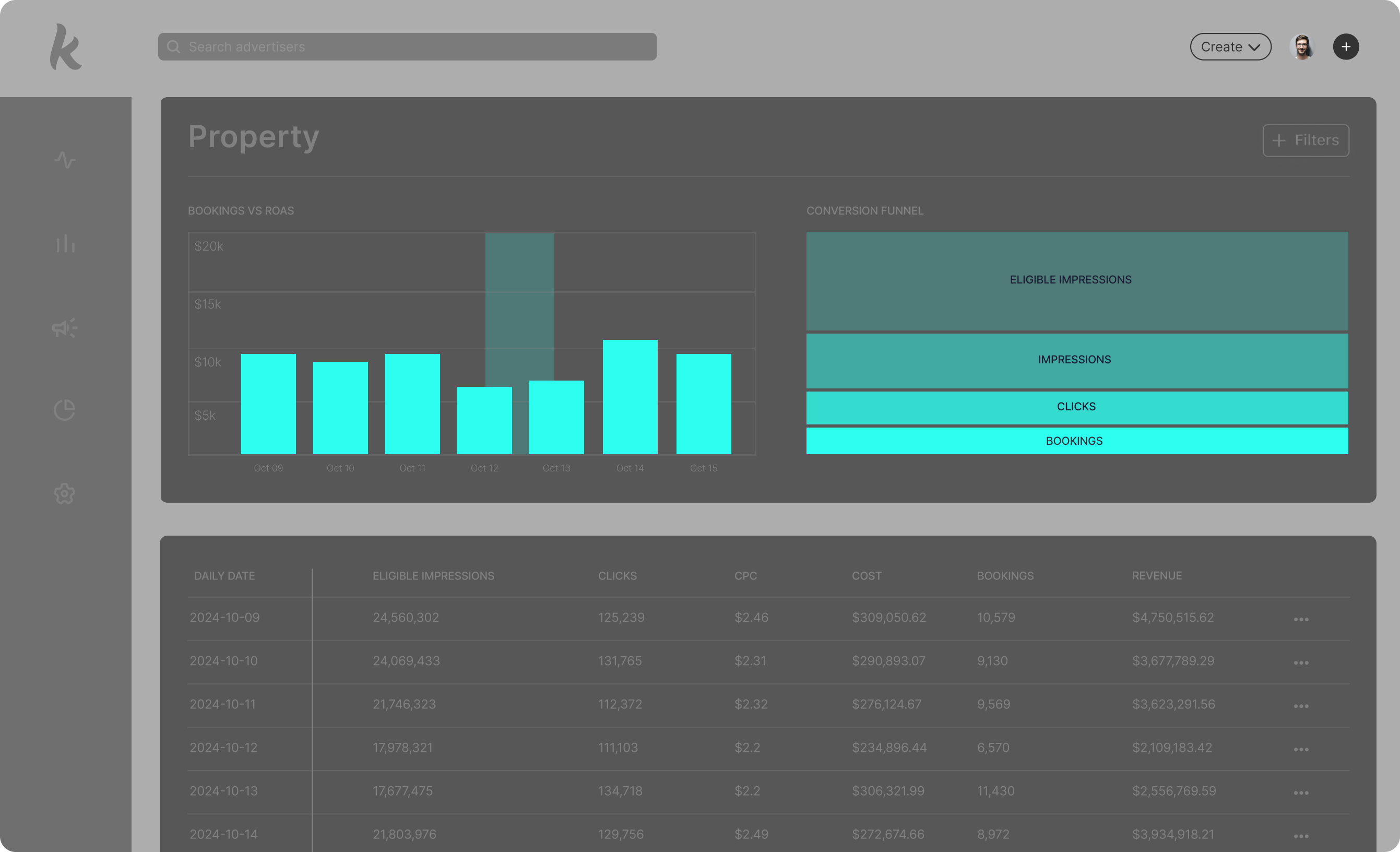
Koddi and Gopuff announced tools in April 2025 to investigate that question. Their framework compares randomly selected test and control groups, measuring additional purchases and revenue. The companies reported that pilot campaigns increased incremental purchases per user by more than 40% on average.
A pilot result belongs to its setting. It is nevertheless a better starting question than the mere sequence of an ad followed by a purchase. For an advertiser, the difference can decide whether to renew. For a retailer, it can decide whether a media business earns loyalty or only borrows it from the merchandise business.
“The risk is that we’re selling something as an industry that maybe is not quite there yet.”Nicholas Ward, speaking to Marketing Dive in 2024
That warning is useful coming from someone who sells the infrastructure. An operator must be able to explain what the advertiser received, which assumptions underlie the result, and whether the measurement supports the promise.
A new login is a small tax
Koddi’s recent partnerships follow the same concern with access. In May 2026, Universal Ads added a route to premium TV advertising. September brought Sabre Sponsored Listings through Koddi Demand, placing hotel promotions within the booking workflow used by travel advisors and corporate bookers.
On September 29, Koddi and Teads announced a partnership bringing OpenRTB-based access to onsite retail inventory across the US and Europe. The appeal is easy to understand: buying another retailer should not always require mastering another miniature advertising universe.
Koddi competes with commerce media providers such as Criteo, and with the option of building internally. Its claimed distinction is the combination of configurable infrastructure, demand connections, and operational support. Buyers should test those claims against their own requirements. “AI-powered” is too widely available a phrase to settle the purchase.
The people doing the work matter here. Koddi advertises hybrid work and unlimited vacation; its stated values include integrity and inclusion. Those are employer descriptions. More revealing for a customer is the scope of its services: network planning, technical management, advertiser sales assistance, and custom engineering.
Copy the entrance, question the result
The transferable idea is to study the first transaction. Count the approvals, payment steps, training sessions, and handoffs needed before an advertiser can buy. Then ask which steps protect quality and which merely preserve an old habit.
The cost calculation should include the technology agreement, integration work, ongoing operations, and actual media spend. A cheap-looking platform that consumes an engineering team can be an expensive purchase. So can an easy launch that leaves the advertiser unable to tell whether anything useful happened.
The approach needs an audience worth reaching, usable product and transaction data, and enough advertiser interest to support the operation. A quiet marketplace does not become busy because its ad server is clever. More ads can also make a buying experience worse; relevance and restraint belong in the design.
Koddi’s story is compelling because its problem is so ordinary. A business already has something valuable. Another business wants to pay for access. Between them is a form, a dashboard, a budget rule, a human handoff. Improve that passage, and an advertising business gets a chance to work.
Go closer to the machinery
Explore Koddi’s website, Koddi Ads, developer documentation, case studies and product writing, and company news.