Convert.com sells a tool for making fewer expensive guesses. Put one version of a webpage in front of some visitors, another version in front of the rest, and watch which group buys, signs up, or keeps moving. It is an ordinary description of A/B testing. It is also a deeply funny business for Convert to have built, because the company's first years were one long uncontrolled experiment - on funding, product scope, hiring, pricing, and how close a founder can get to losing a very good domain.
Today, Convert Experiences sits in the stubborn middle of the experimentation market. It is too serious to be a $20 plug-in and too accessible to behave like a six-figure enterprise procurement project. Growth teams, ecommerce operators, developers, and conversion-rate-optimization agencies use it to test pages, prices, funnels, features, and targeted messages. Public plans begin at $399 a month, or $299 a month on annual billing. Pro begins at $599 monthly. Enterprise is quoted. The customer can see those numbers before surrendering a calendar slot to sales, which should not feel radical, yet does.
The costly pre-testWhen the money arrived, judgment left
Dennis van der Heijden started the company with Claudiu Rogoveanu, a Romanian developer who had quietly become essential to van der Heijden's earlier lead-generation business. They worked together for years before meeting in person. In 2009 they founded the company that became Convert Insights. Van der Heijden had a hunch that browser-based A/B testing was the product. Then he discovered the Silicon Valley game.
Convert incorporated in Delaware, raised $400,000, hired eight people, and set up a team in Mexico. The money came in tranches tied to milestones. So customer interviews became spreadsheet inputs, each new batch tugging the roadmap left, then right, then partly left again. Qualitative comments were given a false decimal-point confidence. The company built a procession of minimum viable products without committing to the original idea.
“When the money hit the bank account, the problem started.”Dennis van der Heijden, co-founder and CEO
What failed first was focus. Next went the cash. Convert dismissed the team and returned to two founders plus contractors. The change of mind was not mystical: the company had tried enough adjacent ideas to recognize that its first instinct had been the useful one. It put the remaining bet on A/B testing. The lesson is almost offensively copyable - interviews are instruments for finding causes and language, not votes in a product election. A founder still has to choose.

A URL with a payment planThe company buys five years
Around 2012, van der Heijden found Convert.com. Its owner converted VHS tapes and wanted $100,000 for the domain. Convert did not have $100,000. Van der Heijden proposed a down payment, $6,000 in yearly rent, and the right to buy within five years. If he failed, the seller kept the rent and the domain. At the deadline, Convert had saved roughly $45,000 and was still short. A friendly customer lent the balance. The URL stayed.
It was expensive branding, but it gave the restart a name that explained the outcome customers wanted. It also bequeathed a small comedy: people still arrived hoping to convert measurements or old tapes. More importantly, the arrangement bought the company time without pretending time was free. Every month made the decision visible on the bank statement.
The part worth copying
- Negotiate access to a scarce asset before insisting on ownership.
- Attach a deadline that forces the asset to earn its keep.
- Choose a name that says what the customer wants, not what the software contains.
Fifty cards at the back of the roomDemonstration becomes distribution
Cash remained tight. At a San Diego conference, speakers were expected to sell a product costing several thousand dollars. Convert's plans then cost roughly $69 to $149 per month, so the company bundled six months of conversion work with a year of software into a package of about $4,000. Van der Heijden reviewed audience websites live, pointing out leaks and missed opportunities. Roughly 50 attendees bought.
The tactic worked because the audience watched diagnosis happen. Convert was not merely claiming expertise; it was showing the work on businesses in the room. But the services bundle had a shelf life. Consulting helped payroll and hurt product focus. Custom requests optimized for ten urgent clients can quietly turn a SaaS roadmap into a coat rack. Convert used services when cash demanded it, then kept pulling back toward software.
The price moved up - the contract stayed visible
*Monthly equivalent on annual billing in September 2026. The chart compares price points, not feature equivalence.The gap in the categoryIts rivals walked upstairs
Convert's decisive break arrived when A/B testing rivals merged, were acquired, or climbed toward enterprise contracts reportedly worth $35,000 to $100,000 a year. Smaller customers still needed mature testing, but their vendors no longer needed them. Convert had maintained broad feature parity and self-serve plans in the low hundreds per month. In 2016, that overflow helped the company pass about $1 million in annual recurring revenue.
This is the sharper answer to what makes Convert different. The platform has a visual editor, more than 90 integrations, granular targeting, real-time reporting, flicker controls, APIs, feature flags, and server-side SDKs. Competitors can check many of the same boxes. Convert's distinction is the commercial wrapper: public prices, most capabilities in one platform, no forced upgrade when traffic spikes, legacy plans honored, and an agency model that says it will not poach services work from partners.
Case studies show the range. Loop Earplugs and its agency tested a personalized carrying case and reported lifts in checkout visits and transactions. Anatta filtered wholesale outliers from a headless Shopify experiment and modeled an annualized $1.27 million uplift. Conversion Rate Experts built a challenger page inside Convert without using its client's development team and reported 57 percent more leads for Earth Class Mail. These are vendor-selected stories, not promises. Their useful commonality is method: isolate a business question, protect the data from obvious contamination, and value the result in money rather than button clicks.
What the product has becomeFrom page swaps to an experimentation stack
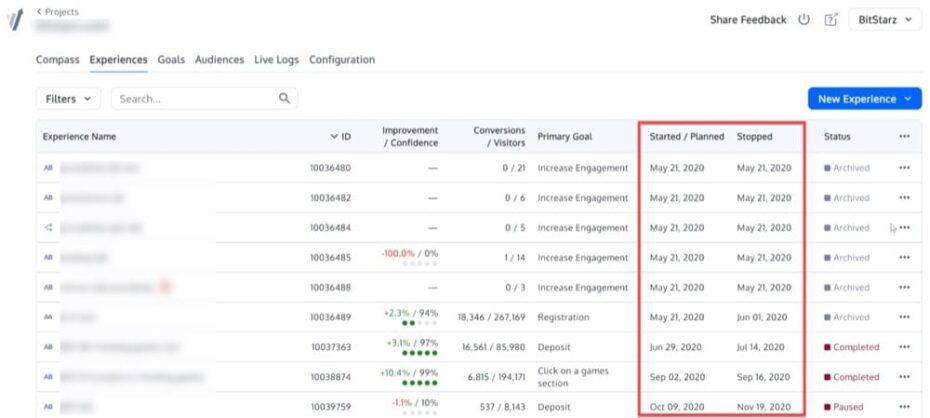
The core job remains simple. A marketer can change copy or layout in a visual editor, split traffic, define goals, and compare results. Pro and Enterprise add multivariate and multipage tests. Developers can run full-stack experiments and feature flags through SDKs. Agencies can separate client projects and permissions. Ecommerce teams can connect Shopify, WooCommerce, GA4, Hotjar, Segment, and other tools.
In 2026, Convert brought qualitative evidence closer to the result. Native heatmaps show clicks and scrolls by variation. Convert Signals filters session recordings for frustration patterns. Multi-armed-bandit options can direct more traffic toward better-performing variants while a campaign is running. Data damaged by internal traffic or a broken tag can be removed without discarding the entire test. These features solve the unglamorous parts of experimentation: finding something worth testing, keeping the sample clean, and knowing what happened after launch.
The AI move is similarly practical. Convert's MCP server lets compatible assistants inspect experiment data, summarize portfolios, search product documentation, and, with elevated permissions, create or modify tests. It begins in reporting mode. Write operations must be switched on, validated, and reviewed. Convert says the server exposes 16 tools and as many as 113 actions, backed by a knowledge base built from 500 support articles. The company that once let milestones steer its product now sells guardrails.
The honest buying testWhen Convert will not convert
A testing platform does not create traffic, a hypothesis, or patience. At $399 per month before discounts, Convert is hard to justify for a tiny shop testing the shade of its checkout button. Low traffic makes experiments drag. Small effects require large samples. A team that stops whenever the graph wiggles upward can pay for software and purchase false confidence.
Likely fit
Meaningful traffic, valuable conversions, several tests a quarter, clear analytics ownership, and a team prepared to act on losing results.
Likely miss
Low traffic, tiny margins, no research pipeline, one-off curiosity, or a culture that only wants evidence when it agrees with the boss.
It also will not suit buyers who want a vendor to invent and build every test. Convert explicitly separates software support from custom development. That boundary keeps the product company from becoming an agency, but customers need internal developers or a CRO partner for complex implementations. And transparent pricing does not mean cheap: a disciplined free or open-source setup may serve a technical early-stage team better.
The operating system behind the softwareA company designed around trust
Convert became remote before remote became a recruiting slogan. The team now spans roughly 18 to 20 countries. In 2017 it adopted Holacracy, organizing work through roles and circles instead of a conventional management tree. Founder interviews describe employees holding company cards, choosing schedules, and operating with unusual autonomy. The setup is consistent with the product's agency: give people information and explicit permissions, then let them act.
The company also makes climate and privacy part of the sale. It runs European servers, promotes GDPR and CCPA compliance, and claims ISO 27001 certification and SOC 2 attestation. It directs portions of revenue toward tree planting, conservation, and carbon removal. The about page sets a goal of becoming ten-times carbon negative by 2028. None of this makes a test statistically valid. It does tell buyers what kind of vendor they are funding.
Convert's history is not a neat argument against venture capital. Funding exposed mistakes faster and bought the experience that changed van der Heijden's mind. The better conclusion is narrower: capital cannot choose a customer, a spreadsheet cannot replace judgment, and a competitor abandoning the middle of a market is an invitation. Convert survived long enough to answer it.