A founder who sells experimentation eventually faces an awkward question: which of his own assumptions is he prepared to put at risk? For Rémi Aubert, one answer arrived in January 2026. AB Tasty, the software business he had built with Alix de Sagazan, announced it was combining with VWO. A familiar competitor would become a colleague. Aubert, previously co-CEO, would take a different seat as Chief Customer and Strategy Officer.
Software mergers are usually introduced with arithmetic. This one came with annual revenue above $100 million and more than 4,000 customers across the two businesses. Those figures describe the scale. The more personal story concerns a founder accepting that the company’s next stage would involve sharing its direction with people who had spent years pursuing the same customers.
Aubert’s career offers several rehearsals for that decision. A colleague became a co-founder. A consulting agency became a software company. An expanding business required its founders to examine how they worked together. At each turn, something familiar had to make room.
A childhood friend, then a business partner
Aubert and de Sagazan knew each other long before they had a company to run. Their adult reunion happened in the world of online advertising. He was working at Keyade; she was at Adlink, subsequently acquired by Hi-Media. A lunch put the possibility of starting something together on the table. Aubert helped recruit her to Keyade in January 2009, where they worked on traffic acquisition.
It was a useful vantage point. Their work concerned getting people to websites. Nearby, analytics colleagues were examining what happened after visitors arrived. A business could become very proficient at buying attention while remaining less certain about what that attention accomplished.
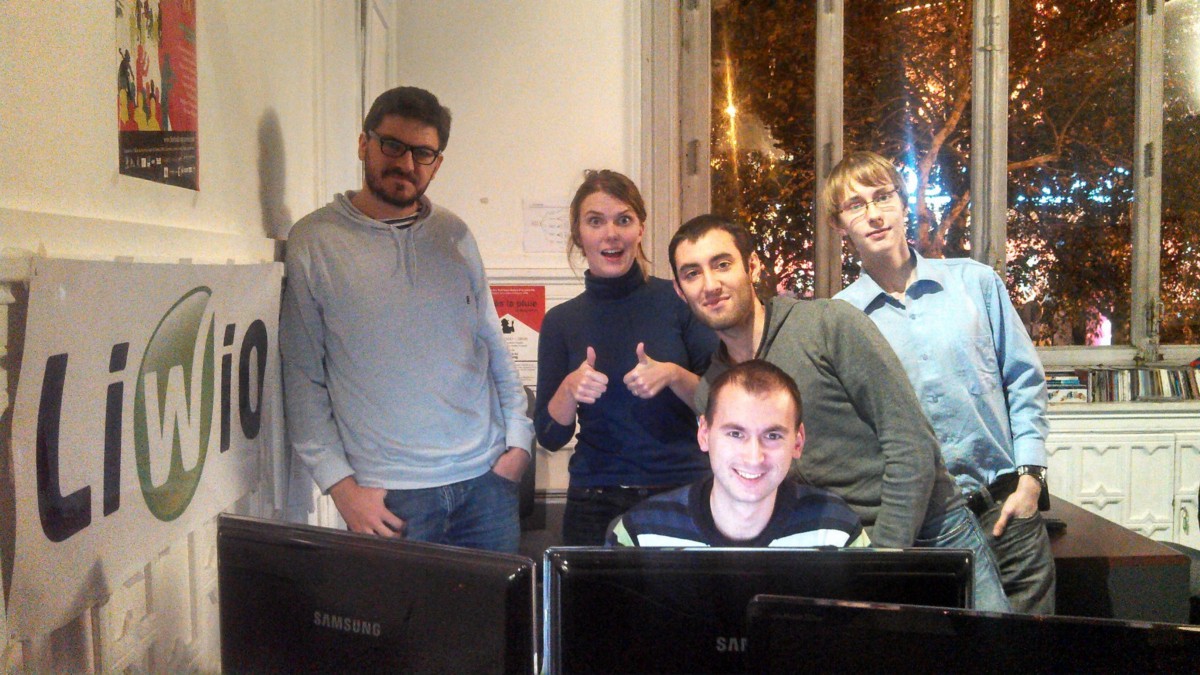
The pair left to start Liwio, a conversion consulting agency, in 2009. The early proposition was service: help clients understand their websites and improve the results. The software emerged from that work. By 2011, they were developing AB Tasty around a practical ambition: let marketers test website ideas without needing technical help for every alteration.
Consider the change in the customer’s working day. A proposed improvement could become a version to try, with an outcome to examine. The founders were giving clients more room to answer their own questions.
The name had a head start
The name AB Tasty was discussed over beers at Le Vintimille in Paris. Aubert arrived with an advantage over the other suggestions: he had already secured the domain. The brainstorming session had, in a small way, been preconfigured. It is a pleasing detail in the history of a business devoted to comparing alternatives.
Another small artifact survives in the WordPress directory. The account remiaubert, linked to AB Tasty’s website, is listed as the developer of its A/B testing plugin. The plugin inserted the tag needed to use the service on a WordPress site. Its description emphasized a graphical editor and the ability to create page variations without technical knowledge.
The account’s contribution history includes releases in 2015. It is a modest piece of software history, far removed from a merger announcement, and useful for precisely that reason. A founder’s product philosophy can show up in an installation step. If using the tool requires less ceremony, more people have a chance to try it.
Fifteen people before the first cheque
Aubert has described growing the business to 15 people before raising outside money. External capital then offered a way to move faster in a market where American competitors were advancing quickly. His reasoning was straightforward: customers do not replace this sort of software every year. Getting established early could matter for years afterwards.
AB Tasty took its first funding round in 2014. Its later financing included a $40 million Series C in 2020. The money accompanied an expanding organization and an international customer base. A product that allowed customers to work more independently still needed people to sell it, support it and explain what could be done with it.
By 2019, the founders’ division of responsibilities put technology and product with Aubert, business and marketing with de Sagazan. The company had offices in New York and San Francisco as well as its European operations. Maintaining a shared culture involved cross-office interviews for potential hires, regular communication and opportunities to meet in person.
Geography gave their partnership a new difficulty. An agreement reached in one room is relatively easy to revisit. Across offices and time zones, it needs habits that survive a busy week.
A BUSINESS THAT KEPT CHANGING SHAPE
- 2009Conversion consulting
- 2011Software for marketers
- 2022Epoq acquisition
- 2026AB Tasty + VWO
More of the customer’s journey
The product expanded, too. AB Tasty acquired Epoq in 2022, adding recommendations and intelligent search. These tools address different moments in the same shopping trip: finding an item, discovering something relevant, deciding what to buy. The company was moving further into the experience surrounding an experiment.
Potions joined in 2024. In November 2025, AB Tasty announced the acquisition of Wandz, whose technology uses signals from a visitor’s current behavior to adapt the experience. The intention was to make personalization respond to the session taking place, including visits by people who had not identified themselves.
There is a consistent direction in that expansion. A marketer wants to know whether a change helps. A merchandising team wants to show something useful. A product team wants to release a feature with some evidence about its effect. The tools differ; the need to connect a decision with an observable result travels between them.
For Aubert, the wider ambition had been explicit by 2023: he wanted the company to become a reference tool for marketing and product teams managing interactions with users. That is a much larger brief than changing a headline on a web page. It also brings more opportunities to build something customers may never use.
The customer who already said yes
Aubert gives customer focus a specific priority: make time for the people who have already bought. The people who have already bought deserve attention because they have already extended trust. In that account, keeping a customer is an ongoing obligation, supported by the quality of the experience and the response when something goes wrong.
“Prioritizing customers above prospects in your day-to-day work.”
Rémi Aubert, 2022
He also cautions against collecting so much data that it becomes impossible to organize. More information can produce more distraction. A company needs ways to interpret what it gathers and act on it. Otherwise, the evidence accumulates while the experience stays much the same.
That view gives his product interests a useful restraint. A growing suite can promise a great deal; the customer still needs to make a decision on Tuesday afternoon. Can the team see the problem, change something and determine whether it helped? That practical test is a reasonable way to read the continuity in his work.
THE DISTANCE THE PRODUCT TRIES TO SHORTEN
A question becomes a change. The result informs the next question.
Two founders, one conversation to keep having
The founders’ working relationship required attention of its own. In December 2024, Aubert spoke about their work with Yvan Wibaux of Sidekicks. With de Sagazan in the United States and Aubert in France, distance and difficult periods in the business had created tensions. Exchanging messages did not guarantee mutual understanding.
He described getting help to recover a shared direction and recognize patterns in their conversations. Their sessions included visual tools and ways of considering the other person’s perspective. The benefit was partly the chance to step back from reacting to events and decide more deliberately what came next.
This is an unusually useful part of a founder’s account. A long history together provides familiarity, but responsibilities keep changing the circumstances of a partnership. Knowing someone well does not remove the need to ask what they mean. The calendar, inconveniently, seldom schedules that work for you.
Aubert’s willingness to discuss it makes the relationship more credible. The business had grown through the pair’s collaboration; preserving that collaboration took effort, structure and another person’s help.
An interview with sand underfoot
By August 2025, Aubert was discussing the next set of changes on SaaS Connection. The interview took place facing the sea, feet in the sand. The agenda remained thoroughly commercial: acquisitions, their successes and failures, the use of AI, and a software market paying closer attention to profitability.
He also discussed the future of e-commerce as intelligent agents and personalization changed how people might shop. The subjects put the founder at an interesting junction. He had experience buying capabilities, building products and living through shifts in what investors valued. The next questions involved how much of the customer journey software could undertake itself.
The beach was a relaxed setting for problems with very little interest in relaxing. It offered a human scale to a conversation about a business whose scope kept widening.
The rival becomes a colleague
In January 2026, Aubert explained the proposed VWO combination through complementary strengths. VWO brought a strong acquisition approach and capabilities such as heatmaps and session recording. AB Tasty brought longstanding customer relationships and adjacent products in recommendations, merchandising, search and predictive segmentation.
He described an immediate connection when the founders met in New York. The partnership had a commercial explanation, but trust between the people involved mattered to his account. An agreement on paper would leave a substantial amount of work for actual colleagues.
$100m+combined annual revenue
4,000+customers globally
Figures describe the combined businesses at announcement.
The current Wingify leadership team places Sparsh Gupta as CEO, Ankit Jain in charge of product and technology, and de Sagazan as Chief Revenue Officer. Aubert’s remit is customers and strategy. His company biography gives that responsibility a concrete purpose: carry the customer’s perspective into roadmap choices across the combined business.
The change is revealing. Aubert helped build a company by giving marketers more control over their decisions. His next job asks him to keep those customers present while a larger organization makes decisions of its own. There will be plenty to measure. The first question is still what helps the person using the product.
Follow the conversation
Company, writing and interviews from across the story.
- Wingify’s leadership team ↗
- AB Tasty ↗
- Rémi Aubert on LinkedIn ↗
- Rémi Aubert on X ↗
- Writing with Alix de Sagazan ↗
- Watch: the 2023 FrenchWeb interview ↗
- Listen: SaaS Connection, episode 172 ↗
- The customer conversation, in Aubert’s words ↗
- The early partnership and the naming story ↗
- Aubert on shared leadership ↗