The Dispatch
He builds software that learns the way fieldwork does
Right now, somewhere inside a food-delivery app, a tiny agent is deciding whether to nudge you about dinner. It is not following a rule someone wrote. It is running a small experiment, watching what you do, and adjusting. Multiply that by a hundred million and you have Aampe, the company Paul Meinshausen runs out of San Francisco.
Aampe sells what Meinshausen calls agentic infrastructure: a layer that lets consumer apps treat every message, push notification, and offer as a behavioral signal instead of a one-off campaign. Most marketing software still assumes a marketer sits at a dashboard, picks a segment, and presses send. Meinshausen thinks that whole posture is backwards. His agents operate at the level of the individual user, across every context, and they keep learning long after the human has stopped watching.
The pitch lands harder when you know where he started. Before he was modeling customer journeys, he was doing statistical inference over unstructured data in a US Army Intelligence analysis unit. In 2010 he deployed to Kabul. The work was the same shape it has always been for him: take messy human behavior, find the structure hiding inside it, and act before the picture is complete. It was in that unit, back in 2009, that he met Schaun Wheeler, the data scientist who would later become his Aampe co-founder. They have been arguing about how humans actually behave ever since.
“
Businesses don't win by perfectly understanding the past. They win by making better decisions about the future.
// Paul Meinshausen on why he stopped trusting dashboards
An anthropology major in a room full of engineers
Meinshausen did not arrive by the usual door. His undergraduate degree, from the University of Louisville, is in anthropology. He picked up a master's at Middle East Technical University in Ankara, then landed at Harvard as an Eric and Wendy Schmidt Data Science for Social Good fellow, studying research methodology, quantitative methods, and computer science. The throughline is not a discipline. It is a question: how do people decide things, and how do you measure it without flattening them?
That question kept pulling him toward harder versions of itself. He simulated battlefield environments for the military. He researched implicit social cognition. He worked as a principal data scientist at Teradata, ran data science at Housing.com in India, and then co-founded PaySense, a mobile lending platform that put credit in the hands of consumers during mobile's first real decade. When PayU acquired PaySense for roughly $185 million, he had his proof that the anthropologist's instincts paid in fintech terms too.
India matters to the story more than a line on a resume suggests. He built consumer software there during the years when smartphones went from luxury to default, when a credit decision or a housing search moved from a branch office to a six-inch screen. That is where he learned, at scale, how unforgiving real users are. They do not behave like the personas in a slide deck. They ignore the message you were sure would convert and respond to the one you almost cut. PaySense forced him to take that seriously, because getting a lending nudge wrong is not a vanity metric, it is someone's access to money. The lesson stuck: the population is a fiction, and the individual is the only thing that actually transacts.
The segment of one, taken literally
Aampe's house phrase is the segment of one. Most personalization software pays lip service to the idea and then quietly clusters everyone into a dozen buckets, because that is what the math can handle. Meinshausen's argument is that the buckets are where the value leaks out. A segment is an average, and nobody is the average. His agents are built so that each user gets their own running model of what they respond to: which time of day, which framing, which single feature of an offer earns a tap. The marketer is not cut out of the loop so much as moved up a level, from writing the message to setting the objective and the guardrails.
This is also why he keeps drawing the distinction between kinds of memory. Generative AI, he points out, is brilliant at procedural memory, the knowledge of how to do a thing, how to phrase a sentence, how to complete a pattern. But people are steered by associative and emotional memory too, by the web of meaning around a goal that no schema fully captures. An app's database knows your last five orders. It does not know that you are training for a race, or grieving, or broke until payday. Aampe's agents are designed to discover that meaning-level information through interaction rather than waiting for a product manager to add a column for it.
The Meinshausen stack — disciplines he keeps reaching for
Behavioral & cognitive science95%
Econometrics (Difference-in-Differences)80%
Anthropology & fieldwork instinct88%
Why he thinks A/B testing is on the clock
Meinshausen has said, on record, that A/B testing will be extinct in three years. It sounds like founder theater until you hear his reasoning. A/B testing splits people into buckets and waits for a winner. It treats a population as a thing to be averaged. His agents do the opposite: they treat each person as their own ongoing experiment, learning which single aspect of a message matters to that specific user and adapting in real time. The unit of analysis shrinks from the segment to the person.
To make that work at scale he borrowed a tool from an unexpected shelf. Difference-in-Differences is an econometric method built for evaluating macro policy, the kind of math you use to ask whether a minimum-wage change moved employment. Meinshausen adapted it for personalized messaging decisions, turning a policy-analysis instrument into a way of judging whether a nudge actually changed a single person's behavior. He likes to point out that his agents invert the usual generative-AI flow: instead of inputting context to output language, his agents input actions and output context.
“
It's not about prediction. It's about responsiveness. Humans are unpredictable; the agent should adapt, not forecast.
// On the difference between guessing at people and listening to them
The employee metaphor he can't put down
Ask him what good AI looks like and he reaches for the workplace, not the lab. The worst employee, he says, is the one who has to be told what to do at every turn. Productive autonomy is the whole point. He is blunt that most machine learning of the last decade produced dashboards and dubious forecasts instead of actionable levers for growth, and he built Aampe partly as a rebuke to that. He also draws a line most AI founders skip: generative models are good at procedural memory, the how-to of language, but real autonomy needs more than that. His agents are designed to emulate how humans learn, through trial, reasoning, and adaptation, rather than just mimicking how humans talk.
Aampe is not a solo act. He founded it in 2020 with Wheeler and Sami Abboud, a former semiconductor engineer with a neuroscience PhD, with Kate Field also among the founding team. It is, by design, a company of scientists. In December 2024 they raised an $18 million Series A led by Theory Ventures, with Z47 joining, pushing total funding to around $27 million and putting real fuel behind the claim of 100 million agents already running across four continents.
Quirks & Tells
What he carries between disciplines
Intellectually restless
Contrarian about analytics
Systems thinker
Cross-disciplinary
Curious about cognition
- His undergraduate degree is in anthropology, not computer science.
- He has lived and built companies across the US, India, and Singapore.
- He keeps a personal blog at pmeinshausen.com and posts as @PMeins.
- Aampe's founding trio mixes cognitive science, neuroscience, and engineering.
- He repurposed an econometric policy method to grade a single push notification.
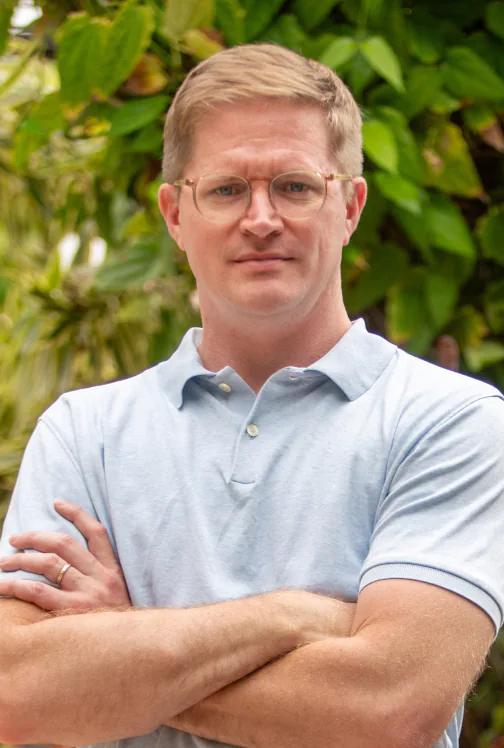 The man behind 100 million agents