The beginning was a nuisance. Alix de Sagazan and Rémi Aubert were working in online traffic acquisition in Paris, sending people toward websites that did not always deserve the traffic. Campaigns could be tuned beautifully, yet the visitor would arrive at a clumsy page, lose interest, and vanish. The money had bought an audience. The page had squandered it. A sensible person might have filed a complaint with the analytics department. Sagazan and Aubert built a company.
They called the first version Liwio. It was 2009, and Liwio was a consulting agency focused on conversion and customer journeys. The founders worked close to the mess: dashboards, page flows, drop-offs, and marketing teams that needed developers whenever they wanted to change a button or compare two versions of a page. The arrangement made experimentation feel like borrowing the ceremonial silver. Possible, perhaps, but only after asking three people and waiting until Thursday.
The irritation contained the product. Why not give marketers a simple tool to run tests themselves? In 2010 the pair began developing software. In 2011 they put an early version in front of Liwio’s clients. By the end of 2012, they had closed the agency and committed to the product that became AB Tasty.
A service business in a lab coat
The fashionable telling of a startup begins with revelation: a whiteboard, a lightning bolt, possibly a napkin. AB Tasty’s origin is more useful. Liwio was paid field research. Consulting let the founders see the same obstruction repeatedly, learn the client’s vocabulary, and build beside people who had reason to complain. It also showed them the boundary of the agency model. Projects were unpredictable and the order book offered only a few months of visibility. Software promised recurring revenue, structure, and scale.
That promise was not obvious in France at the time. Sagazan has recalled that SaaS was neither familiar nor fashionable in 2010 and 2011. The founders were learning the model while teaching customers a new behavior. Their proposition, however, was wonderfully plain: stop arguing about which page might work and let visitors provide evidence.
Photobox discovered the early product through an article and tried the minimum viable version for a month. Then came the sort of problem a founder is delighted to have: the customer wanted to pay, but AB Tasty had not decided what to charge. Founder and customer invented the price together. Bouygues Telecom was another early believer. Etam and Cdiscount followed. These companies did more than buy software. Sagazan has described such customers as the founders’ first business angels, because their trust supplied the proof that spreadsheets could not.
Two friends, one company, divided sensibly
Sagazan and Aubert had known each other in childhood, lost touch, and reconnected as adults. Aubert helped her join Keyade, where the neighboring analytics work caught their attention. Their partnership eventually developed a clean division: he led technology, product, and customer service; she led sales, partnerships, and marketing. The titles could be shared because the responsibilities were not foggy.
Sagazan’s instinct for the commercial side had roots before AB Tasty. She studied economics and English at Paris Nanterre, management sciences at the Sorbonne, and completed a Master in Management at Reims Management School, now NEOMA, in 2007. At nearly every school, she created associations. She has said she always felt a need to gather people around a common project. Student jobs taught her the value of work; digital advertising taught her where the web’s new money and old frustrations met.
As the company grew, the co-founders treated their own working relationship as something that needed maintenance. During a period of fast expansion, they worked with a coach and reserved one day each month to put everything on the table. It is an unflashy practice, and therefore worth stealing. Co-founder chemistry does not remain good because two people were once childhood friends. It remains workable because difficult conversations receive an appointment.
New York, without the postcard filter
In September 2018, Sagazan moved with her family to New York to develop AB Tasty in the United States. The company already had a small go-to-market team. Its funding came with an international mandate, and the East Coast had shown demand. On paper, this was expansion. In daily life, it was a calendar split by an ocean.
She has spoken bluntly about that first year. Her departure unsettled the Paris organization. European problems continued to arrive each morning. American recruiting filled the afternoons. She traveled back and forth and felt she had handled the move badly. The candor matters because founder profiles tend to sand down the year between decision and result.
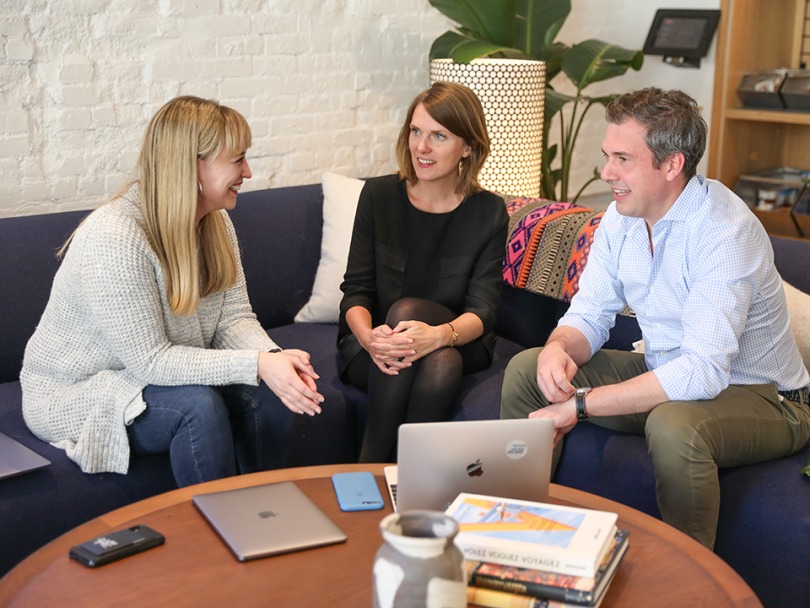
Her first hiring instinct was cautious. She recruited Europeans already living in the United States, worried that a French startup might not attract American candidates. Experience corrected her. Within several years, the US team had grown to about 40 people and was overwhelmingly American. Sagazan came to admire the culture’s pragmatism, reliance on goals and data, facility with marketing, and durable optimism. The founder selling experimentation had submitted her own assumptions to a test.
A new market is not a translated sales deck. It changes the operator. Sagazan’s US chapter worked when confidence followed evidence, not when confidence pretended to arrive first.
Away from work, she skis in winter and kitesurfs in summer. She has linked both sports to company building: a fall or a wrong direction is followed by getting up and trying again. It is an unusually accurate founder metaphor because it permits the undignified middle. Recovery is rarely majestic. It is simply the next necessary motion.
The product became a management language
AB Tasty sold the permission to test. Sagazan tried to extend that permission to employees. Her leadership language centers on collaboration, collective intelligence, and what she calls each person’s “magic power” - the distinctive ability a manager should help identify and improve. “If you have an idea, you’ll be encouraged to try it out, even if it doesn’t work,” she said in 2023.
This is the human version of an experiment: define the idea, make room for it, observe the result, and preserve the lesson. AB Tasty’s mantra made the connection explicit: “We never lose; we either win or learn.” It sounds bright on a wall. The serious part is building a company where a failed attempt can actually produce information instead of a small courtroom drama.
The company’s product range broadened with its ambition. AB Tasty moved beyond web A/B tests into personalization, feature experimentation, and release management. It acquired Germany’s Epoq in 2022, adding AI-powered recommendations and search. In 2023, it acquired Dotaki and introduced EmotionsAI audience segmentation. The original question - which experience works better? - now applied across more of a customer’s digital journey.
Recognition followed. Sagazan was named a Knight of France’s National Order of Merit in 2019, according to her public honors, and received a special entrepreneurship distinction from NEOMA Alumni in 2025. The awards sit neatly on a timeline. Her more revealing measures of progress are social: early customers who stayed, employees who crossed roles and continents, and a co-founder partnership capable of changing shape without coming apart.
Putting the company itself into the experiment
In January 2026, AB Tasty and VWO announced that they were joining forces. The leadership design was specific. VWO co-founder Sparsh Gupta would lead the combined platform as CEO. Aubert would become Chief Customer and Strategy Officer. Sagazan would become Chief Revenue Officer. VWO’s Ankit Jain would lead product and technology. All four co-founders would remain significantly invested.
For two years, Sagazan and Aubert had been asking what the next chapter should look like. They said a merely commercial transaction was not the goal; they wanted shared vision, values, and commitment to customers. The answer they chose brought experimentation, personalization, insights, and feature delivery closer together. It also required a founder’s peculiar form of nerve: treating the company’s structure as another assumption open to revision.
The role change does not erase the chief executive years. It clarifies the thread through them. Sagazan repeatedly moved toward the commercial edge of uncertainty: the unpriced first customer, the agency-to-software turn, the American office, the acquired capabilities, and now the combined platform. Each move placed a larger bet, but the method stayed recognizable. Get near the friction. Ask people what they see. Build a version. Learn before pride can interfere.
Years ago, she said her professional ambition was to keep loving what she did, keep learning, evolve with her team, and take AB Tasty as far as possible. The geography of “far” has changed. Paris led to New York. A testing widget grew into a broader experience platform. Two founders became a leadership group of four. The aspiration survives because it was never a fixed destination. It was a way of moving.
There is an elegant joke in a company built to eliminate guesswork: no founder gets to know the ending. Sagazan’s career offers the more practical consolation. You can create conditions for a better next move. Make the question smaller. Put evidence within reach. Choose collaborators who can challenge the answer. Then test again.