The little bar at the bottom of the phone screen seemed sensible. Keep the price visible. Keep the purchase button within reach. At Leroy Merlin Romania, an Omniconvert experiment tried that familiar retail maneuver. More products went into carts. Yet the overall conversion rate declined. The result was inconclusive. A button had done its job; the shopping journey had not.
- Omniconvert combines website testing, customer analytics and retail feedback.
- Its central question: which customers return, and what makes them worth keeping?
- Its Leroy Merlin program reported 6.27% more website revenue after 46 experiments over 14 months.
The button that needed a second opinion
The team revised the mobile ribbon, adding an “Add to Favorites” option alongside “Add to Cart.” The next iteration won. The larger program produced a reported 39.13% win rate. Most experiments, in other words, did not become winners. That makes this a useful introduction to Omniconvert: the method includes being wrong, discovering it, and spending another afternoon on the problem.
The tempting lesson would be to copy the ribbon. The more useful lesson is to copy the skepticism. An intermediate action can improve while the commercial outcome worsens. A retailer needs to know which number deserves the final vote. Otherwise the dashboard becomes a very expensive way of applauding the wrong thing.
The sale after the sale
Omniconvert sells software and services for ecommerce businesses, direct-to-consumer brands and omnichannel retailers. Its work begins with conversion rate optimization: comparing page variations, asking visitors questions and adapting the experience for different audiences. But a successful checkout leaves a larger question unanswered. Was that buyer acquired profitably? Will they return? What happens if the parcel arrives late?
This is where customer lifetime value enters the story. It moves attention from a single transaction toward the value of the relationship. Two customers can place identical first orders and become very different businesses for the seller. One returns without another paid advertisement. The other needs a discount every time. Treating them as interchangeable is tidy accounting and untidy marketing.
RFM segmentation supplies a practical vocabulary: recency, frequency and monetary value. How recently did someone buy, how often, and how much? Omniconvert uses those distinctions to build audiences and identify customers drifting away. Its segment names include “Lovers” and “Soulmates.” Apparently even a purchase-history table is entitled to a little romance.

Three products, one customer history
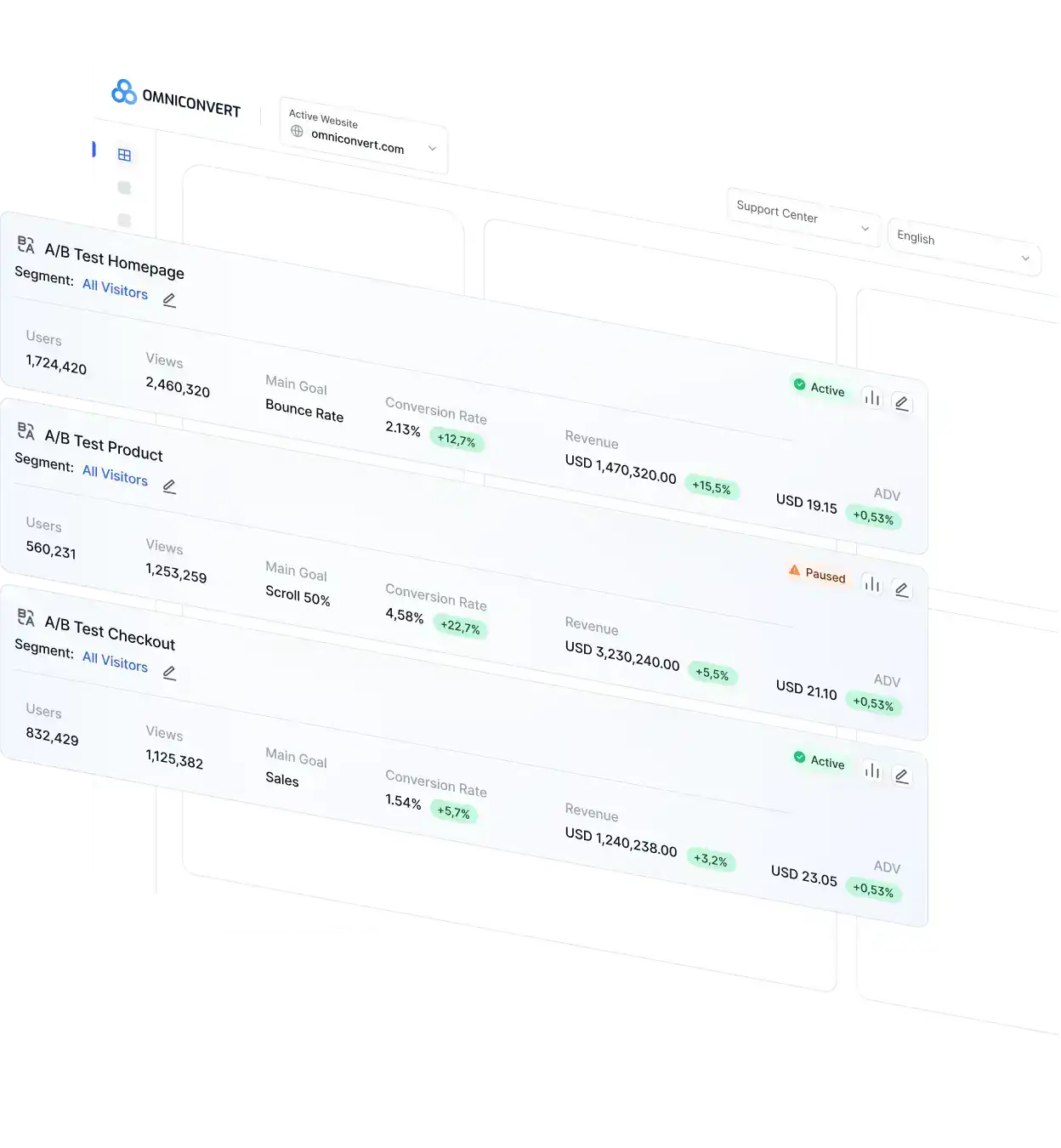
Explore is the experimentation product: A/B tests, surveys, overlays and personalization. A marketer can investigate a confusing product page, collect feedback and test a specific alteration. Managed services add strategists, designers, developers, quality assurance and analysts for companies that need help running the work. The expertise is as much about choosing a question as operating an editor.
Pulse follows customer experience through surveys before and after delivery, after use, and across online and physical retail. It supports Net Promoter Score and other satisfaction measures, analyzes open responses and triggers alerts. A complaint attached to a customer segment and a journey stage is more useful than a complaint floating in a monthly average.
Reveal, the customer analytics product launched in 2020, is now becoming the Customer Intelligence layer inside Nexus. The company says existing RFM, lifetime-value, cohort and NPS capabilities carry over. Nexus connects commerce and marketing data and is pitched as an AI engine that can identify opportunities, generate creative and prepare campaigns. Its promise extends from analysis into execution; live actions require human approval.
“The operator stays in control”Omniconvert’s stated product philosophy
Growth got ahead of the customer
The company began in Bucharest in 2013 as Marketizator. Founder Valentin Radu had been running conversion and retention experiments in online car insurance. In April 2016, Catalyst Romania announced a €1 million investment. That year brought the Omniconvert name, too. The original platform combined testing, surveys and personalized interactions, giving marketers several tools under one login.
The awkward chapter arrived in 2017. Omniconvert’s retrospective describes premature scaling: the sales approach worked, but the market and target customers were not ready for the product’s complexity. It restructured and focused on larger, more mature customers. Subsequent interviews with 200 ecommerce and retail leaders pointed toward lifetime value. Listening changed what the company decided to build.
Today its named customers include Decathlon, Auchan, Avon, Patagonia and Heineken. The company reports profitability since 2023. Those details explain its place in the market: retail operators with a customer history to analyze and enough organizational appetite to act on it. A sophisticated tool still needs a buyer whose problem is sophisticated enough.
Free software still needs an operator
The business model combines software subscriptions, enterprise arrangements, services and training. Explore offers free testing for 50,000 visitors; subsequent plans scale with tested traffic. Pulse pricing depends on monthly orders. Nexus is currently free for founding brands during onboarding, with later pricing planned. The free entry point lowers the cost of trying a workflow, although integration and staff time remain real costs.
For a buyer considering VWO, Optimizely or Convert for experimentation, Omniconvert’s argument is the connection between tests, customer value and feedback. Whether that breadth helps depends on the team. Sparse purchase histories weaken segmentation. Too few observations make tests harder to interpret. Unreliable tracking gives precise-looking answers to badly recorded questions. Someone must also be available to change the website or answer the unhappy customer.
Steal the routine
Start by checking that purchases and important actions are recorded correctly. Find a specific obstacle through behavior and feedback. Rank possible changes by likely impact, available traffic and development effort. Test a clear hypothesis. Read revenue alongside conversion and cart activity. Keep the useful result, revise the inconclusive one, and resist promoting every attractive number into a victory. The ribbon at Leroy Merlin is a reminder: shoppers can say yes to a button and still say no to the business.
Follow the experiment
Omniconvert · Explore · Nexus · Pulse · Current plans
Company blog · Catalyst’s investment announcement · LinkedIn · X · Facebook
Omniconvert on YouTube · Watch a short product walkthrough · Server-side testing tutorials