Nood had an expensive answer to a question nobody likes asking: what happens when the clever changes change nothing? The hair-removal brand had hired a conversion agency, spent more than three months working with it and run twelve split tests. According to Nostra’s account, the $50,000 engagement produced no meaningful improvement. The shop window had received considerable attention. The wait outside it had not.
- Nostra accelerates ecommerce storefronts by serving content from the edge.
- Its expanding toolkit also tackles bots, returning-visitor identity and broken shopping journeys.
- Judge the result with controlled traffic and revenue, rather than a prettier speed score.
Twelve tests, one expensive silence
Nood tried internal speed fixes next, with little success. A specialist’s proposed process looked too complicated for the approaching Black Friday deadline. The team then chose Nostra. Its own setup work took at most thirty minutes, the case study says; the site went live three days after the first call, two days before the sale. “We didn’t have to do anything,” Nood’s Bryan Cano recalled.
Reported load time fell from 7.4 seconds to 5.3 seconds. Nostra attributes a 24% conversion lift to the deployment. Those are vendor-published results around a holiday, rather than proof that every merchant will reproduce them. Still, the change in thinking is instructive: before adjusting what shoppers see, examine how long they wait to see it.
The shop behind the shop
Nostra sells retailers a managed layer between the storefront and its visitors. Its Edge Delivery service caches HTML near shoppers, using a network it describes as more than 310 edge locations. A DNS change routes traffic through that layer. The current onboarding pitch allows roughly two weeks for observation and tuning, rather than assuming every store is ready at once.
The difficulty is that a shop is alive. Carts, inventory and personalized content cannot all be frozen into yesterday’s snapshot. Nostra describes session analysis that decides what can safely be cached, with dynamic pieces restored after the initial HTML arrives. The useful distinction is between delivering the page’s framework quickly and keeping its changing contents accurate.
That places Nostra in ecommerce infrastructure and performance software, with conversion improvement as the commercial argument. Its audience includes DTC brands and larger retailers: Jones Road Beauty, Jolie and BRUNT Workwear appear among named customers. The company currently advertises more than 300 brands. Their shared problem is familiar: attractive imagery and useful integrations can make a storefront heavier.
A second pair of eyes
Credo Beauty supplies a more revealing experiment. It deployed Nostra, then used Noibu’s performance monitoring while switching the service on and off. In the published account, revenue per visitor rose 3.1% over ninety days. Average time to first byte across ten high-traffic URLs improved by 70%; the largest collection page went from 1,014 milliseconds to 219.
Time to first byte measures the wait for the server’s initial response. It does not mean the entire page has finished loading. That distinction matters because an impressive response number can coexist with heavy images or slow scripts. Credo’s commercial measurement gives the technical change somewhere useful to land: money earned from visitors.
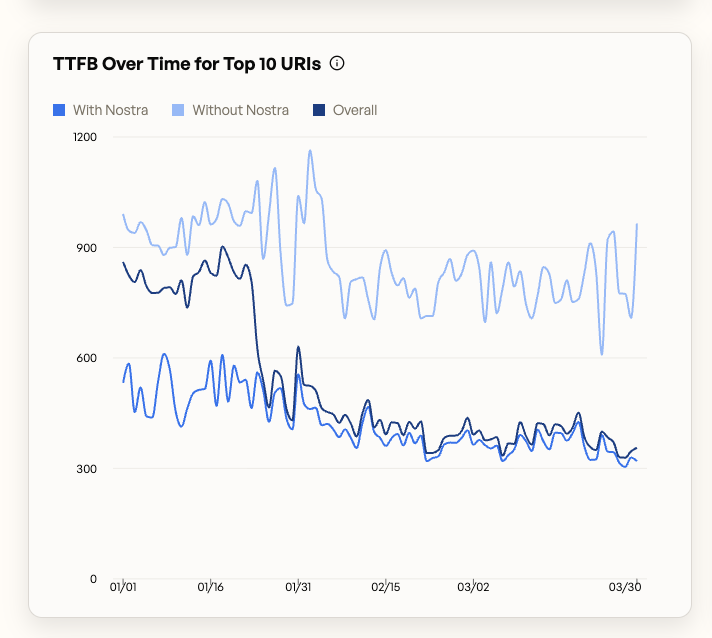
The experiment is worth copying even if the software is not. Keep campaigns, prices and design comparable; separate device and page types; watch revenue per visitor as well as technical performance. Independent monitoring helps prevent the vendor from becoming both contestant and referee. A speed score makes a tidy screenshot. A controlled commercial result makes a purchasing decision.
A bouncer, a detective and a cookie
Nostra now packages five jobs as named agents. Dash handles speed. Knox powers Edge Protect, filtering malicious bots. Sherlock powers Edge Detect, verifying crawlers and passing their activity to tools such as Profound. Crumble handles Edge ID, a first-party proxy intended to extend visitor recognition. Patch checks shopping journeys and produces reproducible bug reports. Infrastructure has acquired a small cast list.
The bot problem requires particular care. Imagine one hundred orders among ten thousand sessions: a 1% conversion rate. Remove five thousand bot sessions and the rate becomes 2%, without another order. Filtering can improve data and advertising audiences, but a rising percentage alone cannot establish incremental sales. Nostra’s separate detection and protection products also distinguish useful crawlers from unwanted automation.
A rising conversion rate can mean more buyers. It can also mean fewer bots.THE DENOMINATOR DESERVES A LOOK
Edge ID promises cookie lifetimes of up to two years through server-side, first-party tracking. That is a product claim, not a guarantee against every browser or user action. Edge Assurance takes another route to lost sales: it walks desktop and mobile journeys, then reports issues with severity, reproduction steps and video. Faster delivery offers little comfort if the checkout button misbehaves.
The receipt matters

Founder and CEO Arthur Root has attracted backing for that proposition. A September 2024 announcement named High Alpha as the lead investor in an $8.9 million round, bringing announced cumulative funding to $20 million. The money was earmarked for research and expansion in Shopify and Salesforce ecosystems. That was an investment plan, not evidence that every integration was already complete.
Nostra charges software subscriptions and handles implementation. Its public Edge Protect page displays $99 and $249 monthly options tied to traffic, with a fourteen-day trial and month-to-month terms for self-service customers. Edge Delivery and Edge ID require sales conversations. Contract terms also permit usage commitments and pageview overages, which belong in the buyer’s arithmetic.
Yottaa offers an alternative combining performance measurement and automatic optimization; merchants can also use specialists or their own engineers. Nostra’s pitch combines commerce-aware caching, managed support and server-side tests. The sensible buyer asks which bottleneck remains, then compares incremental gross profit against the full fee. A low-traffic store, an already quick site or an unappealing offer may leave little room for a speed subscription to pay. The lesson is portable: measure the wait, test the change, and make the invoice earn its place.