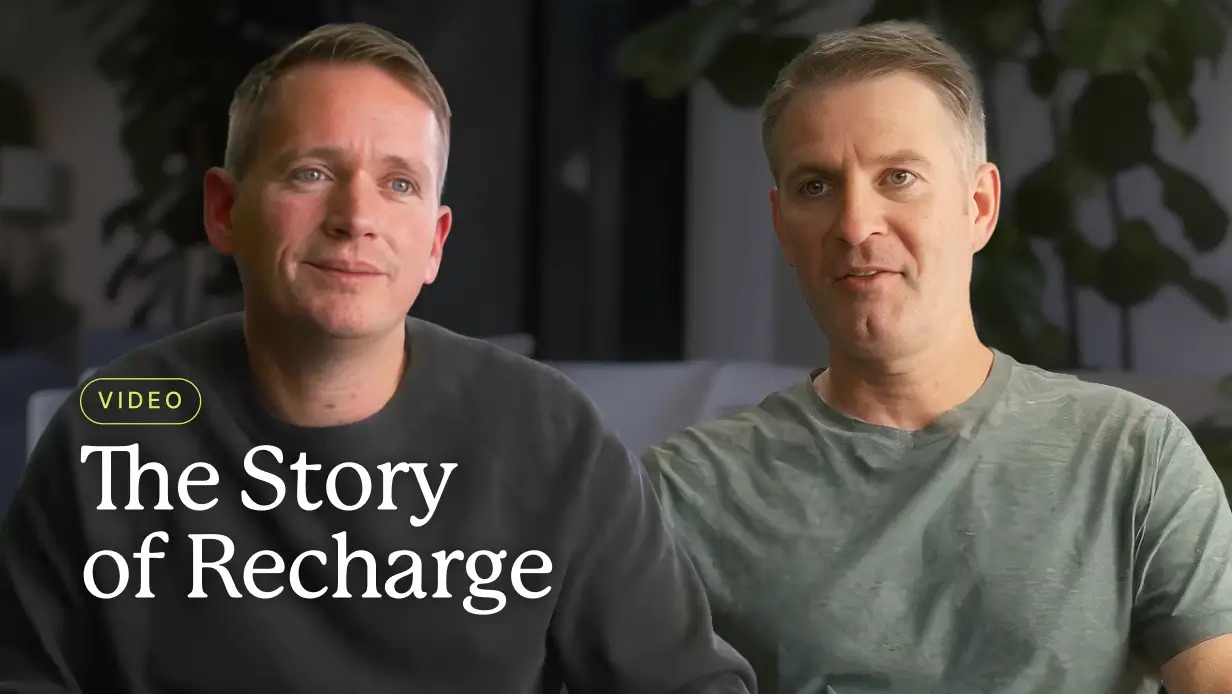
The bags were the tell. When the little Los Angeles software venture looked especially little, Michael Flynn packed. A return to his parents' home near San Francisco was the sensible contingency: cheaper than clinging to an apartment while a startup consumed the last of its runway. His co-founder, Oisin O'Connor, could read the company's prospects in the luggage. More packed bags meant trouble. Books returning to the shelves meant hope. It was business intelligence of a domestic sort, with no dashboard required.
The pair had met at a barbecue in Santa Monica. Both could build software and design products; neither had the capital to indulge a grand theory for very long. They began as a development agency, took paid work, called people who understood commerce better than they did, and launched products the way impatient geologists drill test wells. Roughly six went into the ground. The last one found something.
Recharge, founded in 2014, solved an unlovely but consequential problem. Online stores could sell a bottle of shampoo or a bag of coffee. Selling the next bottle automatically, on terms the customer could understand and alter, was far harder. Recurring billing for physical goods was brittle, improvised, or designed for something else. Flynn and O'Connor saw merchants wrestling with machinery that should have been ordinary. So they made it ordinary.
An engineer before the software
Flynn arrived at software by a route that makes more sense in retrospect than it does on paper. He studied mechanical engineering at UCLA. Machines taught him to think in loads, constraints, interfaces and failure points. His first prominent company was not a payments business but Opportunity Green, a conference and professional network he co-founded in 2007 around sustainable enterprise. The venture brought executives, designers and environmental thinkers into the same rooms. It also brought the clerical burden peculiar to events: sponsors, accounts, schedules and all the paperwork that multiplies while everyone is discussing a cleaner future.
In 2012 Flynn founded Sponsumo, described as a tool to automate event and sponsorship management. The jump from a conference to conference software was already a miniature version of what came later. First, live with a repeated operational nuisance. Then turn it into a system. His 2011 Empact100 recognition placed him among young American entrepreneurs before subscription commerce became his defining field.
O'Connor brought a different tempo. He has described himself as someone quick to see an opportunity, and Flynn as the partner who keeps the details honest and takes an idea from 80 percent to finished. Their division was not a tidy sales-versus-code cliché. Both had product instincts. Both had built software. Yet their contrast mattered: one scanned the horizon; the other checked whether the bridge could carry traffic.
“The most rewarding part of this is not just the business results... It's the number of entrepreneurs we've helped to grow their businesses from scratch.”Oisin O'Connor and Mike Flynn, 2021
The last test well
Timing supplied the current. Shopify was still a relatively small platform when the founders began studying ecommerce. Its app marketplace offered something a young company with no sales army desperately needed: distribution. A merchant could discover software, install it, and get to work without a courtship involving conference rooms and steak. Flynn and O'Connor designed for that channel. Recharge could be added quickly, which let the product introduce itself.
The first merchants also became an unpaid committee of exacting editors. They wanted integrations with the best ecommerce tools. They wanted ways to communicate with subscribers, workflows that increased revenue, and an API that would not trap an ambitious brand inside someone else's assumptions. Flynn's technical brief grew with them. Billing was merely the visible cog. Reliability, data, customer portals and integrations formed the clock.
The founders sold their other products or left them running quietly, producing about $250,000 that could be fed into Recharge. Then they stayed away from institutional capital for more than five years. Bootstrapping is sometimes decorated as founder virtue. In practice it meant the rent remained persuasive, every hire was legible on the bank statement, and a feature had to answer to somebody willing to pay. Recharge doubled or tripled year after year. It took four years before the company hired for sales and marketing.
When repetition becomes infrastructure
A subscription company makes its living from repetition, but repetition is unforgiving. The first payment can be a celebration; the fortieth is plumbing. Cards expire. Customers move. A product is delayed, swapped, bundled or cancelled. Currencies and languages multiply. Every exception arrives wearing the costume of a simple purchase. A technical founder in this business is building not a checkout button but a calendar with money attached.
By 2021, Recharge reported 15,000 merchants and 20 million subscribers. Its merchants had processed more than $3 billion in gross merchandise value during the preceding year, while the platform recorded 99.95 percent uptime. That last figure is the Flynn sort of number. Valuation attracts the camera; uptime keeps a merchant from calling at 3 a.m.
Then came the number that did attract cameras. Summit Partners, ICONIQ Growth and Bain Capital Ventures supplied $277 million in growth capital, valuing Recharge at $2.1 billion. The company planned to invest in its product, support and route to market. Flynn and O'Connor's announcement thanked the team, merchants and partners, contemplated the next six years, and ended without a victory lap: “Time to get back to work.” Four words, then the workshop door shut.
A sustainable-business conference gives Flynn his first visible founder chapter.
He turns event and sponsorship administration into a software problem.
The sixth-ish experiment focuses on recurring billing for physical ecommerce.
$277 million arrives after more than five self-funded years.
Flynn remains the technical co-founder more than a decade after launch.
A quiet role in a noisy category
Flynn's public footprint is restrained. He has not fashioned himself into the kind of chief technology officer who publishes a personal doctrine every Tuesday. The available glimpses come through colleagues and collaborators: humble, serious, committed to employees, exacting about the work. An old connection from his Opportunity Green days recalled a youthful, casual appearance that disguised unusual seriousness. A later Recharge colleague described both founders as down to earth and genuinely concerned about the people they employed.
There is something apt in this. The best subscription infrastructure disappears into the customer's routine. Coffee turns up. Toothpaste turns up. The merchant receives payment. Nobody writes a sonnet to the retry logic. The maker's reward is often silence.
Yet the scale behind that silence is now considerable. Recharge says it serves more than 20,000 businesses, has processed over $30 billion in transactions, and learns from activity across more than 100 million shoppers. It works with brands including quip, Dr. Squatch, Blueland and Oats Overnight. The company has expanded from the original billing wedge into analytics, retention, loyalty, bundles and customer experiences. Each addition rests on the same premise Flynn and O'Connor discovered in the early merchant calls: repeat business is a relationship disguised as a transaction.
The company also grew beyond the geography of its origin. A remote-first team spread across countries while Recharge pursued merchants outside North America. Flynn's own family history gave the European expansion a quiet symmetry: the son of emigrants from Cork was helping an American company consider an Irish foothold.
The books stay on the shelf
Flynn is a second-generation Irish American whose parents emigrated from Cork. He has spent his founder career in Los Angeles, first convening a sustainability community, then automating the work around it, then building the recurrent machinery of ecommerce. The industries changed. The instinct did not. Find the messy work people perform again and again. Understand the constraint. Make a tool sturdy enough to become forgettable.
Startup stories tend to grow tidier with valuation. Experiments become vision; desperation becomes discipline; luck applies for a new job as strategy. The packed-bag anecdote resists that polish. It preserves uncertainty in the room. Recharge did not announce itself as destiny. It was one more test by two builders who had enough humility to ask merchants what hurt and enough patience to stay with the answer.
Today the bags are no longer a runway gauge. Flynn is still Recharge's co-founder and CTO, more than a decade after that final test well began to flow. The durable achievement is not merely that he stayed in Los Angeles. It is that thousands of merchants can now build repeat business on machinery designed to stay out of sight. The books went back on the shelf. The code kept running.