In 2010, when Greg Alvo started building Ordergroove out of his New York apartment, roughly three online retailers sold anything on a subscription: Amazon, QVC and Petco. The rest of the internet was built for a single transaction, one order at a time, then start over. Alvo's bet was that this was backwards - that the interesting money in commerce was not the sale you made today but the one you would make automatically next month, and the month after that.
Fifteen years later, that bet reads less like a hunch and more like the operating assumption of modern retail. The "subscribe & save" toggle on your favorite brand's checkout page, the autoship box for your dog food, the paid membership that quietly renews - a large share of that machinery, for large brands, runs on infrastructure most shoppers never see. Ordergroove has become one of the companies supplying it.
The company brands its whole approach as Relationship Commerce: the idea that a brand's job is not to keep re-winning the same customer but to convert that customer into a durable, recurring relationship. It is a tidy piece of positioning, and Ordergroove more or less coined the phrase. What sits underneath it is decidedly less romantic - payment retries, cancel flows, dunning emails, retention analytics. The unglamorous plumbing of getting people to not stop paying.
What Ordergroove actually does
At the surface, Ordergroove sells subscriptions software. A brand plugs it into their storefront and can suddenly offer recurring orders - weekly coffee, monthly vitamins, quarterly razor refills - along with paid memberships and prepay plans. But the surface is the easy part. The reason enterprises pay for it is everything that happens after the first recurring order.
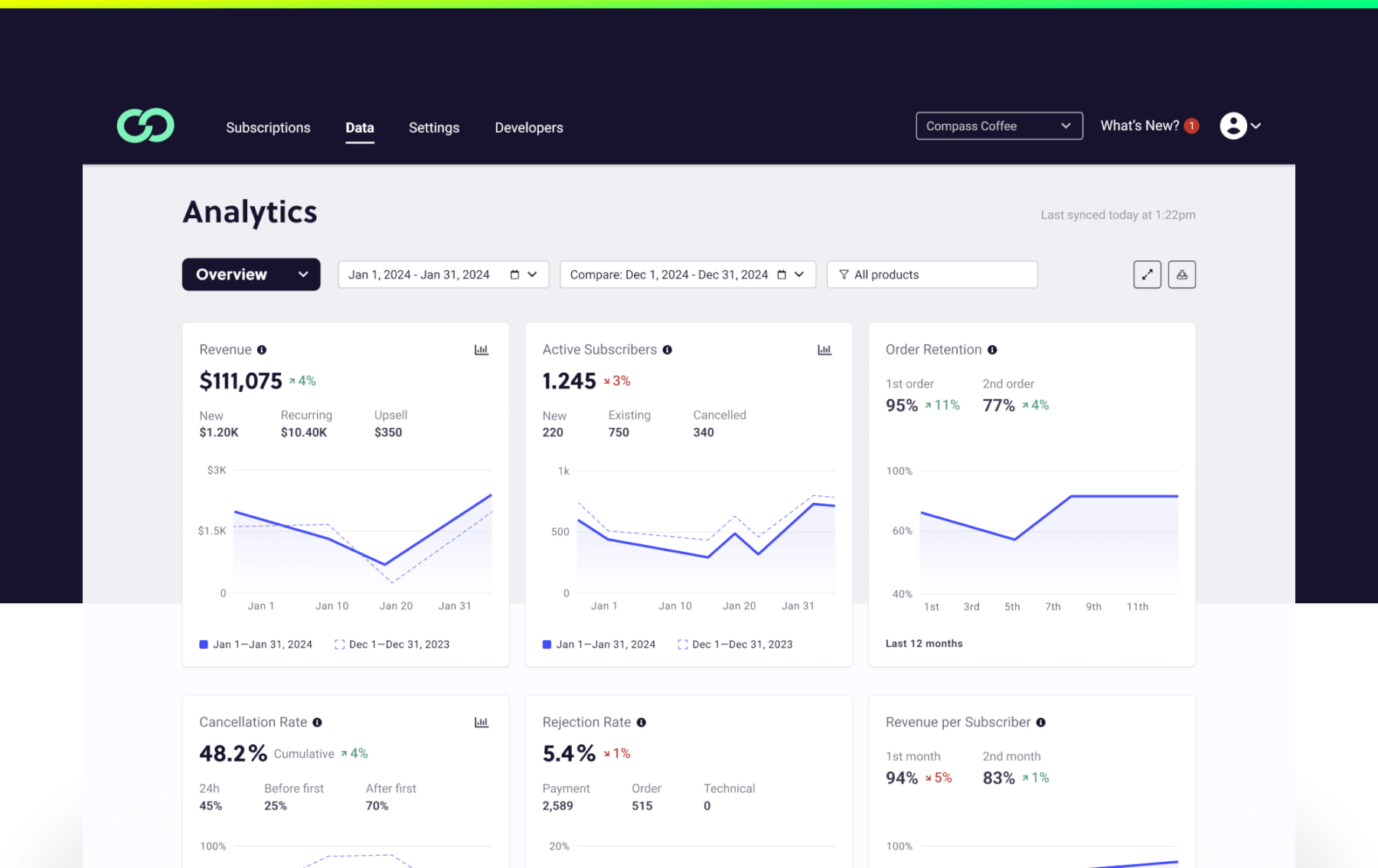
Subscription businesses do not usually die at signup. They die slowly, through churn: the customer who cancels, the credit card that expires, the payment that silently declines and is never retried. Ordergroove's products cluster tightly around that failure point - configurable cancel flows that intercept a subscriber before they leave, win-back offers, and failed-payment recovery. In 2025 the company folded much of this into an AI suite called Frontier, whose Recovery Optimizer it says lifts payment-recovery rates by around 56%.
Who is paying for it
Ordergroove's customer list is the argument for its whole strategy. It runs subscription and membership programs for roughly 500 brands, and the named ones skew large: L'Oreal, Walmart, Nestle, PetSmart, The Honest Company, Peet's Coffee, OLLY, Hotel Chocolat and Herbalife, among others. In 2024 it expanded into the UK; in 2025 it migrated pet brand BARK onto the platform. Collectively these customers are processing billions of dollars in subscription GMV a year, with the company reporting customer retention around 90%.
That enterprise tilt is not an accident - it is the entire wedge. Which is where the story gets more interesting.
Why it is not just another Shopify app
The subscription-tech category is crowded. Recharge, Bold, Skio, Stay AI, Loop and Recurly all sell some version of "add subscriptions to your store." Most of them grew up inside the Shopify ecosystem and skew toward smaller and mid-market merchants, where setup is fast and volume is high.
Ordergroove went the other direction. It is deliberately platform-agnostic and enterprise-first, with deep integrations into Salesforce Commerce Cloud, Adobe Commerce, commercetools and custom carts - the stacks that Walmart-scale retailers actually run. It is more expensive and harder to stand up than a Shopify plug-in, and it is not trying to hide that. The pitch is that a brand doing serious subscription volume needs infrastructure, not an app.
Ordergroove
Enterprise-first. Platform-agnostic - Salesforce, Adobe Commerce, commercetools, custom carts. GMV-based pricing, no per-transaction fee. Built for brands processing serious subscription volume.
The Shopify-native pack
Recharge, Skio, Loop, Stay AI. Fast to install, priced for SMB and mid-market, largely Shopify-centric. Great for a growing DTC store - less so for a retailer running five commerce stacks at once.
The business model, plainly
Ordergroove is B2B SaaS, sold as what it calls subscriptions-as-a-service. The pricing choice is worth noticing: instead of taking a cut of every transaction, fees scale with a merchant's subscription GMV. Third-party sources put the floor somewhere north of $2,900 a month. The effect is an alignment of incentives - Ordergroove makes more when its customers' recurring revenue grows, and it is not nickel-and-diming individual orders. It is a model that only works if you genuinely move the retention needle.
The funding curve tells its own story about pace. Ordergroove raised patiently - a $7M Series B in 2012, a $20M Series C led by National Securities Corporation in 2017 - before landing its biggest check: a $100M+ growth investment led by Primus Capital in November 2022. It has raised somewhere around $130M+ in total across its life, remains independent, and has never been acquired. One founder, no flashy pivots, one idea compounded for over a decade.
The founder, and the long game
Greg Alvo founded Ordergroove in 2010 and is still its CEO - with, notably, no co-founder on record. Before this he worked in enterprise sales at Liquidation.com, which went public in 2006, and earlier founded a hardware company called Voteq. His arc with Ordergroove is unusually linear for a startup: one thesis, held through more than fifteen years, while the rest of ecommerce slowly came around to it.

On the AI push, Alvo frames Frontier as the connective tissue rather than a bolt-on: "Frontier is the brain of Relationship Commerce," he said at its 2025 launch. "It allows merchants to scale customer relationships effortlessly, using AI to anticipate needs, drive engagement, and maximize CLTV." Whether AI meaningfully changes subscription retention or just automates the emails is a fair open question - but the direction is consistent with everything the company has done.
Where it fits in the market
Zoom out and Ordergroove occupies a specific slot: the enterprise floor of a category that got loud from the bottom. As acquisition costs climbed and DTC brands discovered that one-time buyers are a leaky bucket, recurring revenue stopped being a nice-to-have and became a hedge. That macro shift is Ordergroove's tailwind. Its risk is the same one every infrastructure company faces - that the platforms it plugs into, or the giant retailers it serves, decide to build the plumbing themselves.
Ordergroove at a glance
- Founded2010, New York
- Founder / CEOGreg Alvo
- CategorySubscription & membership commerce
- Customers~500 enterprise brands
- Total raised~$130M+
- Largest round$100M+ • Primus Capital • 2022
- Team~120, distributed
- StatusIndependent, PE-backed
For a reader wondering what to take from all this, the copyable idea is the reframe, not the software: stop selling transactions, start selling the relationship - and build the retention machinery before churn shows up, because by the time it does, it is already late. Ordergroove's whole existence is a fifteen-year argument that the boring part - the cancel flow, the payment retry, the win-back - is where the value actually lives.