The curious number in the Series Entertainment story is 35. That is how many days a two-person team reportedly needed to build PicMon RPG, a game that turns a photograph into a creature card and sends it into battle. During those same 35 days, the team produced 20 builds. The arithmetic is almost comic: one new version every working day and a half. In the conventional telling of game development, two people and five weeks gets you a prototype, some placeholder art, and a nervous conversation about scope. Series got a live product.
Speed is the company's favorite subject, but speed alone is a party trick. The more consequential part of PicMon sits behind the creature cards. The game plugs into RUN, Series' platform for hosting, player data, analytics, purchases, ads, multiplayer, AI generation, and publishing. The team did not merely make the game faster. It skipped much of the plumbing that normally begins after someone says, “The prototype works.”
The engine learned to open its doors
When game veteran Pany Haritatos founded Series in 2023, the company looked like a studio with an unusually elaborate workshop. Its core technology was called the Rho Engine, a multimodal authoring system designed to coordinate roughly 20 kinds of generators. Textures, backgrounds, 3D meshes, audio, scripts, characters, and long branching narratives could all move through the same production environment. The ambition was to let a tiny expert team make work that once demanded departments.
Haritatos had spent his career arriving near platform shifts. He built browser games during the Flash era, sold one studio to Zynga and another to Kongregate, later ran Kongregate, then led games at Snap. His useful obsession was not AI in isolation. It was leverage: what becomes possible when a new distribution or production technology lets a small group behave like a large one?
Investors bought the premise. Andreessen Horowitz led a $7.9 million seed round in 2023. A year later, Netflix and Dell Technologies Capital joined returning backers in a $28 million Series A. The disclosed total reached $35.9 million, and one outside estimate placed the post-money valuation around $190 million. Series also grew from 17 employees at the beginning of 2024 to more than 100 that September.
“You don't need a massive budget or a large team; you just need the vision and something interesting to share.”Pany Haritatos, founder and CEO
Then the workshop became a storefront. In August 2026, Series put RUN into public beta. The product now includes Game Studio, Story Studio, Video Studio, and Adventure Studio, along with a consumer destination where the results can be played or watched. Coded browser games can use an SDK instead of the visual tools. Creators can connect rewarded ads, in-game purchases, storage, notifications, analytics, hosted AI models, and live experiments through a single API.
That sequence is the differentiator. Unity and Unreal remain formidable general-purpose engines. AI assistants and testing tools can accelerate individual jobs. No-code builders can produce quick games. Series is trying to compress the entire trip from idea to operating business. It is an engine, a back office, a publisher, an arcade, and a cash register sharing one login.

The first thing to fail is usually the handoff
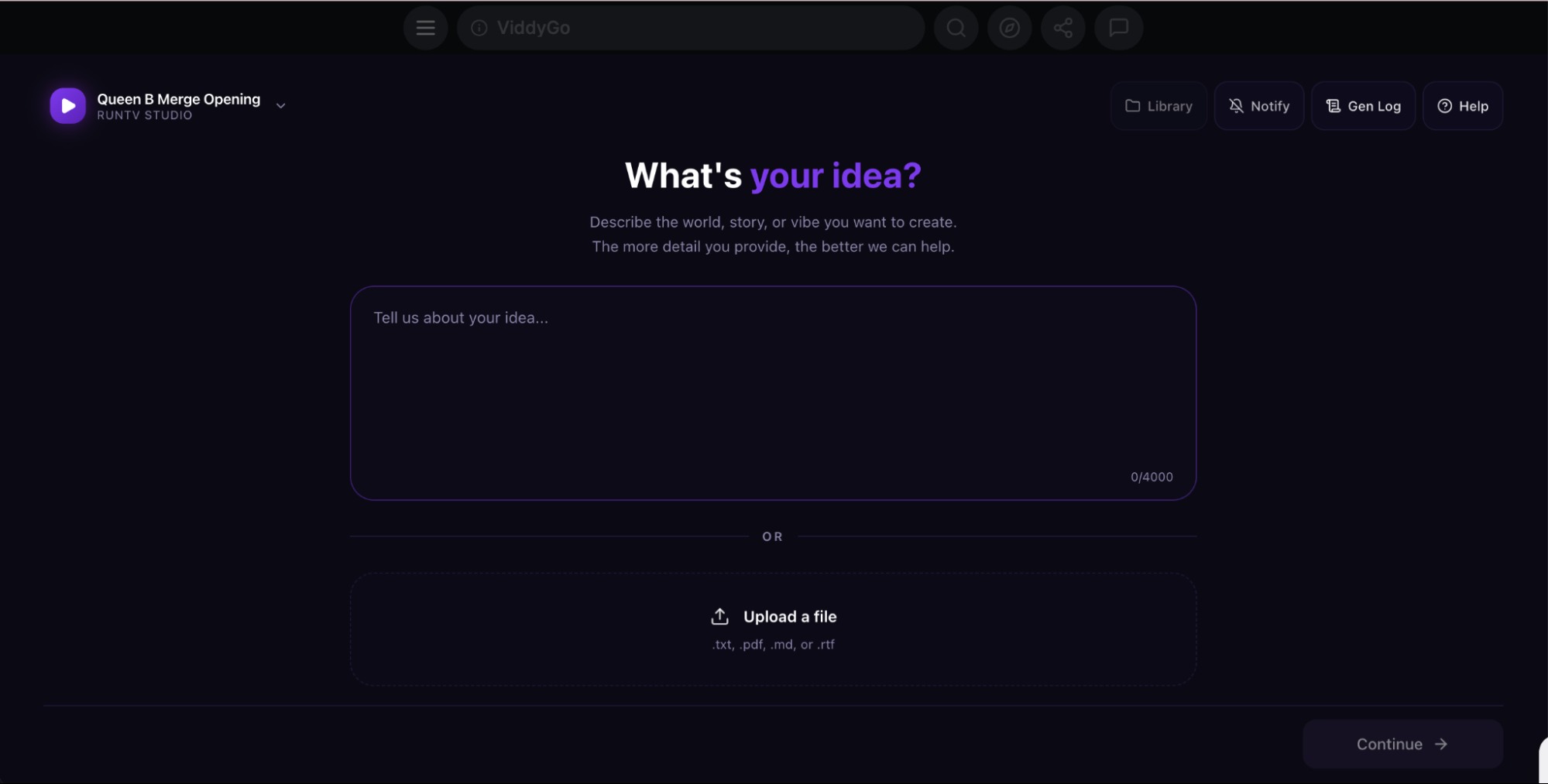
Series describes the enemy with unusual precision: creative ideas tend to die between tools. A writer gets a premise into a notes app, then needs concept art, character design, storyboards, footage, a thumbnail, formatting, and a place to publish. Every handoff adds a new interface, subscription, export, or specialist. Viddy Go, Series' short-video tool, is a clean example of the company's answer. It turns a premise or reference image into a storyboarded 90-second episode and publishes it to RUN's video destination. Series says the full trip can take under 30 minutes.
The storyboard is the interesting choice. Many AI video products sprint directly from prompt to moving image. Viddy inserts narrative structure first: opening, escalation, payoff, hook. The company is making a quiet argument that automation works better when it respects the old craft checkpoints. Faster pixels are plentiful. A sequence that earns the next 90 seconds is harder.
That idea also explains Series' 2024 purchase of Pixelberry Studios, maker of the long-running interactive-fiction game Choices: Stories You Play. Pixelberry brought a recognizable title, a practiced story team, and an audience with strong opinions. Series later said the studio had been overly lean after an earlier layoff, so it added writers, artists, engineers, and producers and introduced tooling tested elsewhere in its portfolio. Choices became both an asset and a living laboratory: new machinery had to meet an existing community, not an empty demo room.
The business is the loop, not the prompt
RUN serves two populations that creator platforms often struggle to hold together. Makers need cheap experiments, dependable infrastructure, discovery, and a way to earn. Players need worthwhile things to do. Series can make its own games, operate acquired titles, and invite outsiders to fill the shelves. Monetization comes through advertising, in-app purchases, platform currency, and revenue sharing, though public take rates and pricing remain undisclosed.
In September 2026, the company put $1 million behind the supply side. The content-support fund covers cash-prize jams, subsidized AI credits, paid promotion, creator education, and a participation program. The Android app had already crossed 50,000 downloads. Those numbers are early signals, not proof of a self-sustaining market. A creator economy becomes real when a stranger returns, spends, and gives a maker enough reason to make the next thing.
RUN's SDK is aimed at browser-based games. Several advanced systems, including parts of multiplayer and server-authoritative simulation, are still marked beta. AI and streaming multiplayer calls require a signed-in user aged 18 or older. The platform can remove technical friction; it cannot supply taste, an audience's trust, or retention by itself.
The privacy bargain deserves equal billing. RUN collects account and usage data, and its policy warns creators not to place sensitive, confidential, or personally identifying material into AI chat fields because inputs may be stored and used to improve models. Players can request deletion, and data is encrypted in transit. For a platform that wants creation and consumption to blur together, those controls are part of the product, not merely legal upholstery.
What a small team can borrow
The most copyable Series idea requires no generative model. Reduce the distance between making and learning. Use shared services for the boring systems. Release a narrow version, observe where players stay or leave, and let those signals shape the next build. A two-person team can attempt 20 builds in 35 days because it is spending less time rebuilding accounts, storage, payments, and analytics.
The approach is a poor fit when a project depends on bespoke engine behavior, offline control, highly sensitive inputs, or production systems that cannot tolerate beta infrastructure. It also falters when fast iteration is mistaken for creative direction. Twenty builds are useful only if each one asks a better question.
Series began by promising professionals a more powerful engine. RUN makes a broader promise to people who may not yet call themselves professionals: make the thing, put it in front of someone, and learn what it wants to become. The company has compressed the route. Now comes the part no engine can automate - persuading an audience to care.