Haining Wang found a business in feeding fish. The fish were virtual, their owners were real, and one of the useful things you could do was feed a friend’s fish as well as your own. It was a small courtesy, translated into a game. For a founder who had worked in social networks, the attraction was easy to understand: people already had relationships. A game could give them another reason to keep those relationships going.
By December 2011, Wang said Happy Elements had sold more than five million fish on Facebook, priced between ten cents and a dollar. The aquarium had acquired useful accessories, including a seahorse that could do the feeding automatically. Even an imaginary pet, it appeared, could require a little domestic outsourcing.
Wang compared the work to making a television series. Each instalment needed something new. Over roughly two years, the fishbowl game had gone through about 250 versions. That comparison is a useful entrance to his story: the object on the screen was an aquarium, but the work behind it was a continuing appointment with an audience.
Before the fish, a different kind of argument
Wang’s route into games began well before Happy Elements. He graduated from Wuhan University in July 2000 with a bachelor’s degree in information technology. At university, he had also been the first captain of its debate team. The team won the Lingyun Cup national university debate competition in 1999. There is something pleasing about a future entertainment executive having spent his student years taking words seriously.
His early internet career included ChinaRen and, after its acquisition, Sohu. Enterprise technology followed: he worked as a high-tech industry manager at Oracle from March 2004 to March 2005, then as an account executive at SAP until June 2007. Those positions put him in a different commercial world from cartoon fish, one of business customers and technology suppliers.
From June 2007 to October 2009, he was a senior director at Renren. He subsequently founded Beijing Shuangyu Hudong Technology Development in October 2009. Happy Elements dates its beginnings to 2009; its Japanese company followed in April 2010. The sequence matters because Wang arrived with experience of platforms and customers, rather than a career spent solely inside game studios.
An aquarium with a passport
Happy Elements’ early games travelled through the social networks people already used. My Fishbowl appeared on Renren in May 2009 and its Traditional Chinese Facebook version followed in August. Within two months, it had attracted 2.4 million daily active users. My Bar, a management game, went to Japan’s Mixi. A young Beijing business was finding audiences outside mainland China almost immediately.
In 2010, the company described a team of more than 100 and a recently established Tokyo office. Its fishbowl already had English, Spanish, Italian, French and Chinese versions. Language was only part of the adjustment. A Mid-Autumn Festival promotion might suit one audience and leave another wondering why the aquarium had become interested in mooncakes.
Mixi also had its own customer-support expectations and restrictions on viral promotion. Successful habits on Facebook could not simply be carried over. This gave Wang’s company an early practical education in international entertainment: the game travelled, but the obligations travelled with it. A new platform meant another set of people to understand, another service to maintain, and another way of discovering whether the invitation actually worked.
The people who kept their fish
By July 2012, Wang was talking about the players who had stayed. He said 70 percent of the fishbowl’s players had been playing since 2009. For a game with such an uncomplicated premise, that was a striking measure of persistence. Buying a fish was one transaction. Returning to look after it for years was a different sort of relationship.
Happy Elements had a department dedicated to player feedback. About one fifth of the fishbowl’s updates came from suggestions by players, according to the account at the time. New characters and continuing changes kept the aquarium from becoming a familiar room with nothing left to notice. The audience had a route into the development process, rather than merely receiving whatever the company happened to send.
Wang also insisted on working across social platforms. More than half of revenue then came from networks other than Facebook. Staying close to users therefore did not mean staying attached to one distributor. The combination is revealing: cultivate the relationship with the player, while keeping the business capable of reaching that player in more than one place.
Money for the next screen
In October 2011, Happy Elements announced a $30 million Series B round from Legend Capital and DCM. Wang said the money would support recruitment and expansion into mobile. It was a decision about the people needed to make the next generation of games, as well as the devices on which those games would appear.
The timing puts the fishbowl story in perspective. Happy Elements was already thinking beyond the social-network page while its aquarium was attracting visitors. Mobile was a destination for investment, rather than an excuse to abandon the audience it had. A service business has to manage that awkward overlap: keep today’s appointment, and prepare for the place where tomorrow’s appointment may happen.
Wang’s later mobile hit, Anipop, known in Chinese as Kaixin Xiaoxiaole, made that transition visible. The PC version launched in 2013; iOS and Android versions followed in 2014. Its reported monthly audience rose from 1.8 million at the start of its mobile launch year to 42 million by year’s end. Matching colourful pieces had become an activity that could travel in a pocket. The scale had changed; the demand for something approachable remained.
Japan made the games; China changed the journey
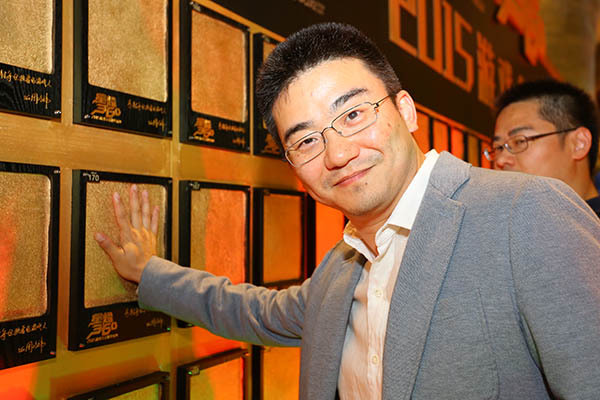
Wang’s Japanese expansion developed a second strand of the business. Merc Storia was made by the Japanese team, launched there in January 2014, and brought to China later that year. It was a role-playing game with card elements and an anime aesthetic, a different invitation from tending a fishbowl. Its Chinese launch took place at Guangzhou’s Firefly anime convention.
The adaptation involved some thoroughly unromantic work. Wang explained that the Chinese release needed a smaller download. His chief technology officer, Ling Cong, described image compression and putting later stages into downloadable content. Beautiful artwork was part of the attraction; getting that artwork onto a player’s phone was part of the job.
For China, Happy Elements worked closely with Bilibili to reach young anime fans. In Japan, television advertising and advance registration had helped build the audience. The different choices make the expansion more interesting than a simple export story. Wang’s company was learning to match a work with its surroundings. A convention, a video community and a television commercial were different doors into the same fictional world.
A stage full of people who did not exist
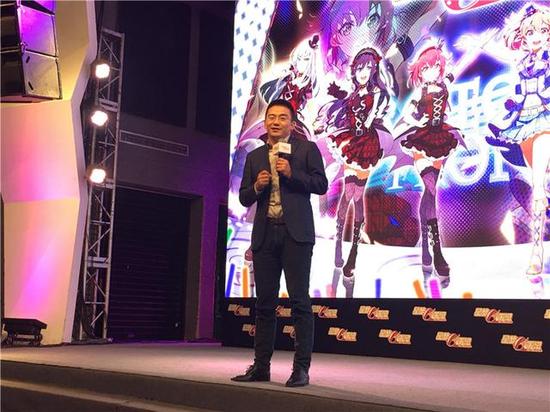
In September 2016, Wang stood on a Beijing stage in front of the brightly dressed characters of Idol Memories. Happy Elements was presenting an original animation project. Its fictional idol school belonged to a future in which virtual reality had changed entertainment. For an executive associated with casual games, it was a colourful way of broadening the family business.
The project brought together animation, manga, radio drama, music, broadcasts and live events. Happy Elements worked with Japanese animation company Seven Arcs Pictures, with Bilibili involved in promotion. The series was scheduled to begin broadcasting in China and Japan in October. Two idol groups sat at its centre, with different looks and musical identities.
Wang treated the move as an extension of the company’s purpose. At the screening, he said there was no immediate plan for a game adaptation: the animation needed its own attention. That choice gave the characters a chance to be interesting before they were useful to another product. His colleagues were building a story people might care about, rather than treating a television series as a compulsory stop on the way to a game.
The ambition also had a familiar social ingredient. An aquarium asks someone to return for a fish; an idol story asks someone to return for a character. The forms differ, and a fictional singer requires rather more dialogue than a seahorse. Both depend on whether an audience wants another encounter.
The audience that left its wallet closed
At a June 2018 gathering in Guangzhou, Wang described the difficulties behind the mobile transition. Some earlier games had attracted millions of daily users without producing enough revenue to justify their substantial server needs. A large audience could be an accomplishment and a financial problem at the same time. The company had to find a way to make its preferred kind of entertainment pay.
He dated Anipop’s mobile launch to February 28, 2014. By the time of that speech, he reported roughly 120 million monthly players and nearly 40 million daily players. Those are figures from 2018, and they describe how far the mobile puzzle had travelled by then. They also explain why small moments of play could add up to a considerable business.
Wang emphasised brief gaps in a day: waiting for food, waiting for a lift, taking a moment between other things. He acknowledged that most players did not spend money. The paid minority supported the model, while the wider audience gave the game its place in everyday life. His interest in competing with Tencent and NetEase came behind a question about the value Happy Elements itself could create.
“We are running a service.”
An early Happy Elements motto, recalled by Wang
The company beyond the hit
For all those audiences, Wang was cautious about public celebration. In a conversation published in January 2017, he compared game companies to castles built on sand dunes. A hit could rise and then disappear. He had spent several years doing little publicity, and explained that his renewed willingness to talk had a practical purpose: attracting colleagues who understood the company.
His hiring analogy was a walk in Haidian Park. A mountaineering captain and a hiking enthusiast might look much alike there; an expedition to the Himalayas would reveal the difference. The challenge was finding people capable of the next undertaking. It was a more demanding ambition than collecting names for a growing organisation.
“We are running a service,” read an early company motto. The sentence remains a compact account of Wang’s approach. The work must continue after a successful launch. His company’s Japanese history records a Kyoto development office opening in 2011 and subsequent expansion. By 2023, Ensemble Stars’ Element animation had reached event screenings and YouTube. The games had continued to generate stories.
In May 2025, Wang was still identified as Happy Elements’ chairman and general manager, alongside his independent board role at Keep. A June 2026 filing continued to list him on Keep’s board and audit committee. His career had grown beyond the first aquarium, but that early business offers an unusually tangible picture of his thinking. Someone comes back. There needs to be something worth coming back for. The fish, mercifully, do not need to understand the strategy.
Keep reading. Keep watching.
- Wang’s continuing board role · June 2026 ↗
- Happy Elements ↗
- Haining Wang on LinkedIn ↗
- Happy Elements on LinkedIn ↗
- Happy Elements on X · company account ↗
- Happy Fish on Facebook · game page ↗
- Wang’s 2017 conversation ↗
- The fishbowl and player feedback · 2012 ↗
- Wang’s Guangzhou speech · 2018 ↗
- Career biography · May 2025 ↗
- Happy Elements Japan · company history ↗
- Watch HELIOS Rising Heroes’ opening film · official game video ↗
- The early Facebook and Mixi games · 2010 ↗
- Wang on running a game service · 2011 ↗
- The mobile investment · 2011 ↗
- Merc Storia comes to China · 2014 ↗
- Anipop’s first mobile year · 2017 retrospective ↗
- Idol Memories takes the stage · 2016 ↗
- Ensemble Stars: Element · production credits ↗
- Wuhan University’s first debate captain ↗