A multiplayer game has an awkward little ending. Someone wins. Someone complains. Then the software, having completed its duties, has very little to say about what the friends should do next. In a living room, nobody needs an answer. They are already together. On a phone, togetherness can disappear with the match. Bunch began with the conviction that this was a product problem worth solving.
- Keep the conversation going before, during and after a game.
- Give friends shared activities, from video chat to virtual homes.
- Make joining easier: today’s iOS listing calls the app MiniParty.
The room mattered more than the match
Founded in 2017 by Selcuk Atli, Jason Liang and Jordan Howlett, Bunch drew its inspiration from LAN parties: friends assembling in one room to play networked games. The remembered pleasure included all the unofficial entertainment around the screen. There was teasing, commentary and the chance to see somebody’s face when a plan went wrong. A game supplied the occasion. The room supplied the evening.
The original app tried to carry that room onto mobile devices. Friends could talk over voice or video, launch multiplayer games and remain connected between sessions. Bunch also developed a platform for game developers to add its social functionality. Its expertise sat at a fiddly junction: real-time communication, mobile performance and moving a group into play. A party has several passengers. Getting only the host aboard is insufficient.
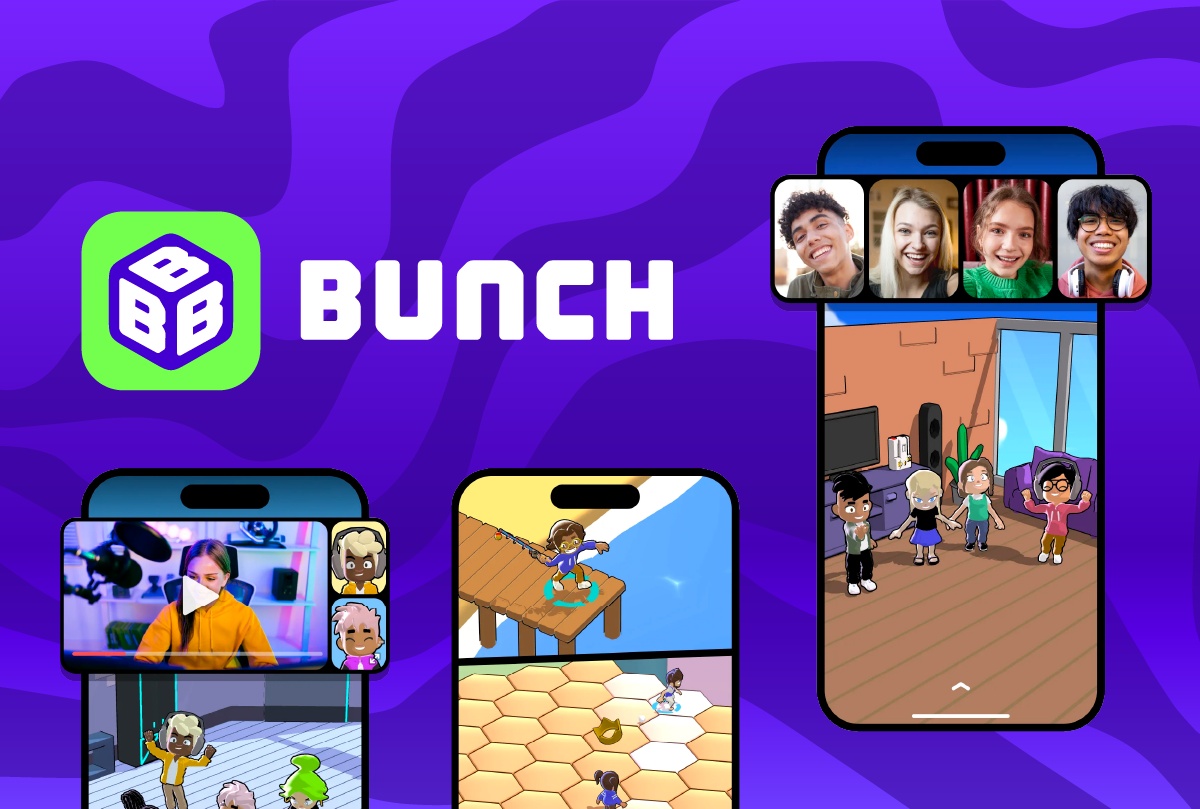
That gives Bunch a particular place in the market. Discord offers persistent conversation around gaming and communities. Roblox offers a platform of shared experiences. Bunch’s original proposition was a mobile party that could accompany friends through different games. The attraction was continuity. You could change what you were doing without reassembling the people doing it.
A small phone, an expensive conversation
There is a catch to this pleasant idea. A phone running a game is already busy. Ask it to handle several faces and voices as well, and the living room becomes an engineering assignment. Agora’s account of Bunch’s implementation says the first communication solution ran into CPU and RAM challenges. The team adopted Agora’s voice and video SDK, using adjustable video profiles to reduce the demands on devices.
“hearing them laugh and watching their reactions enhances the gaming experience.”Selcuk Atli, in Agora’s Bunch case study
This is a useful corrective to the usual discussion of social products. Delight can depend on an unglamorous resource budget. Sharper video is desirable until it competes with the game. The practical lesson is to design the combined workload, then tune each component. A conversation that looks slightly less polished may serve a group better than one that makes its game stumble.
The financial version of that problem arrived during the pandemic. In an April 2020 interview, Atli and product manager Harsh Kher described rising infrastructure costs and analytics usage exceeding inexpensive service tiers. Keeping the service running became a priority. Free access for a player still creates a bill for the operator. Every additional minute of companionship has machinery behind it.
Change the activity. Keep the company.
The game industry buys a seat
Bunch raised a $3.8 million seed round in November 2018, led by London Venture Partners. The announcement described plans to expand user acquisition and the developer platform. A further $3.85 million round announced in November 2019 brought backing from companies including Supercell, Tencent and Riot Games. The studios had an understandable interest in software that helped friends arrive at games together.
In September 2020, General Catalyst led a $20 million Series A. Participants included Electronic Arts, Krafton, Take-Two Interactive and Ubisoft, alongside returning investors. These were investments, which should not be mistaken for a promise that every publisher’s games had a working Bunch integration. They nevertheless put a striking collection of game businesses behind a company concerned with the space between games.
The pandemic also exposed the importance of circumstances. Atli described an unexpected influx from Italy, followed by other countries. Users needed a substitute for seeing friends. Bunch’s founders had built around an existing social habit; isolation made that habit urgent. Readers building their own products can copy the attention to behavior. They cannot schedule the external event that makes demand suddenly acute.
A house in the metaverse
In February 2022, Bunch announced a larger canvas. Bunch 2.0 added a spatial world with avatars and places to explore, while preserving the ambition of moving into outside games. Atli described users spending hours in parties, sometimes doing homework and sometimes playing. That observation helps explain the expansion: people were using the party as somewhere to be, beyond a tool for starting a match.

The 2022 pitch also included blockchain-based ownership and an economy for virtual items. Those were period-specific ambitions. The more tangible consumer experience was a customizable avatar, a private home and activities shared with friends. Bunch’s developer-era website describes watching YouTube, playing instant games and launching titles such as Roblox and Minecraft. These are invitations to spend time together in several different ways.
Virtual possessions offered possible things to sell. By April 2024, Samsung’s Bunch listing advertised Bunch+, a subscription with benefits including store discounts and doubled daily rewards. The free app also offered in-app purchases. The commercial question was whether people would pay to improve the place where they gathered. That is a different question from whether they enjoyed gathering there.
The invitation gets shorter
Today’s iOS listing introduces Bunch as MiniParty. It promises party games across phones and laptops, with friends able to join without installing an app. The examples are pleasantly ordinary: drawing, cards, pool and basketball. The language puts practical access ahead of the virtual-world vocabulary. This is a change in the public pitch; the listing alone does not establish why management made it.
Atli’s own website says Bunch has been used by more than 10 million players. That is a cumulative founder claim, rather than a measure of today’s active audience. The enduring idea is easier to judge than the scale: give friends something to do and reduce the work of doing it together. It depends on friends being available, compatible devices and a connection that holds. The party begins when the last person gets in.