A hundred million people can enter a room and still leave you with an awkward party. In July 2023, Threads collected that many registrations in roughly five days. Instagram supplied a wonderfully convenient invitation: bring your identity, bring the accounts you already follow, and try talking in text. The host had solved the problem of getting guests through the door. Whether they would enjoy one another was a separate matter.
- The head start: Instagram made joining and finding familiar accounts easy.
- The first snag: early curiosity did not reliably become a returning habit.
- The work: better discovery, useful conversations and tools for people who publish regularly.
- The opportunity: creators can test ideas; businesses can join discussions and buy feed ads.
The guest list was the advantage
Threads is Meta’s text-led social network, built by the Instagram team. People post observations, links and media, reply to others and follow accounts or interests. It occupies the public-conversation market alongside X, Bluesky and Mastodon. Instagram provides the family connection; the product gives words a room of their own. You can participate without staging a photograph or editing a video. A sentence and a worthwhile opinion will do.
For a new social network, an empty feed is a business problem disguised as a blank screen. Threads could begin with familiar identities and connections. The convenience was considerable. So was the assumption hidden inside it: that the people you wanted to look at were also the people you wanted to listen to. A lovely holiday photograph is not a binding contract to enjoy its owner’s views on everything else.
The first difficulty appeared quickly. Reuters reported in July 2023 that Zuckerberg told employees more than half of the early users had not stayed active. He described retention as better than expected, while acknowledging the room for improvement. The launch had proved that people would try Threads. It had yet to prove how many would make it part of Tuesday.
Monthly active users reported by Meta in June 2026.
The edit button did not save the party
The obvious prescription was to add missing features. Threads gained a chronological Following feed, web access, search and editing. Users could finally do things that felt ordinary elsewhere. There is satisfaction in repairing an omission. There is also a temptation to confuse that satisfaction with proof of growth.
In a 2024 interview with Platformer, Adam Mosseri said several requested features had moved the app’s trajectory little or not at all. He attributed more effect to improvements in ranking, connections, Instagram integration, notifications and reliability. Requested features still mattered to enthusiastic users. They simply did not all produce a visible surge. The useful lesson is to listen to customers while measuring what their requested changes actually do.
“making the thing better every week”
Adam Mosseri, on the team’s focus in 2024
Mosseri described an early team whose recurring meeting bundled decisions into one document. That is a process a smaller business can copy: give unresolved decisions a regular appointment and handle several together. A giant corporation’s distribution cannot be ordered from a stationery catalogue. A shorter queue for decisions can.
The later numbers establish scale, rather than the cause of it. Threads passed 175 million monthly active users by July 2024. Meta announced 500 million in June 2026. Neither figure tells us which feature persuaded a particular person to return. The gap between a feature’s popularity and its measurable effect is precisely why this story is useful.
A conversation needs somewhere to go
Threads’ audience was developing its own connections. In July 2025, Meta said more than a third of daily users with connections followed mostly different accounts on Threads than on Instagram. The qualification matters: this was a defined group, not every person who had registered. Even so, it suggested that some guests were choosing their own company.
Messaging arrived that month, allowing a public exchange to continue privately. Group chats followed in October, with up to 50 people. For a creator meeting a possible collaborator, or someone finding a new friend through a shared interest, the app could carry the conversation beyond the public reply. It had another reason to remain open.
Longer writing supplied a particularly instructive product clue. People had been sharing screenshots of books, articles and other text when 500 characters proved insufficient. In September 2025, Threads introduced attachments of up to 10,000 characters. An author could share an excerpt; a journalist could offer part of an argument and link to the full piece. Users had demonstrated a task before the company gave it a button.
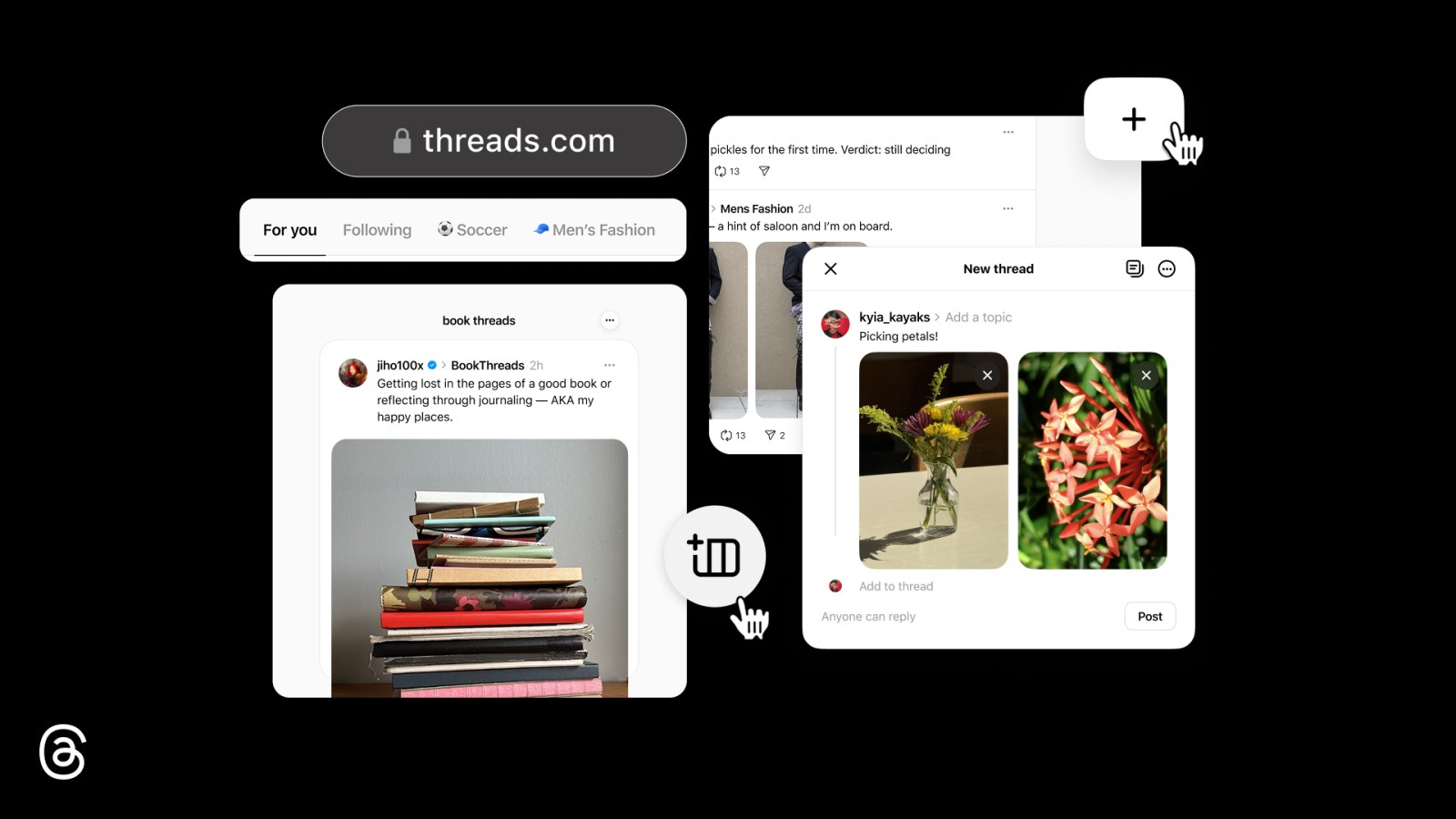
Communities gave interests a more explicit address. Meta introduced public spaces around topics such as basketball, television and books in 2025, with topic-specific Like emojis. Book lovers got a stack of books: a small detail, but social products are partly made of small recognitions. By June 2026, communities were graduating from beta.
The wider product also includes analytics, drafts and scheduling tools for people who publish as work. Its API lets outside applications manage publishing and replies. Fediverse support opens another route for public conversation across compatible services, although it should be understood as an evolving integration. Owning a large venue and connecting it to other venues are different engineering jobs.
The advertiser already knows the way in
Threads has two audiences with different transactions. Ordinary users exchange their time and contributions for access to conversation. Advertisers pay to reach people in the feed. Creators, journalists and businesses may sit on either side: publishing useful material to develop an audience, or paying to reach one.
Meta began a limited advertising test in January 2025, expanded access to eligible advertisers worldwide that April, and announced a broader user-market rollout in January 2026. The buying system was already familiar to Meta advertisers. Businesses could extend campaigns rather than learn an entirely separate advertising machine. That reduces operational friction; it does not establish that the next impression will sell anything.
For ordinary posting, the monetary entry price is free. A business pays in staff time to create, answer and measure; paid promotion adds a campaign budget. Treat that time as a real cost. An account that requires daily attention but produces no useful customer contact can be expensive without ever sending an invoice.
Its competitive advantage, in this analysis, combines distribution and existing infrastructure. X, Bluesky and Mastodon offer alternative places for public text; Reddit overlaps in interest communities. The relevant comparison for a business is narrower: where are the people it needs to meet, and will they talk back? The app with the bigger aggregate audience can still contain the wrong audience for a particular shop.
A small experiment beats a grand announcement
A sensible Threads trial begins with one purpose. A bookseller might want local readers to discover an event. A software founder might want reactions to a product decision. A newsletter writer might want readers to visit an article. These are examples of possible uses, not reported customer results. Pick the desired action before counting applause.
Then join existing discussions. Meta’s creator guidance says replies account for almost half of views on Threads. It also recommends posting two to five times a week for people building an audience. Those are platform observations and suggestions, not promises. The practical experiment is simple: write something useful, answer people who respond, and contribute a useful reply elsewhere.
- Choose a destination.An event, article or product page.
- Join a real discussion.Offer an answer before an announcement.
- Count useful actions.Visits, enquiries and returning readers.
Use Insights to examine responses and link visits rather than treating every view as a prospective customer. Compare the time spent with the result. This approach is most useful when your customers discuss things publicly and you have something worth contributing. It is a poor fit when the relevant people are absent, the material belongs in a confidential conversation, or the business can only repeat sales copy. A party grows tedious when every guest brings a brochure.
The next crowd is chosen, not inherited
The newer feed controls acknowledge that interests change. February 2026’s Dear Algo lets people make public requests for more or less of a topic, temporarily. June’s Your Algo added private requests lasting one, three or seven days, initially in five countries. Someone may want basketball tonight and an entirely different feed tomorrow. Yesterday’s click is an imperfect expression of today’s appetite.
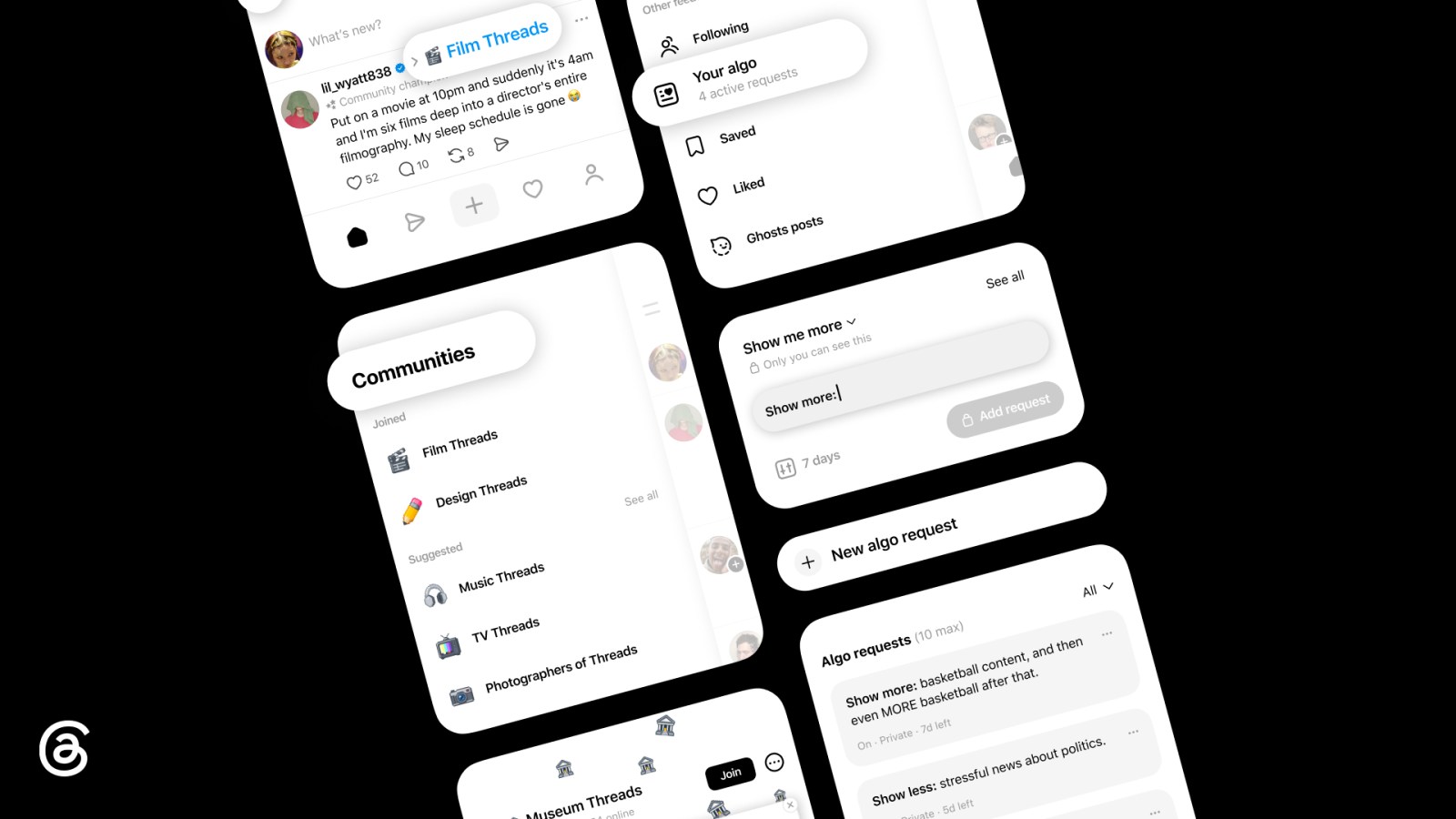
Other updates widen what the product must manage. Meta’s Japan newsroom confirmed AI conversations in mobile DMs in July and public AI mentions in September 2026. On September 15, parental supervision began rolling out globally, adding time and privacy controls through Family Center. A public-conversation service has to accommodate more than its keenest adult posters.
Threads began with an inherited invitation list. Its continuing task is to help people find the accounts, topics and exchanges that make returning worthwhile. The lesson for the rest of us is fairly demanding: distribution can buy you a hearing. After that, you still need something worth hearing.
Take the conversation further
- Open Threads · Threads’ own account · Instagram
- Meta on LinkedIn · Threads product news
- Read Adam Mosseri’s first-year interview
- Watch Colin and Samir interview Adam Mosseri (broader Instagram and creator discussion, 2024)
- Watch Metricool’s Threads walkthrough (the original 2023 interface)