Boris Cherny built the first version for himself. He had arrived at Anthropic in 2024, wanted to learn the company’s API, and made a small tool in the place an engineer could test an idea quickly: the terminal. It let him ask Claude to do things with code and see what happened. Colleagues began using it. Then more colleagues did. The experiment grew into Claude Code, and Cherny became the person explaining why a tool born in an unadorned command line might change how a great deal of software gets made.
There is a tempting short version of this story: an engineer has a clever idea and the future arrives. It leaves out the years in which Cherny learned what sort of problem deserves a tool. He had already built features people used, argued over details that looked trivial from the outside, written a technical book, and crossed the world to join an app he had not tried. Claude Code is the most visible result of that history. Its original shape makes more sense when the history comes first.
The first useful trick
In secondary school, Cherny programmed a TI-83 calculator to help with math work. He also taught himself HTML so his eBay listings for Pokémon cards would sell better. They are modest origin stories, pleasingly short of destiny. Both start with a specific task and a tool close at hand. Cherny later studied economics at the University of California, San Diego, and left before completing a degree to start companies. He has described programming as a practical skill, something learned by making products and seeing what breaks.
At Facebook, that habit put him near the messy edge where product ideas meet large systems. One early project brought chats into Facebook Groups, an attempt to connect the public conversation of a group with the immediacy of Messenger. Cherny recalls that a product manager’s suggestion caught his attention, so he began building. A few more engineers joined. The team tried web and mobile versions. The feature showed signs of life, even if the early experience was rough.
The memorable part is how he checked whether people understood it. Without a user researcher on the team, he went to the cafeteria and showed new features to the workers there. Could they find a way to open a chat? Sometimes they could. Sometimes they could not. A conference room can make an interface feel obvious; a person encountering it between lunch orders is less easily persuaded. The test also captures a constant in Cherny’s work: a working prototype gives people something real to react to.
“If you hit the same problem two or three times, you should probably look around, see if other people are hitting that problem too.”Boris Cherny, on choosing engineering projects
Another Groups project sounds as though it could fit in one sentence: let people interact with a public group without joining it first. Cherny has said the code change could be tiny. The consequences were not. Was someone who followed a group now a member? Could they comment? What should the database call them? An experienced engineer challenged the team’s first approach, and the answer required deeper work. The distinction between a follower and a member is the sort of detail an interface can hide until millions of people depend on it.
He also pushed Facebook Groups onto Comet, the project to rebuild Facebook’s desktop site. The migration meant bargaining for engineers and working with infrastructure teams outside his own organization. Cherny says the Groups team helped shape abstractions other teams would use. It is a revealing early rehearsal for Claude Code: begin with a product problem, work across boundaries, then discover that the local solution can become shared infrastructure.
A book, a meetup, a move
Cherny’s side projects had a habit of becoming substantial. A deep interest in TypeScript turned into Programming TypeScript, published by O’Reilly in 2019. He also started a TypeScript meetup in San Francisco, where he met figures in the JavaScript world, including Node.js creator Ryan Dahl. Cherny has said the experience made an instructive impression: the people whose names appeared on projects and talks were just people building things. It is a wonderfully deflating discovery for a technical scene fond of mythology.
His public GitHub still shows the practical side of that period. There is a tool for compiling JSON Schema into TypeScript declarations, a React state library called Undux, and answer files for readers of his book. The code and the book circle the same problem: as a program grows, how can the people changing it understand what is allowed, what is expected, and what might fail? Types provide one answer. Later, Cherny would work on a tool that could write much of the program, making those questions more urgent.
Then came a move driven by life outside the office. His future wife found a job in Japan. Cherny tried to arrange a way to keep working at Meta there and eventually joined the Instagram team in Tokyo. He has recounted accepting the role without having used Instagram, then installing it before the move. That is a charmingly direct way to join a consumer product: say yes, download the app, learn quickly.
At Instagram, he encountered a culture he describes as attentive to craft, human experience and products people wanted to use. His own site says he prototyped and scaled product and infrastructure ideas there. The shift mattered. The Facebook Groups projects had taught him how a simple behavior can conceal a difficult system. Instagram added a sharper eye for the feeling of using the thing. In product work, correctness is only part of the conversation; a person also has to want to return.
A terminal is a very small stage
Cherny was living in Japan when he first tried a modern language model. He later recalled reading technology news each morning and feeling struck by the new possibilities. Science fiction was another part of the pull. At a lunch with Anthropic cofounder Ben Mann, Cherny mentioned an obscure book and found several people ready to discuss it. He has cited that moment, alongside the lab’s mission, as part of why the company appealed to him.
Once there, he made the terminal prototype. It was a sensible choice for a solo experiment: no elaborate interface, no complicated distribution plan, just a prompt and a way to let Claude inspect and change code. Others at Anthropic tried it. The company developed it into Claude Code, released publicly in 2025. The tool’s first home has remained central to its identity even as it has appeared in other settings. The terminal gives the agent access to the same files, commands and feedback loops a developer uses.
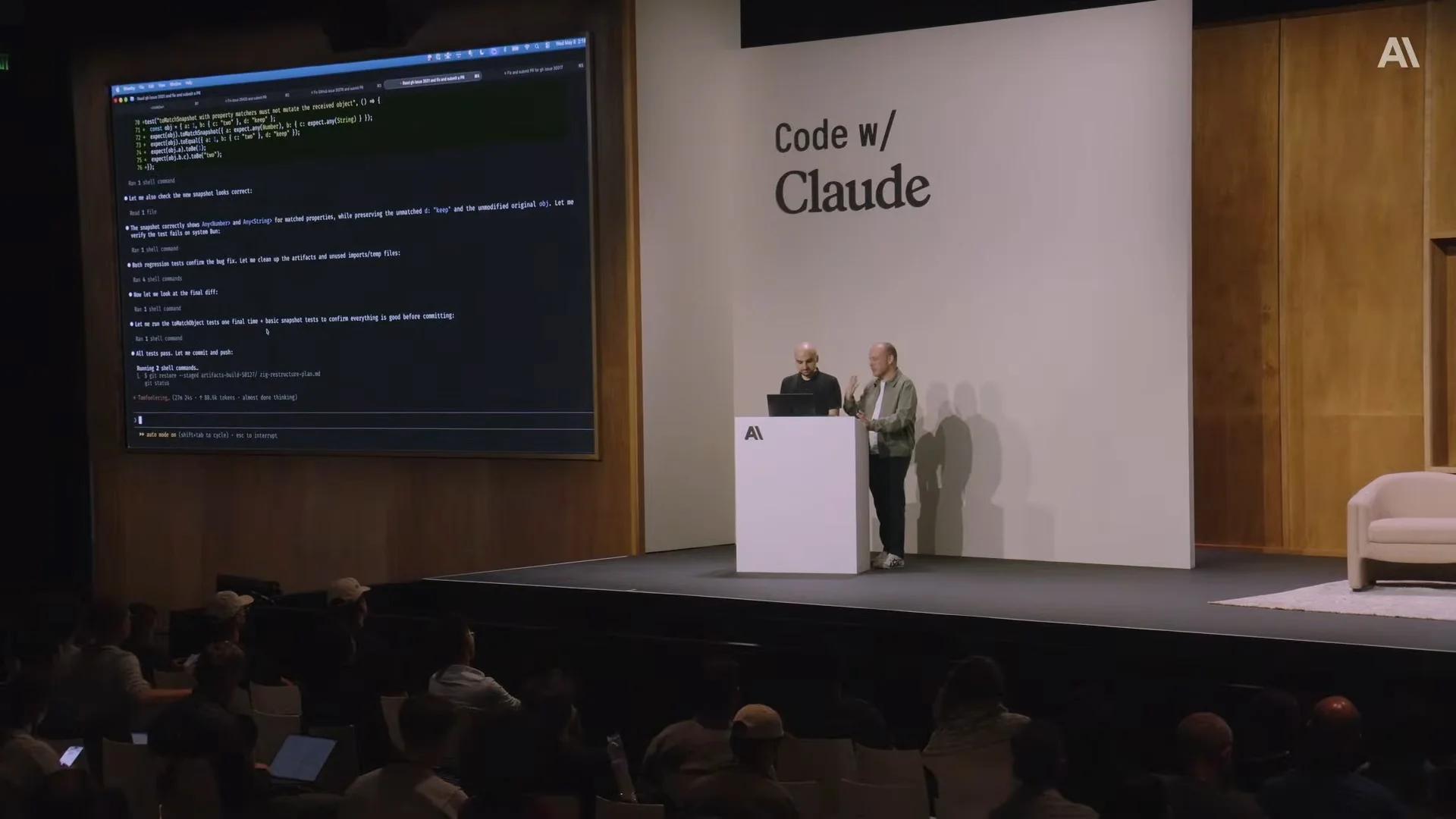
The early versions were hardly effortless. Cherny has said he used the tool for only a small portion of his own coding at first because the models could not yet handle many tasks. His manager urged him to build for the model six months ahead. As later models improved, the bet began to look less speculative. Cherny’s own workflow changed. He describes starting several agents, checking their work, and moving among tasks rather than typing every line himself. The person who wrote a book about precise code now spends much of his day deciding what code should be produced and whether it is good.
“We built the simplest possible thing.”Boris Cherny, describing Claude Code
That simplicity made an unexpectedly broad invitation. Cherny has talked about Anthropic colleagues outside engineering using Claude Code, including sales staff. The company later developed Cowork for tasks beyond code, prompted in part by people who wanted the agent’s help without the terminal. The pattern is familiar from his earlier work: the team builds for an immediate need, then watches what people actually do. A product’s most interesting use may arrive from someone who was not in the original design meeting.
The work after the typing
Cherny’s public comments about AI coding can sound startling when reduced to a headline. He has described code written by agents, teams running many of them, and work that begins on a phone before he reaches a computer. Yet he also talks about quality checks, testing, review and the burden of maintaining what gets built. If an agent can generate more code, a team has more decisions to make about which code belongs. The old Facebook Groups question returns at a different scale: a one-line change can carry a whole product’s assumptions inside it.
He has also said that the work of engineers is changing toward talking with users, coordinating with other teams, choosing what to build and holding the bar for the result. That view has room for both excitement and friction. Faster production can make a good idea easier to test. It can also make a bad idea cheap to multiply. Cherny’s own career offers a useful method for deciding: find a recurring problem, build a small answer, put it in front of real people, and pay attention when they use it differently from the way you expected.
In September 2026, Cherny appeared at the Computer History Museum to discuss Claude Code and the future of AI. It is a long way from using HTML to improve a Pokémon card listing, though the motive is recognizable. The tool changes; the urge to make a stubborn task easier remains. Cherny’s story is not a straight line toward a grand invention. It is a series of practical experiments, each one opening a door to a larger problem.
His personal site offers a lighter final detail: outside work, he likes reading, running and salting things. It is hard to improve on the last item. A person who has helped make computers write code has also reserved a line in his own biography for seasoning.