The reason to use Murf appears at 2:07 a.m., when somebody discovers that slide 34 says “fifteen percent” and the narrator said “fifty.” In the old workflow, that small typo could reopen a recording session, disturb a voice actor, require another export and make a producer contemplate a new career in forestry. In Murf Studio, it is a text edit. Correct the line, regenerate the block, listen once and go home.
That unglamorous rescue is the product’s real pitch. Murf is for people who need speech to behave like editable media: instructional designers maintaining a library of courses, marketers changing a product demo every quarter, a global team localizing explainers, or a developer whose phone agent cannot leave callers waiting through a synthetic half-second shrug. It is less compelling for a filmmaker chasing one singular, emotionally jagged performance. A good actor still owns that room.
First, decide which Murf you mean
The name now covers two neighboring businesses. Studio is the familiar one: paste a script, audition a voice, divide the copy into blocks, adjust delivery and line it up with pictures, video or music. Murf Dub takes an uploaded piece of media and creates localized versions. The API side is voice infrastructure, with Gen 2 aimed at controlled, finished narration and Falcon 2 tuned for live conversation.
That division matters. A lovely ten-second demo tells you almost nothing about a customer-support call. In live speech, the pause before an answer can matter more than the color of the voice. Falcon 2, released in August 2026, is Murf’s answer: streaming speech, more than 150 voices, 35-plus languages, code-switching inside a sentence and a launch price of one cent per generated minute. Murf says time to first audio sits below 100 milliseconds and the service can scale to thousands of simultaneous sessions. Those are vendor figures, so serious deployments should replay their own scripts under their own traffic.
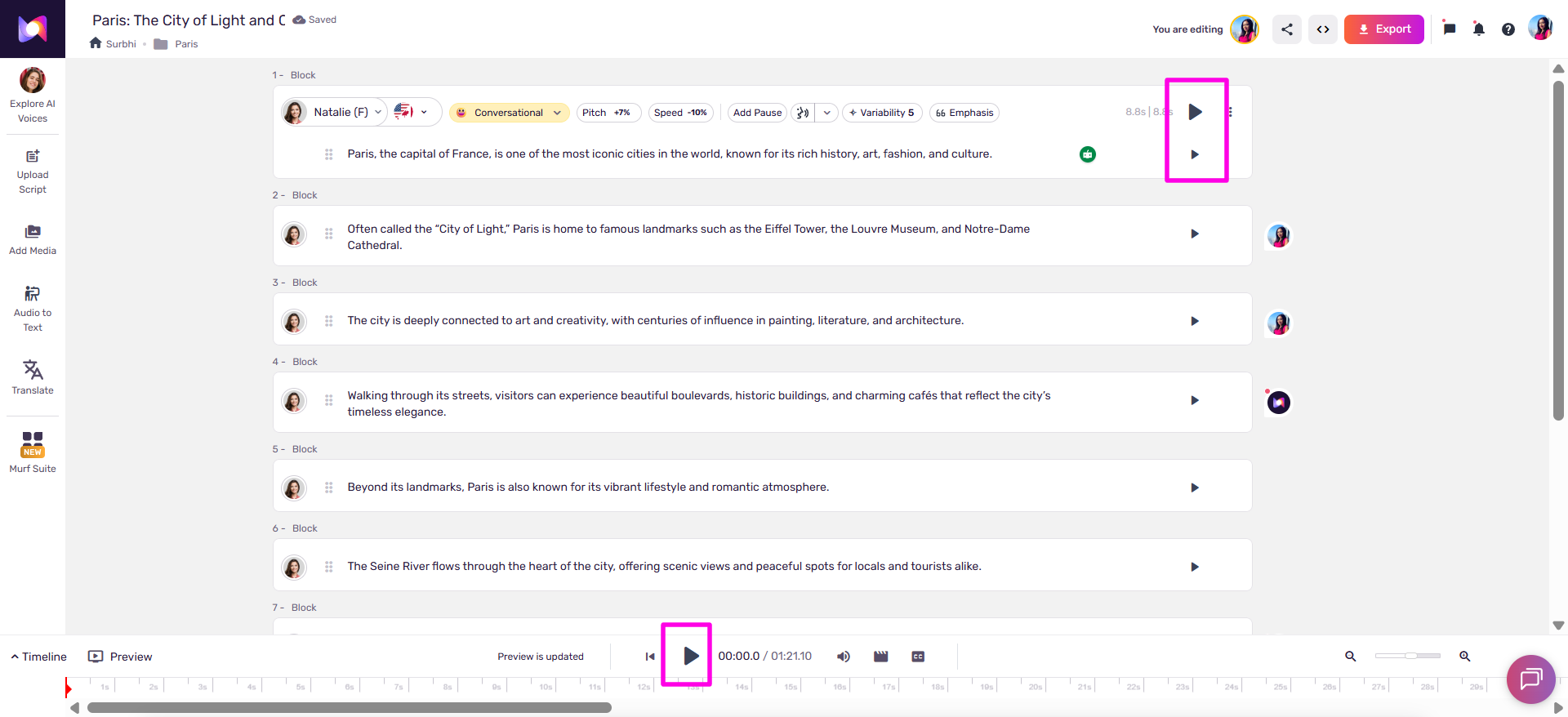
The editor is the product
Murf’s voice picker filters by language, accent, gender, age and use case. Once a voice is chosen, the practical tools begin: speed, pitch, pauses, emphasis, variability, a pronunciation library and “Say It My Way,” which lets a user guide a stubborn name or phrase. The script is arranged in blocks, so one sentence can be changed without cooking the entire project again. A timeline below holds voice, visuals and background audio; a preview window shows whether the narration and picture agree.
This is why Murf often makes more sense to learning-and-development teams than a raw text-to-speech endpoint. An Articulate course or safety video is not one WAV file. It is 80 clips, three reviewers, a pronunciation sheet and a stakeholder who will move a comma on Friday. Murf also plugs into Canva, Google Slides and PowerPoint, and publishes workflows for Adobe Captivate, Audition, Notion, WordPress and Webflow. The production furniture is already in the room.
“The pronunciation option made it really dynamic.”A March 2026 Trustpilot reviewer, after making phone-tree messages and voicemail
Dubbing is the next useful layer. A user uploads audio or video, allows Murf to detect the source language, picks one or more destinations, and reviews the processed versions. Recent export changes allow combinations of original and dubbed files with burned-in subtitles. Enterprise customers can add linguistic review. It is a credible workflow for training and product education, but “supports the language” is not the same as “understands the joke.” A native reviewer remains cheap insurance.
| Job to be done | Best Murf lane | Why it fits | Watch closely |
|---|---|---|---|
| Training and explainers | Studio + Gen 2 | Block edits, pronunciation control, media timeline | Generation minutes and long-project lag |
| Global video versions | Murf Dub | Multi-language projects, subtitle exports | Native review, idioms, speaker matching |
| Phone or support agent | Falcon 2 API | Streaming, low latency, concurrency, code-mixing | Test p95 latency on your full stack |
| One dramatic performance | Human actor or audition widely | Emotional specificity still benefits from direction | Do not mistake a clean voice for a moving one |
What reviewers love, and where they swear
Across G2’s large review pool, the recurring compliments are easy use, natural voices, customization and quality. The recurring complaints are just as instructive: expense, pricing, limited voices and pronunciation issues. Trustpilot’s smaller pool is more polarized. Happy reviewers describe quick production and useful control. Unhappy ones mention timeline friction, interface lag and renewals they did not expect. The split is believable. Murf removes a complicated craft process, then replaces it with software limits and software billing.
The YesPress ear test
The important caveat is that “200-plus voices” is a catalog number, not a guarantee that your language, accent and temperament will produce 200 good options. One corporate narrator may sound steady and persuasive while another turns a product name into a minor plumbing accident. Run a sample containing names, abbreviations, dates, currencies, questions and the most emotional paragraph in the project. Listen on headphones and a cheap phone speaker. Then ask someone who speaks the target language at home.
There is also an ethical question parked inside every cloned syllable. Murf says its voices begin with real performers who choose to participate, receive compensation and sign transparent contracts. The company advertises SOC 2 and ISO 27001 certification, GDPR compliance and HIPAA-related controls, with data residency in multiple regions and on-premise deployment for stricter enterprise environments. Procurement teams should still inspect the contract: consent to train, rights to output, retention, deletion and acceptable-use enforcement deserve nouns and dates.
The price is simple until it isn’t
Read the checkout, not an old blog postThe public Studio lineup currently starts with a free trial, followed by Creator, Business and custom Enterprise plans. Monthly list prices displayed in 2026 are $29 for Creator and $99 for Business, while annual offers can reduce the effective monthly cost. The free trial includes ten minutes of generation, but blocks downloads and commercial rights. Murf’s API is metered separately; new accounts receive trial credit, and Falcon 2 launched at $0.01 per generated minute. Dubbing has its own pay-as-you-go and Enterprise path.
Minutes are where a tidy price card becomes accounting. Generation time, transcription, project slots, editors and downloads are not interchangeable. Regenerating a line can consume allowance. Paid minutes may not roll over. Murf’s terms restrict many refund requests after 24 hours or more than ten minutes of text-to-speech use. A team should calculate its real monthly script volume, revision rate and seats, then confirm those exact limits in the live checkout. Screenshots from last year are archaeological artifacts.
- Paste a real 90-second script, not the demo copy.
- Include the ugliest acronym and every proper name.
- Change one sentence after timing the visuals.
- Export the format your editor actually needs.
- For agents, load-test complete round-trip latency.
- Record the renewal date and rollover policy.
Who should buy it?
Buy Murf Studio when the voiceover is part of a repeatable content operation and the person doing the work is not an audio engineer. It is particularly sensible for training departments, product marketers and small production teams that value fast revisions, shared assets and predictable voices. Choose Murf Dub when localization volume makes manual handoffs painful, but budget for human review. Consider Falcon 2 when an agent needs to speak quickly at scale, especially across multilingual or code-mixed conversations.
Keep shopping if the voice itself is the star. ElevenLabs is the obvious audition for expressive range; WellSaid Labs belongs on corporate shortlists; Cartesia competes for real-time agents; Descript makes sense when speech editing sits inside a broader audio and video workflow. Cloud services from Amazon, Google and Microsoft may fit teams already committed to those platforms. No leaderboard can hear your brand name, legal disclaimer or regional accent the way your audience will.
The company itself has traveled quickly. Ankur Edkie, Sneha Roy and Divyanshu Pandey started Murf in October 2020 with ten voices after running into the nuisance of producing and updating voiceovers. Murf raised a $1.5 million seed round in 2021 and a $10 million Series A led by Matrix Partners India in 2022. At that point it reported 22-fold ARR growth over 18 months and more than one million synthesized projects. Today it describes a 10-million-plus user base and work with more than 300 Forbes 2000 companies. Its About page displays a lower six-million unique-user counter, a useful reminder that growth numbers often arrive with different clocks and definitions.
Murf earns its place when revision is the enemy. The voices are capable, the controls are practical and the surrounding editor saves more time than a waveform beauty contest reveals. Studio is the safer recommendation for structured, frequently updated narration. Falcon 2 is the more interesting bet for developers, where speed and economics can outweigh theatrical range.
The smart purchase is a small one: build a real project on the free allowance, count every regeneration, and make the most skeptical native speaker on the team listen. If the workflow survives that afternoon, the booth can stay in the browser.