The average camera bag is a small museum of future intentions. The portrait lens waits for a face. The telephoto waits for a bird. The ultra-wide waits for architecture, or perhaps a kitchen that needs to look like a ballroom. Tamron has spent decades making a practical wager against this collection: if one lens can cover more of the day without becoming a dumbbell, people will accept a few carefully chosen compromises.
That wager is visible in the 12–20mm F2.8 announced by Tamron Americas in July 2026. The full-frame zoom costs $1,699 for Sony E-mount and $1,799 for Nikon Z. It holds F2.8 across the range, weighs 570 grams in its Sony version and focuses down to 7.1 inches at 12mm. None of those numbers is magical alone. Their combination is the point: an unusually wide view, a bright aperture and a body that need not occupy its own postal code.
Tamron Americas, based in Commack, New York, is the regional arm that sells, markets, teaches and services the Japanese parent’s optics. Its public face is photography - lenses for Sony, Nikon, Canon and Fujifilm bodies - but the less photogenic half of the catalog includes surveillance, machine-vision, automotive and medical optics. One side photographs the fox. The other may inspect the factory line that made the camera.
The first product was competence
Tamron did not begin with a heroic lens launch. In November 1950, Fujio Watanabe and Takeyuki Arai established Taisei Optical Equipment Manufacturing in Urawa, now part of Saitama City. Thirteen employees polished binocular lenses on a subcontract basis. The company’s own history mentions “challenges and errors” without turning them into a cinematic disaster. What failed first, in other words, was ordinary production work.
The response was more interesting than the mystery. The workshop kept raising its manufacturing standard and became reluctant to deliver anything it considered unsatisfactory. In 1952, it incorporated with 2.5 million yen in capital and Uhyoue Tamura joined. Tamura was an optical designer, and his arrival helped establish an in-house design section. The company’s eventual name is a nod to him.
Service work taught the process. Design talent turned that knowledge into a product.The useful version of Tamron’s origin story
A year later came Wide Vision Binoculars 7×35 11°, the first product it designed and manufactured itself. It sold well. By 1957, the company had a 135mm F4.5 interchangeable camera lens and the T-mount, a universal mount system intended to let one lens design work across multiple SLR bodies. Tamron’s early move was not simply “make glass.” It was “remove an expensive incompatibility.”
Arai also chose telephoto lenses, a field larger camera companies were not prioritizing. That narrow wedge led to an affordable 95–205mm zoom, interchangeable mount systems and, eventually, the all-in-one zooms most closely associated with Tamron. The U.S. subsidiary arrived in New York in 1979. In 2023, the regional business changed from Tamron USA to Tamron Americas as it took direct responsibility for Canada and the photo and industrial optics businesses across North and South America.
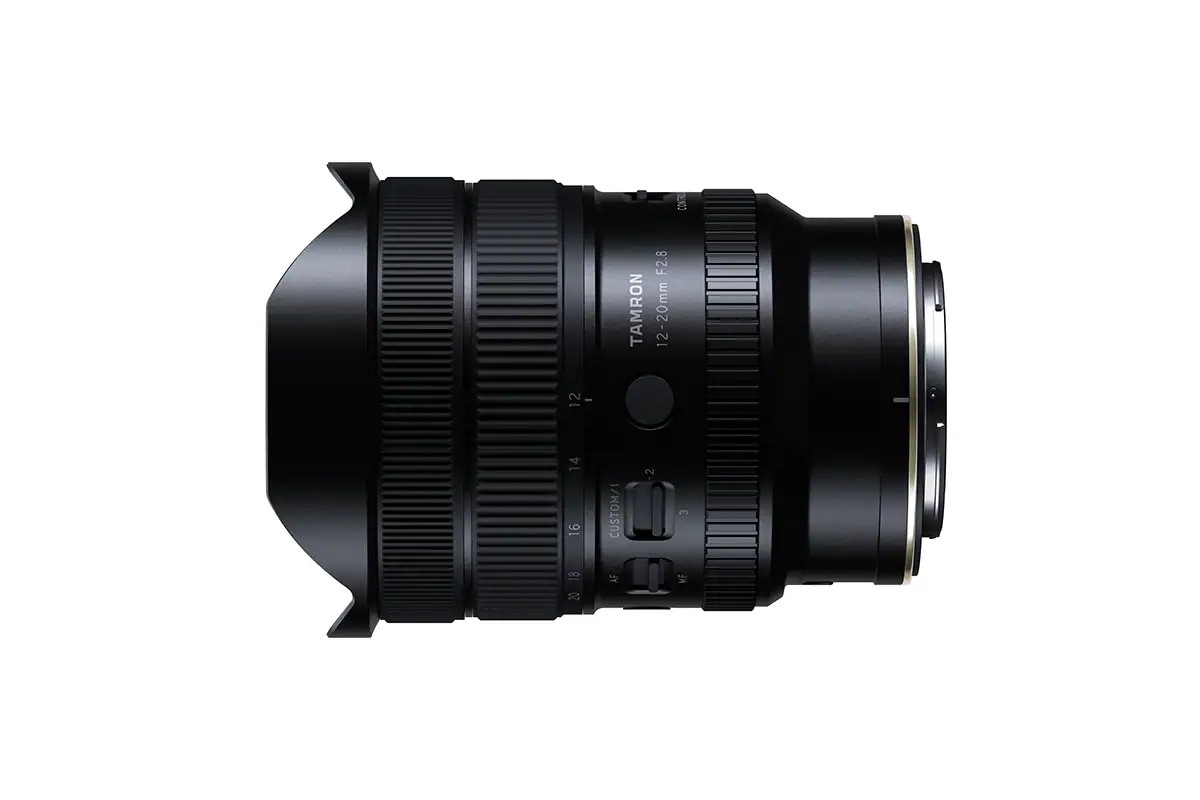
The 12–20mm F2.8 looks like a sensible black cylinder until 12mm makes the nearest chair believe it is the lead actor. Official product image courtesy of Tamron Americas.
Affordable is the headline. Range is the strategy.
Tamron sits in a crowded market. Sigma is the closest third-party rival; Tokina, Samyang, Viltrox and Laowa press from different directions. Then come the camera makers’ own lenses, which can offer tighter body integration, proprietary autofocus behavior and the confidence of one logo on the receipt. Tamron cannot win every specification fight, and it does not need to.
Its strongest products redraw familiar boundaries. The 35–150mm F2–2.8 stretches a fast event lens from environmental portraits into meaningful telephoto territory. The 50–400mm begins where a conventional wildlife zoom is still behaving like a normal lens. The 25–200mm G2 starts wider than its 28–200mm predecessor without giving up the telephoto end. The new 12–20mm reaches the kind of width once associated with specialty glass while keeping a zoom ring and constant aperture.
This is why “cheaper than first-party” undersells the company. Price gets a buyer to compare. A focal range the camera brand does not offer can end the comparison. For a wedding photographer, one 35–150mm may replace two lens changes. For a traveler, the 25–200mm can move from a street to a distant detail. For an APS-C owner, the stabilized 17–70mm F2.8 reaches roughly 25.5–105mm on Nikon and 27.2–112mm on Canon. The product is not merely glass; it is fewer missed seconds.
The lens now has an afterlife
The modern Tamron product extends beyond the barrel. Compatible lenses connect by USB-C to Tamron Lens Utility, which can update firmware and alter focus-ring behavior, button assignments and video functions such as A-B focus. In July 2026, firmware version 3 for the 25–200mm G2 improved maximum magnification to at least half-macro between 25mm and 70mm, reaching 1:1.7 around 35–50mm. A lens purchased as hardware became meaningfully better at close-ups after launch.
Software cannot fix every optical limitation; physics remains famously unwilling to download a patch. But it changes the relationship. Tamron gets a channel for correcting behavior and adding utility, while the owner gets a reason to register the lens and revisit the brand. The same feedback loop appears in free Tamron University classes, photo tips, a creator collaborative, retailer workshops and a multilingual magazine.
The commercial machinery is similarly layered. Tamron Americas sells directly online to U.S. addresses and through authorized dealers in the United States, Canada and Mexico. Eligible authorized purchases carry a six-year limited warranty. Registration can unlock extra benefits, while gray-market products receive no regional warranty or repair. That boundary is strict, but strategically coherent: lower-priced third-party hardware feels less risky when the buyer can identify the official channel and the company standing behind it.
The hidden portfolio behind the pretty pictures
Photography supplied roughly 71 percent of parent-company net sales in 2025, but Tamron’s optical skill travels. Its industrial catalog includes network-surveillance lenses, fixed-focal machine-vision glass, stabilized camera modules, board-mount lenses, automotive optics, medical components, high-precision molds and a beam-divergence module for laser communications. These buyers do not care about creamy portrait bokeh. They care whether a system sees reliably at speed, under vibration or in difficult wavelengths.
That breadth matters because consumer-camera demand can move with travel, smartphones and new body cycles. Industrial optics let the same core capabilities - optical design, coatings, precision molding, actuators and high-volume manufacturing - earn revenue in markets with different rhythms. It also makes Tamron harder to summarize, which may be why the company is known as a lens bargain instead of a compact optical conglomerate.
What a smaller company can steal
Tamron’s story does not offer a universal recipe. Optics require capital, patience and tolerances that would make a casual dropshipper perspire. Still, the sequence contains four moves that transfer neatly to less physical businesses.
Subcontract polishing exposed the young company to process, quality and customer expectations before it carried full product risk.
Manufacturing knowledge became proprietary products only after optical design came inside the building.
Telephoto and universal mounts were wedges. Today, unconventional zoom ranges attack weight and lens-changing friction.
Dealers, direct sales, education, registration, firmware and repair turn a one-time purchase into an ongoing relationship.
The most copyable idea is the willingness to define a product by what the customer no longer has to do. A broad zoom saves a lens change. A compact barrel saves weight. Licensed mounts save adapters. Firmware saves a service visit. Education saves part of the learning curve. Each subtraction is small; together they form a position that is more durable than a discount sticker.
Where the playbook breaks
- It fails when the platform owner withholds access. Tamron’s Nikon Z and Canon RF products depend on licensing, and native makers still control deeper integration.
- It weakens when a buyer values the widest aperture, smallest prime, fastest burst compatibility or single-brand service above zoom convenience.
- It becomes a bad bargain if range creates unacceptable weight or optical compromise. The 35–150mm is versatile, but at roughly 1.2 kilograms it is not everyone’s travel lens.
- It does not travel to businesses without hard-earned operational expertise. “Do more with less” works only when less remains reliable.
Tamron’s latest lenses are not cheap in the everyday sense. A $1,699 ultra-wide is a considered purchase. Yet the company has kept the logic of its first successful moves: learn the process, own the design, find the neglected gap and make the compromise legible. Seventy-six years after 13 people polished binocular glass for somebody else, Tamron is still selling control over light. The more useful promise is control over the bag.