OpusClip's founding team once had a problem more awkward than a weak sign-up chart: people would use its product only when they were paid. The product was Opus Studio, an AI livestreaming tool built during the pandemic with generated memes and audience interactions. After three months, it had attracted roughly 200 users. Founder Young Zhao has said the team offered them $20 or $30 to sit through feedback sessions. When the stipends ended, the users did not return.
A founder can explain that away as bad onboarding, premature distribution or insufficient education. OpusClip took the less flattering signal seriously. The livestreaming studio looked clever, but it did not save customers meaningful time or help them earn more. Inside it, however, was a clipping feature that did something painfully specific: find useful moments in long footage and turn them into short social videos.
That feature became OpusClip. An early version reportedly shipped as a Discord bot. It found 1,000 users in three days, then 5 million signups within seven months. By 2024, the company said it had passed 6 million users and reached eight-figure annual recurring revenue. Its current media kit claims more than 16 million creators and businesses. The contrast is the company in miniature: 200 users who needed a stipend versus millions who wanted to skip the timeline.
The product was hiding inside the product
At its simplest, OpusClip ingests a long video or link and returns a batch of short clips. The software selects moments, reframes horizontal footage for vertical feeds, generates animated captions, removes filler and silence, and can add B-roll. A "virality score" grades candidates on qualities including the hook, flow, engagement and trend. Users can edit the result, apply a brand template and publish or schedule it to connected accounts.
The job is not mysterious. A 60-minute podcast might contain six good shorts, but somebody must scrub the hour, mark the boundaries, crop two speakers for a phone screen, correct captions and export several aspect ratios. For a creator posting daily, that chore repeats with the reliability of laundry. OpusClip sells fewer hours of laundry.
The change of mind came from behavior, not a brainstorm. Livestream users stopped when the subsidy stopped. Clipping users asked to pay for faster queues, higher-resolution exports, more downloads and more credits. The first product created curiosity. The second removed work. If you need a one-line definition of product-market fit, that reversal is better than most diagrams.

“If you can't make more money or save time for your users, they just feel like it's a cool product.”Young Zhao, co-founder and CEO
From clipping button to video operating system
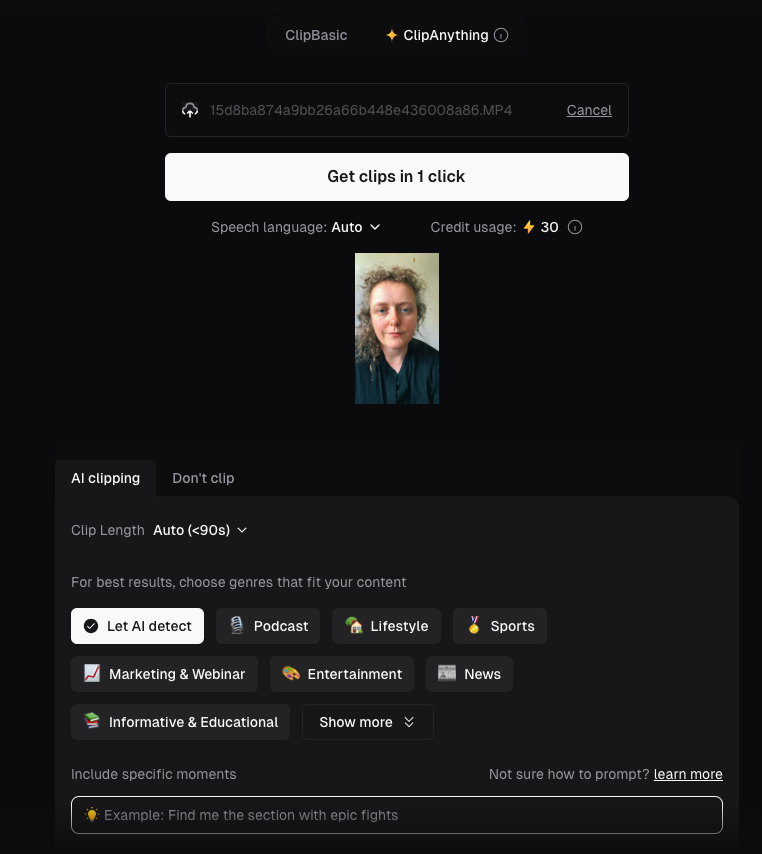
Clipping was the wedge, not the boundary. In 2024, OpusClip introduced ClipAnything, a multimodal model meant to look beyond transcripts. A natural-language prompt can ask for a specific play in a sports video, a visual gag in a vlog or a low-dialogue moment in a show. The model considers visual, audio and sentiment signals, expanding beyond the talking-head podcasts on which automated clippers were built.
ReframeAnything tracks moving subjects while changing aspect ratios. OpusSearch indexes a creator's video catalog so an old remark can be found and republished while a topic is timely. Agent Opus goes in the other direction: instead of starting with footage, it can start with an idea, article, script or audio file and coordinate research, scripting, storyboarding, generation and editing. API, Zapier and MCP integrations turn the product into plumbing for teams and software agents.
That widening matters because the customer list widened too. OpusClip began with beginner creators. It now names Billboard, Univision, iHeartMedia, Visa, LinkedIn, HubSpot, GitHub, FloSports and Audacy alongside individual creators. A solo podcaster wants a good clip before lunch. A newsroom wants throughput, permissions, brand consistency, integrations and an audit-friendly human review. Same bottleneck, very different consequences.
What it costs - and what the price leaves out
OpusClip uses a freemium, credit-metered subscription model. Its public monthly pricing currently lists Free at $0, Starter at $15 and Pro at $29, with lower effective pricing for annual Pro billing. Business contracts are custom. The free plan carries a watermark and tighter editing and export limits; Pro adds team seats, brand templates, more sources, multiple aspect ratios, a scheduler, B-roll, dubbing and limited API access.
The software price is easy to calculate. The true cost includes review. Captions can mishear technical language. Automatic crops can choose the wrong speaker. A statistically promising segment can land without the emotional setup that made it work in the long video. One-click output is a first draft with unusually low friction, not a waiver from editorial responsibility.
| Choice | Best when | The trade |
|---|---|---|
| OpusClip, Vizard, Klap, Quso | You need many social cuts from repeatable long-form footage | Fast selection; uneven taste |
| Descript, Riverside, CapCut | You want transcript-led or hands-on editing in one workspace | More control; more operator time |
| Premiere Pro, DaVinci Resolve | Every frame, mix and approval matters | Maximum control; highest labor |
OpusClip's difference is the length of its automated path: multimodal moment selection, scoring, reframing, captions, B-roll, branding, scheduling, archive search and developer interfaces. Competitors overlap almost every individual feature. The advantage is having the sequence under one roof, plus the usage data to tune which moments people keep, reject and publish.
Where the magic button stops
It will not work as promised when the source footage is poor, the important moment depends on long context, the subject moves unpredictably, the terminology defeats transcription, or the brand requires legal and editorial review. It is also a bad bargain when selecting the moment is the creator's distinctive craft. In those cases, automate the mechanical pass and keep the judgment.
The company grew because the output was measurable
In August 2024, OpusClip announced $30 million in total funding, including a Series A led by Millennium New Horizons, with participation from Samsung Next, DCM Ventures, GTMfund, AI Grant and others. In March 2025, SoftBank Vision Fund 2 invested another $20 million at a reported $215 million valuation. The company said its users had generated more than 172 million clips during the prior year and accumulated more than 57 billion views.
Those figures are company-reported, and views do not prove that every clip changed a business. They do explain the investor logic. Video supply keeps growing. Every webinar, podcast, interview, livestream and conference recording creates more inventory than a team can manually distribute. If OpusClip can turn a dormant archive into a daily publishing queue, it sells both efficiency and another chance at reach.
The culture appears built around that feedback loop. In 2025, executives said the company received more than 5,000 customer requests a week and met with up to 20 creators weekly. Its second-year update claimed a redesigned editor that was 50 percent faster and 60 percent smoother, and a ClipAnything revision that found 32.5 percent more relevant clips. The percentages are less revealing than the operating posture: watch what gets accepted, changed, exported and posted.
What to copy
Measure return behavior. Isolate the feature that removes a recurring cost. Launch it before building the grand interface. Expand into adjacent steps only after the wedge pulls users in.
What not to copy
Do not confuse more output with better output. Do not automate the part customers value as their taste. And do not use a virality score as permission to stop watching the clip.
The useful promise is smaller than “viral”
The word “viral” appears throughout OpusClip's marketing because it is the desire that brings people to the door. No editor can guarantee an audience. What OpusClip can credibly offer is a lower cost per attempt. It can produce ten plausible clips while a human editor is still finding the first clean boundary. That makes daily publishing possible for a small team and archive mining practical for a large one.
The most interesting thing about OpusClip, then, is not whether an AI can identify the funniest 42 seconds of a podcast. It is how quickly a company changed when its first answer was wrong. The team paid people for feedback, noticed they would not stay, and followed the feature that users pulled from their hands. The tool now promises to remove more and more of video production. Its own origin argues for keeping one human skill close: noticing what people actually choose.