The first character to explain Hedra’s future was not a polished corporate spokesperson. It was a photograph with a song. Michael Lingelbach, the company’s founder, had been playing with funny music made on Suno. He fed one track and one picture into the model his team was building. The picture sang. He thought other people might enjoy doing the same thing.
That seems a small revelation, but small revelations are often easier to sell than grand visions. Hedra rushed a basic web interface into shape, improved the model alongside it, and launched a research preview in June 2024. Lingelbach later described the push as roughly six weeks. He also described an early audience of about a million users, while acknowledging that the precise number had blurred in memory. What he remembers clearly is the mistake that followed: the team treated a popular feature as proof that it understood the whole job.
The short version
- Hedra makes AI models for expressive, speech-driven characters and offers a studio for creating images, audio and video.
- Its customers include solo creators, agencies, marketers, educators, sports teams and developers.
- The first talking-character launch drew a crowd; interviews showed the company needed a fuller creative workflow.
- Paid plans start at $15 a month; enterprise contracts and usage-based APIs serve bigger teams.
The trouble with applause
Before Hedra, Lingelbach acted in theatre and studied AI at Stanford. The theatre experience helps explain his fixation on performance. A digital character that merely opens its mouth is a technical demonstration. A character that seems to mean a line can carry a scene. Hedra’s first model put that distinction in front of millions of curious people, but curiosity is an unreliable accountant.
The initial service was free. The team added features users requested, then monetized and reached a reported million dollars in revenue within several months. Yet Lingelbach said the product still felt incomplete. He did customer support, interviewed hundreds of people and watched customers move between Hedra and other tools. They could make a speaking face; they could not easily finish all the work around it. He concluded the team had solved a piece of the problem, not the workflow.
“Free users can be really false signal.”Michael Lingelbach, on the first launch
The distinction was costly in time. Lingelbach says the company rebuilt its technical approach and product while growth slowed. This is the less photogenic part of the story: a viral release can produce enough noise to drown out the customer who would pay. Hedra’s change of mind came from watching what people did after the clip was made.
A whole studio grew around a face
Hedra still has a reason to begin with a face. Its own Character-3 and Avatar models animate a still portrait from audio, matching speech with facial motion. A marketer can make a presenter deliver an explainer; an educator can give a recurring illustrated guide a voice; a creator can make a mascot sing. The inputs are plain enough to understand: an image, a voice track and instructions. The output may be a short social clip or a longer talking segment, depending on the model.
But the current product is larger than the talking head. The studio’s creative agent helps plan and generate across formats. It offers Hedra’s own models beside outside models such as Veo, Kling and Seedance. That is a revealing choice. Hedra is both a model maker and a place to use competitors’ models, because a production team will choose the engine that suits the shot. The company has added shared workspaces, team billing, a developer API, SDKs, a command-line tool and an MCP connection for agents. The center of gravity has moved from making one clip to keeping the entire process in one place.
The pricing shows the same spread. Individual paid subscriptions are listed at $15, $30 and $75 per month, with different credit allowances. Teams and enterprises can buy collaboration and custom capacity. Developers can pay for generated output through the API; Hedra’s Avatar page lists rates from 2.5 cents to 6.25 cents per second by resolution. Those numbers describe the generation bill, not the total price of a finished campaign. A useful calculation includes discarded takes, editing and approval.
Three customers, three different jobs
The Texas Rangers’ ballpark entertainment team has 81 home games to fill. Its first Hedra experiment turned television announcers into babies calling big plays. The joke worked. The team says it now uses Hedra regularly, with ChatGPT upstream and Adobe Premiere and After Effects downstream, for mascot animation, still-image motion and quick graphics. In its account, a visual that once took days in Cinema 4D and After Effects can take 10 to 15 minutes to prompt. That is a team estimate for its work, not a promise for every production.
Exact Agency found a different use. Its chief creative officer, Joni Dobrov, says the agency delivered an eyewear campaign in 15 days under a deadline that would normally have allowed four or five months of conventional production. She values Hedra for character micro-expressions, but also for the speed of showing an idea before a client commits a large budget. Her method is practical: make a small, persuasive clip, see what the client understands, then refine the selected direction.
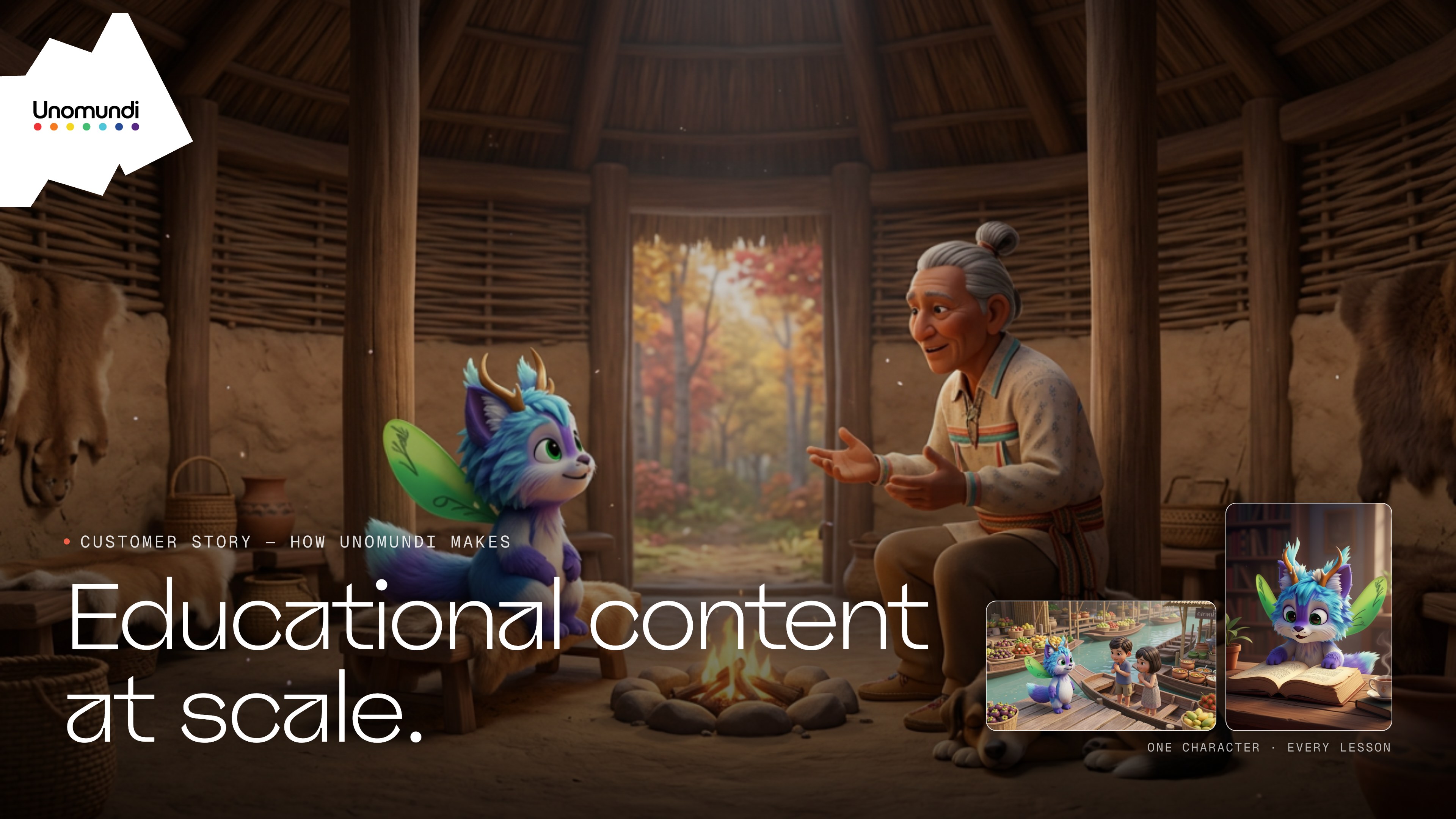
Unomundi, an education app, supplies the third example. It wanted its character Una to guide children through cultures around the world. Rather than build a 3D rig, the team animates a still image with Hedra Avatar, driven by voice audio from ElevenLabs. Unomundi says a group of three or four people produced material covering 160 countries in under half a year. It estimates its broader technology stack made the library roughly 40 times cheaper than its internal conventional-production benchmark. The team still defines the curriculum and reviews scripts and finished videos; real places are shown with real footage, while invented scenes are deliberately stylized.
Each customer is buying a different thing: the Rangers buy speed between innings, Exact buys a faster conversation with clients, Unomundi buys continuity for a character across many lessons. The common feature is iteration. A face that can be regenerated makes a revision less expensive to attempt. It does not make judgment automatic.
The new arithmetic of a reshoot
For a reader tempted to copy Hedra, the first useful lesson comes from its own false start. Make something people share, then watch what they do next. Lingelbach’s interviews revealed adjacent tasks his first product left unfinished. A second lesson comes from customers: use cheap drafts to decide what deserves expensive attention. Exact’s small concept clips help clients see the idea; Unomundi’s reviewed pipeline separates generation from editorial responsibility.
There are limits. Hedra’s own guide recommends clean audio, a clear and well-lit portrait, and generating several versions before selecting one. Exact’s team has described reflections that got a dress wrong. Unomundi found that different models could turn the same scene into wildly different action. The output may be fast; dependable work still needs inspection. For a project demanding exact physical continuity, documentary truth or a perfect first render, the time saved at generation can return as review and repair.
The practical test: start with one approved image and one clean voice track. Make several short versions, count the usable ones, then price the whole process - generation, editing and review. A clip that costs pennies to render can still be expensive to trust.
Hedra’s public scale is notable. In May 2025 it said more than 2.5 million users had made over 10 million videos; its current enterprise page claims more than 20 million users and 45 million content generations. It announced a $32 million Series A led by Andreessen Horowitz’s infrastructure fund, following a $10 million seed round. Those numbers help explain why a small lab now talks about infrastructure as well as storytelling. The more interesting measure is whether the next person comes back to make the next scene. That, unlike a singing photograph, takes listening.