Akash Nigam's first useful product may have been a failure. Blend, the group-messaging app he built with Evan Rosenbaum and their team, did not become the social phenomenon they expected. The crew worked from a tiny room attached to a mosque in San Jose. They imagined each new app taking off. Sometimes, Nigam later recalled with cheerful cruelty toward his younger self, there were 16 users.
There was an exit opportunity, though not a glamorous one. The founders turned it down. Then they noticed Bitmoji sitting near the top of the App Store and began to suspect the more interesting business was not another place to type. It was a new way to appear.
That suspicion became Genies. The company launched publicly in 2017 with large-headed, customizable avatars that could act out the news. The pitch was cheeky, occasionally chaotic and very much of its moment. Yet beneath the novelty was the question Nigam had been asking through every messaging experiment: how can a person show more of themselves online than a text box permits?
“The one thing that's been really consistent in my life is the obsession around how humans interact.”Akash Nigam, 2023
A Silicon Valley childhood, with cleats
Nigam grew up in Mountain View in an Indian household, close enough to Silicon Valley's machinery that entrepreneurship felt less like a distant career than neighborhood weather. He has joked that his soccer teammates were surrounded by venture capitalists, chief executives and engineering directors. He played for years and still describes himself as a right midfielder in a Los Angeles recreational league. The detail is small but fitting: he likes systems built from roles, motion and other people.
At the University of Michigan, where he studied computer science and economics from 2010 to 2014, the startup itch became a company. His parents offered a bracing compromise: raise $3 million or stay in school. He raised the money and left during his final year. The wager bought him freedom, not certainty. Blend struggled, the acquisition conversation went nowhere, and the team kept building.
The important habit formed in the wreckage. Nigam did not remain loyal to the group-chat interface. He remained loyal to the behavioral puzzle behind it. Text had not been enough. Photo and video messaging had not been enough. Avatars offered a third route, one in which identity could be exaggerated, edited and performed without requiring the physical person to be present.
Keep the obsession. Be less sentimental about the product carrying it.
The avatar changes outfits
Genies has lived several corporate lives in public. The first version turned daily events into animated scenes starring the user. A 2018 app, launched with Gucci as its first advertiser, leaned into customization and messaging. Then celebrities became the distribution strategy. Offset was among the first artists onboarded. Justin Bieber, Cardi B, J Balvin and other performers later used official digital versions of themselves in promotions, videos and fan interactions.
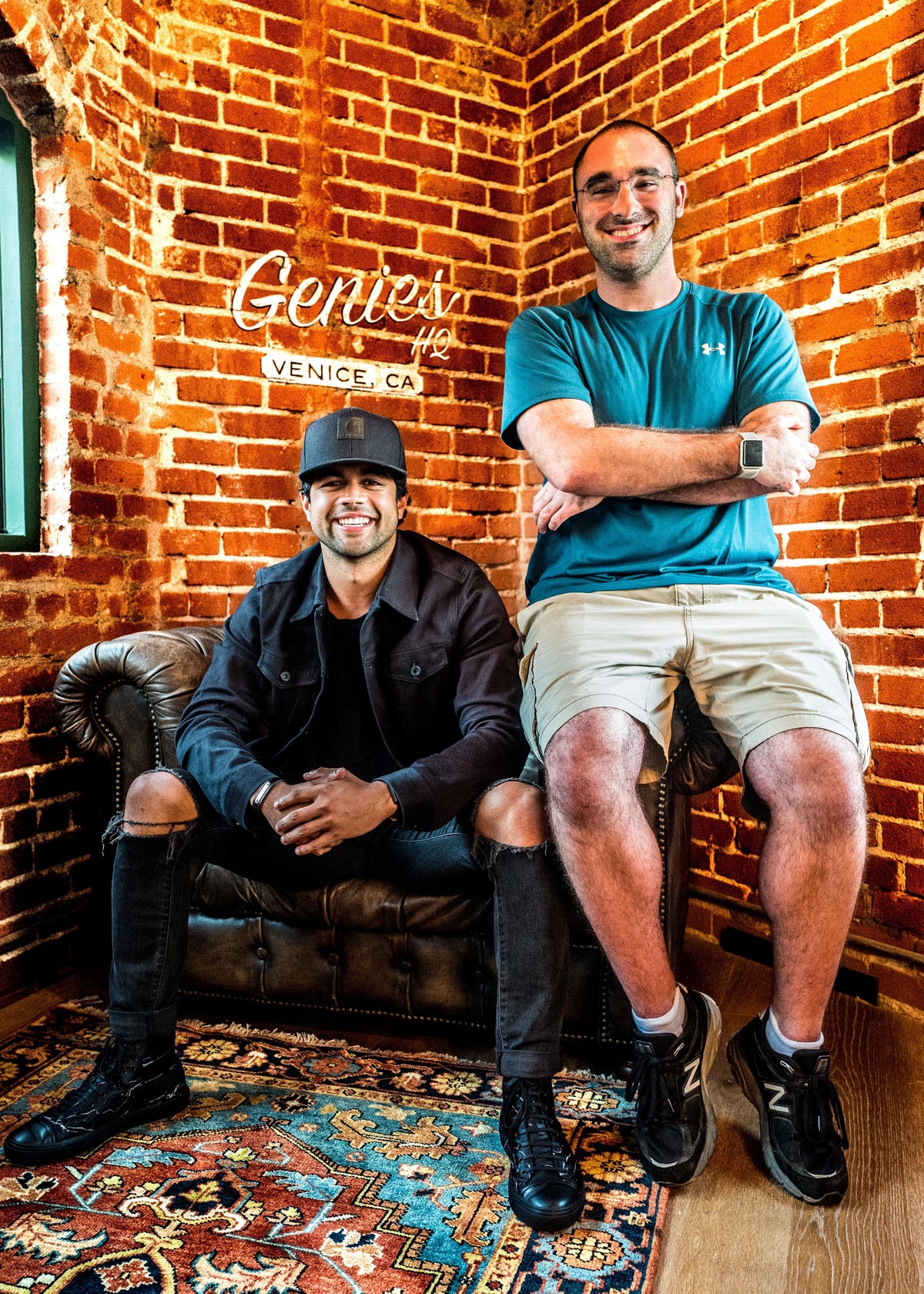
The celebrity work was more than decoration. It taught the company that an avatar could be a media asset, a piece of authorized identity and a small business all at once. Partnerships with Universal Music Group and Warner Music Group made Genies an official provider of avatars and digital goods for their artists. Fashion became part of the grammar. An avatar needed clothes, and clothes required designers, rights, marketplaces and an economic model.
By 2019, Nigam and Rosenbaum had landed on Forbes' 30 Under 30 list for consumer technology. In 2021, Genies raised a Series B led by BOND. In April 2022, Silver Lake led a $150 million Series C that valued the company at a reported $1 billion. Former Disney chief Bob Iger invested and joined the board. The funding arrived during the fevered Web3 period, when virtual goods could command more attention than the people wearing them.
Capital for the character stack
A valuation is a photograph, not a plot. Nigam later described 2022 as a bad year for the company. Genies then spent years refining the technology while the prevailing vocabulary shifted from metaverse and NFTs toward generative AI. The avatars stayed. The explanation changed.
From digital twin to playable intelligence
The current Genies thesis begins with a mild complaint about chatbots: they have brains but little presence. Nigam argues that an AI personality should be seen, dressed and played with, not only summoned for a task. A useful assistant waits in a box. A character can join a game, remember a player and react with a gesture. Genies calls this the visual layer for large language models.
Blend
Group messaging and early experiments in social behavior.
Avatars
Custom characters for everyday users and famous talent.
Creators
Digital fashion, asset ownership and design tools.
AI characters
Memory, behavior, game play and cross-platform identity.
In 2025, the company announced a partnership with Unity and released an Avatar SDK through the Unity Asset Store. The move matters because it changes Genies from a destination into infrastructure. Developers can add customizable avatars to their own projects, manage clothing and inventory, and build toward characters that retain memory or respond to players. Genies has also shown user-generated tools for making fashion, props and games. Nigam wants a single character to cross experiences while adapting to their visual styles.
This is the mature version of the early instinct. The news-reacting cartoon has become an engine-ready asset. The app has become a framework. The static likeness has become an aspiring participant. In 2026, Genies added a partnership with MLB Players, Inc. to create approved AI characters of baseball players, bringing the questions of likeness and control into a category already uneasy about both.
“Characters are going to represent the new UI/UX of the internet.”Akash Nigam on Genies' AI companion thesis
Nigam's argument is aimed especially at generations that socialize inside Roblox, Fortnite and other playable spaces. If interaction is already a game, an AI relationship cannot feel like a help desk. It needs motion, context and a reason to be around when nobody is fixing a tire or planning dinner.
A second vehicle called HUMANS
The same fascination now extends beyond Genies. Nigam and Andrew Tan founded HUMANS, an AI-native venture studio that invests in and builds companies intended to increase human potential. Its public portfolio ranges from AI recruiting and cybersecurity to space-based data centers, agent testing and digital memory. The name is a useful tell. Even when the product is synthetic, Nigam frames the assignment around people.
He is unusually candid about the awkward chapters of building. The early apps “sucked.” Some years at Genies were good; some were bad. In a company note shared publicly, he wrote that 2025 felt like a new founding moment after years of building and refining. He emphasized the culture that produced the progress, not merely the contracts. This is not modesty in the monkish sense. Nigam is comfortable making very large predictions. He simply seems willing to let the old predictions acquire dents.
That mixture of bold thesis and public self-mockery is part of his operating style. At Genies, internal rituals have included Charms, a recognition system, and the Genies Games, complete with dodgeball. One year-end post wandered happily from engineering plans to a holiday party, animated movies and the moment the team decided to move its office toward the beach. A company building personality as software should probably have some personality in the building.
The question that survived
There is no guarantee that the internet will choose a portable avatar as its next interface. Platforms tend to prefer identities they control. Game engines disagree about formats. Famous people want reach and rights at the same time. Ordinary users may adore a character in one context and abandon it in another. Interoperability is a technical challenge, a business negotiation and, occasionally, a grand word looking for a practical door.
But Genies has earned the right to be read as a long experiment rather than a sudden AI conversion. Nigam was trying to make personality portable when the dominant object was a sticker. He kept trying when the object became an NFT, and he is still trying now that it has a language model for a brain. The label changes. The human appetite beneath it is familiar: we want to be understood, and we enjoy choosing the costume.
The most reusable part of Nigam's story is therefore not a forecast about avatars. It is a method for surviving forecasts. Choose a human behavior that moves slowly. Build products around it quickly. When the market's nouns change, check whether your question still matters. If it does, dress it for the next room and keep walking.