There is an occupational hazard in building avatars: eventually, everyone asks to see your face. Jake Adams has mostly declined the invitation. The co-founder and chief operating officer of Genies has a public record measured in careful handfuls - a professional profile, a few launch reactions, several crisp explanations of where game characters ought to go next. In a company whose product is identity rendered visible, Adams has chosen the operator's old camouflage: the work.
That restraint makes his tenure more interesting, not less. Genies has worn a surprising number of outfits. It arrived publicly in 2017 with personalized cartoon doubles that acted out the news. It found an audience among celebrities and brands. It moved into digital fashion and collectible goods, then built a marketplace during the Web3 rush. It spent years on interoperability, user-generated content, and a platform called Parties. Now it presents avatars as a visual layer for artificial intelligence: characters with a look, memory, behavior, and a role inside games.
Adams stayed in the same executive seat while the sales vocabulary performed several costume changes. That is the useful fact about him. A founder can fall in love with a product. A chief operating officer has to fall in love with what remains after the product has met reality.
His education adds one clean line to an otherwise economical biography. Adams attended the University of Michigan's Ross School of Business from 2011 to 2014. The school sits inside the origin story of the wider founding network around Genies, though Adams has not turned his own years there into a public parable. What followed is easier to measure: a long executive tenure in a private technology company where consumer taste, entertainment rights, venture capital, and 3D production all had to occupy the same spreadsheet.
The face changed. The skeleton remained.
The first Genies proposition was easy to picture and difficult to sustain. Users assembled a stylized likeness, and the app dropped that character into short animated scenes tied to culture and daily news. The idea had charm, a large waitlist, and obvious trouble deciding whether it was a social tool, a news product, or a very elaborate sticker pack. Yet the underlying work was real. A digital person needed a body, clothes, motion, expressions, scenes, and enough identity to be recognized as yours.
When celebrity use became the stronger signal, Genies leaned toward talent. Digital doubles appeared in social posts and entertainment campaigns. Partnerships with Warner Music Group and Universal Music Group gave the company access to artists and their likenesses. Gucci and other brands made virtual clothing. The consumer novelty was becoming a rights, production, and distribution business, which is precisely the sort of turn that makes an operator earn the second half of the title.
In April 2022, the company raised $150 million in a Series C led by Silver Lake. The deal valued Genies at $1 billion and named Adams alongside co-founders Akash Nigam and Evan Rosenbaum. Then came an announcement rarely paired with a giant cheque: farewell. Genies said it would turn away from the usual publicity circuit and put its attention inside the company, on building avatar ecosystem tools.
Silence can be theater, of course. Startups are not monasteries, and a funding release is still a funding release. But the choice fits Adams' public style. His visible contribution is not a stream of futurist declarations. It is continuity across the revisions. The company kept returning to difficult, unglamorous pieces: rigging a 3D model, fitting an item to different bodies, preserving an inventory, translating motion, and making one identity behave coherently in another environment.
One company, five public vocabularies
An operator's sentence
When Genies unveiled its Parties technology stack in November 2024, Adams shared the announcement with one sentence: “Excited for this next chapter as we get our technology into the hands of others looking to build their own Parties!” It is cheerful launch language, but the object of the sentence matters. He did not celebrate a prettier avatar. He celebrated transfer.
Getting technology into other people's hands is the moment a studio begins trying to become infrastructure. Parties were pitched as customizable gaming platforms built around intellectual property. The pieces included AI-driven avatars, user-made games and goods, and assets designed to move between environments. Instead of Genies producing every experience, developers and partners would build with its stack.
“Most AI avatars as we think of them today simply don't exist in gaming.”Jake Adams, 2025
Adams sharpened that argument during Genies' 2025 partnership with Unity. Existing options, he said, tended to be static 3D characters or chat-based companions, rather than dynamic, intelligent figures ready to participate in a game and adapt to a user's behavior or context. It was a practical criticism disguised as a philosophical one. A character that can talk but cannot play is still waiting in the lobby.
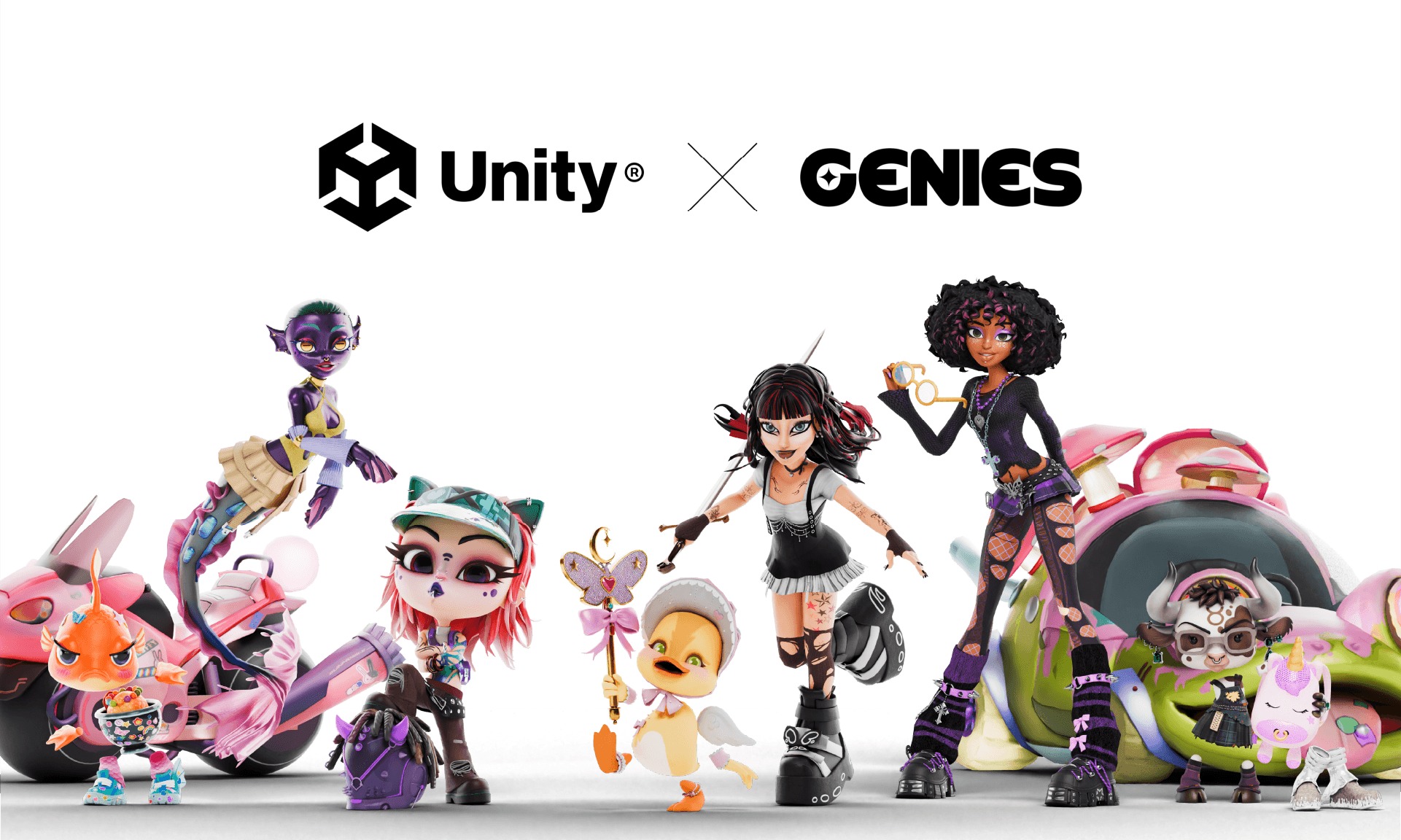
Unity matters because it is where many game makers already work. The partnership proposed to place Genies avatar and user-generated-content tools in the Unity ecosystem, first through its asset marketplace and later through deeper editor integration. Distribution, in this case, does not mean another app icon on a phone. It means shortening the distance between an idea and a developer's working scene.
The marathon inside the machine
Adams' clearest explanation begins with a runner. Imagine that a player has recently started training for a marathon and chooses to share that information. A game might respond with a fitness-themed quest, scenic running trails, or a companion who tracks progress and offers encouragement. A favorite athlete might even appear with advice. “It makes the experience feel personal, alive, and directly connected to your world,” Adams said.
It is a revealing example because it gives the avatar something to do beyond resembling its owner. The character becomes an interface between the player's life and the game. The delight is easy to describe. The consent, context, memory, art direction, gameplay logic, and data plumbing are the operator's invoice.
How Adams' marathon example becomes a game
This is also where Genies' earlier lives become less embarrassing than useful. Digital fashion taught the company that every garment is a compatibility problem. Celebrity work taught it that identity is also intellectual property. Marketplace experiments treated virtual objects as inventory. Interoperability work asked whether the inventory could travel. Parties supplied a destination. AI gives the character a reason to react once it arrives.
The market labels were never interchangeable. An NFT is not a game character, and a celebrity campaign is not a developer platform. Still, each era financed or refined part of the same technical anatomy. The clever move was not predicting which buzzword would survive. It was keeping the expensive capabilities when the word around them expired.
The quiet half of a public company story
Adams is based in San Francisco, according to his professional profile, while Genies makes its headquarters in the Los Angeles area. He attended the University of Michigan's Ross School of Business from 2011 to 2014. Beyond those spare coordinates, his biography resists the customary founder treatment. There is no public origin fable polished to a shine, no childhood anecdote recruited to explain the cap table, no endless archive of podcast confessions.
What exists instead is a decade-long professional association with one improbable idea: that a digital self should be more than a profile picture. Adams has served as COO while Genies accumulated famous partners, venture backing, and technical ambition. He also joined the committee overseeing Humans, an investment initiative created to back companies using Genies avatars. His network is visible through the institution more than through self-advertisement.
That does not make him mysterious. It makes the evidence pleasantly proportional. Adams talks about builders, dynamic characters, and gameplay that responds to context. He appears interested in the point at which a demonstration becomes a system. His public personality is the personality of a useful tool: specific, restrained, and happiest when somebody else can pick it up.
Genies still has much to prove. Interoperability is an old dream with a formidable graveyard. Personalized AI can become invasive if its permissions are careless. Developers adopt tools because they save time, work reliably, and improve the game, not because a concept deck promises the next internet. The partnership logo is the opening screen, not the completed campaign.
Yet Adams' long tenure offers a modest reason to watch. He has already operated through several futures that arrived, peaked, and changed their names. The avatar survived because its skeleton kept acquiring useful joints. Now Genies wants that figure to enter a game, remember why it came, and do more than wave. For a quiet executive, it is an eloquent ambition.