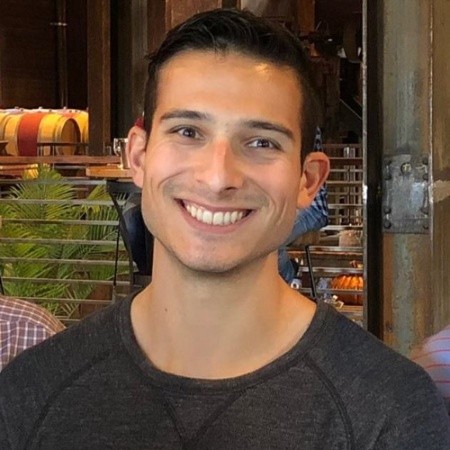
Origin Story
Everyone Was Karl
In January 2014, Graham Gaylor shipped the first version of VRChat. Every single user who logged in
inhabited the same avatar - a generic character named Karl, standing in a virtual cafe that Gaylor had
pulled directly from the Unity Asset Store. There were no custom avatars. No worlds to explore.
Just Karl, multiplied, in a borrowed room.
That's the kind of detail that either discourages you or reveals something essential about a founder's
instincts. Gaylor didn't wait for the platform to be ready. He waited for people to show up - and they did,
recruited from Reddit's fledgling Oculus community, the same crowd who'd backed the Rift on Kickstarter
back when VR was still a speculation.
Gaylor was one of them. He'd backed the Oculus Kickstarter in 2013 and received one of the first DK1
developer kits. Where most early adopters were content to use the hardware, Gaylor asked what was missing:
a place to actually be social in it. He found his co-founder Jesse Joudrey the same way - heard him on a
podcast pitching ideas for a VR social platform, reached out, and the rest followed.
Customizable identity is VRChat's secret sauce - and the path to monetization.
- Graham Gaylor, Voices of VR Podcast #1666
The Decision That Changed Everything
Version 0.3.5, March 16, 2014
Two months after launch, Gaylor made the call that defined VRChat's trajectory. On March 16, 2014,
version 0.3.5 shipped with one new feature: users could upload their own avatars. Not choose from a list.
Not customize a preset. Upload. Anything.
It seems obvious in retrospect. It wasn't at the time. The early VR market was focused on hardware
capabilities, engine benchmarks, and field-of-view specs. Gaylor was focused on identity. He understood
something the industry wouldn't widely acknowledge for years: in social VR, who you look like matters
more than where you are.
Today VRChat hosts millions of custom avatars - anime characters, fursonas, photorealistic humans,
and creatures that have no analogue in physical reality. The platform has hundreds of thousands of
user-created worlds. Almost none of this was designed by VRChat the company. It was built by
the community that Gaylor's early decisions invited in.
The "VR Not Required" Insight
While competitors built for headset owners, Gaylor made VRChat playable on regular PC - mouse,
keyboard, no Rift required. The counterintuitive bet: most social VR users wouldn't own a headset.
The market would be defined by the people who showed up, not the hardware they carried. He was right.
Today VRChat runs on PC, Meta Quest, Pico, Steam VR, iOS, and Android.
Company Architecture
Building the Infrastructure for Infinite Worlds
Gaylor studied mathematics and computer science at Vanderbilt University, graduating in 2014 - the same
year he co-founded VRChat. He had brief stints at GREE International and a few months as a software
engineer at Zynga before VRChat became the full commitment. The pattern of a technical founder who
understood both systems and social dynamics runs through every major product decision.
The tech stack reflects that origin: Unity for world and avatar creation (the SDK is publicly available
and free), with a backend built on AWS, MongoDB, Node.js, and Python. The platform uses spatial audio
for natural conversation dynamics, full-body tracking support where hardware allows, and Udon - a custom
scripting language for world builders who want to go beyond what the basic tools offer.
VRChat is, in engineering terms, a content delivery problem at unusual scale. The content isn't Netflix
episodes. It's real-time 3D environments and avatar physics, built by amateurs and professionals alike,
that need to perform consistently across wildly different hardware configurations. That Gaylor has kept
this running for over a decade - through VR winters, metaverse hype cycles, and their own internal
restructuring - is itself an achievement.
Funding & Growth
$95.2M and a $500M Bet on Social Space
VRChat Funding Rounds
Series A (2018) - GFR Fund
~$5M
Series C - Makers Fund, HTC, Brightstone
$10M
Series D (Jun 2021) - Anthos Capital
$80M
The June 2021 Series D, led by Anthos Capital with participation from Makers Fund and GFR Fund,
valued VRChat at $500 million. The timing was no accident - VR adoption had accelerated, Meta
(then Facebook) had announced its metaverse pivot, and VRChat was the only platform that already
had a massive user base, a functioning creator economy in embryo, and years of community trust built.
Gaylor used the capital to scale the team. By 2024, VRChat employed over 130 people - a significant
organization for what remained, at heart, a community platform. When economic conditions tightened,
he made the harder call: a 30% workforce reduction in June 2024. His framing was direct - long-term
financial stability. No spin, no pivoting to new narratives. Just the math.
Craft & Leadership
The Long View on UGC Monetization
On the Voices of VR podcast in late 2025, Gaylor talked through the thing that's occupied him for
years: how to let creators earn money on a platform built entirely on user-generated content, without
breaking the culture that made the content worth anything. The Avatar Marketplace, launched in June 2025,
is the first major answer.
It's a deceptively difficult problem. VRChat's community has always valued freedom - the ability to
upload anything, be anyone, build any world. Introducing commercial transactions into that ecosystem
risks making the platform feel like a store. Gaylor's position, stated plainly: the identity is the
product, and if you can let people earn from who they build themselves to be, you've found something
durable.
The AWE Hall of Fame induction in 2025, alongside co-founder Jesse Joudrey, acknowledged what the
industry has taken a while to fully recognize: VRChat was doing the metaverse before the metaverse
became a word that required quarterly apologies to shareholders.