wealthtech
(43)
The Caterer Who Learned to Speak Wall Street
Marie Swift built a national agency by mastering one small, difficult language: how financial advisers earn trust. Three decades later, its best marketing lesson is still the least glamorous one - know the business before you reach for the megaphone.

The Rudin Group Put the Lighthouse Out of Work
April Rudin built a consultancy around a small, stubborn observation: rich people are still people, and financial brands should stop talking to them like marble buildings. The result is a specialist firm that turns technical expertise into language clients might remember.
intelliflo wants to give financial advisers their week back
The software behind thousands of advice firms is taking aim at the work after the meeting. Its customers show why fewer forms can matter as much as smarter financial forecasts.
Dynamic Planner built a business on the second opinion
People wanted a human to check the computer’s financial advice. Dynamic Planner turned that habit into a software business, then rebuilt it when its original customers changed course.
Valuefy wants to end wealth management’s spreadsheet relay
The wealth technology company grew out of portfolio analytics. Its bigger bet is that advisers can do better work when the client, the trade and the back office share the same numbers.
Envestnet Built the Operating System for Advice. Now It Has to Make the Whole Thing Feel Like One Product.
After 25 years of buying and building the plumbing behind financial advice, Envestnet reaches roughly a third of U.S. advisors. Its new challenge is less about adding another tool and more about making a sprawling suite behave like one coherent machine.

Snappy Kraken Put the Boring Parts of Advisor Marketing on Autopilot - Without Pretending Trust Can Be Automated
Seven thousand advisors use Snappy Kraken to keep prospects warm, clients informed and compliance teams out of panic mode. Its real product is not content - it is follow-through.
Advisor360° Spent 20 Years Learning the Advisor Workday. Now It Wants AI to Run the Busy Parts
The wealthtech company began as an internal system built for people who actually advise clients. Its next act is a bigger bet: unify the data first, then let AI handle the administrative drag.
Orion Built a $6 Trillion Control Room - Now Advisors Have to Learn Every Switch
The Omaha wealthtech company spent 27 years turning portfolio accounting into an advisor operating system. Its scale is the pitch; making all those acquired parts feel like one product is the test.
Addepar Built the $9 Trillion Answer to One Expensive Question: What Do We Actually Own?
Addepar turned the family office's ugliest spreadsheet problem into a global data platform. The software is powerful, costly and increasingly difficult to replace - which is precisely the point.
WBI’s $1 Billion Day Was the Easy Part. Then It Had to Build the Advisor’s Operating System
WBI made its name by launching 10 active ETFs and attracting more than $1 billion in a day. Its harder, more revealing act is Cy - a platform built to turn an advisor’s paperwork, portfolio math and operational drag into one guided workflow.
InvestCloud Put $4 Trillion on One Screen. The Hard Part Is Making the Plumbing Disappear.
InvestCloud grew by turning the wealth industry’s jumble of old systems into modular software. After a $1 billion deal made the platform much bigger, its next test is harder: make public and private assets feel like one portfolio without making the machinery visible.
CAIS Built a $2 Billion Business Out of Wall Street's Least Glamorous Problem
Independent advisors wanted private markets. What they lacked was the institutional plumbing. CAIS spent 17 years assembling access, diligence, education and paperwork into one operating system - and turned the boring middle into a company valued above $2 billion.

Wealthbox Bet Advisors Would Use a CRM They Didn't Hate - Now It Wants AI to Run the Follow-Up
A clean interface got Wealthbox into thousands of advisory firms. A $200 million bet now asks whether that beloved system of record can become the system that does the work - without turning into the bloated software it set out to replace.
A Client Rejected His Financial Plan. Asset-Map Turned the One Page He Kept Into a Business
Financial planning kept producing thicker reports. Adam Holt's client wanted the scribbled one-page map instead. Asset-Map built a fintech company around that awkward, useful rejection.
FMG Turned the Compliance Headache Into a Marketing Machine
Financial advisors are supposed to market constantly and phrase everything carefully. FMG built a business by making those two demands coexist - then bought the missing pieces.
The $120 Billion Spreadsheet Problem Canopy Wants to Retire
The richest portfolios often run on the poorest plumbing. Canopy turns bank feeds, PDFs and private assets into one reconciled record - then gives family offices and wealth managers something rare: a number they can defend.

The Rails Under Your First Slice of SpaceX
Templum is the roughly 30-person infrastructure company quietly wiring private markets - the reason a SoFi member can now buy into OpenAI, Anthropic, or Stripe without a private banker.
The $10 Door Into Wall Street's Private Room
Fundrise started by letting neighbors buy a piece of a Washington property. It now manages billions across real estate, credit and venture - an ambitious attempt to give ordinary investors institutional-style access without pretending private assets are as simple as stocks.

Exinity
Exinity grew out of online forex, then began placing the same market machinery inside an investing app, a prediction game and even Roblox. Its wager is that the next generation will learn finance in the digital spaces it already inhabits.
Opto Investments
Opto is building the operating system behind bespoke private-market programs - turning fund formation, diligence, subscriptions, capital calls and reporting into one continuous workflow for wealth managers.
Doxim
For 25 years the Ontario-born, Michigan-based software company has done the unglamorous work behind your bank statement - turning paper-bound financial communications into omnichannel conversations for thousands of regulated institutions.
BETA DATA
The Shanghai wealthtech firm arming banks with AI advisory workbenches - now expanding across Asia from Singapore and Hong Kong.
Wealor
Wealor is a San Francisco startup building an AI-native platform for wealth managers. It creates a single source of truth across wealth management, tax, and legal, then runs specialized AI agents that automate back-office work directly inside firms' existing legacy systems using APIs and browser automation. Backed by Y Combinator (Spring 2026 / P26), it targets an industry that oversees roughly $90 trillion on infrastructure built decades ago, where advisors report spending most of their day on administrative work rather than with clients.
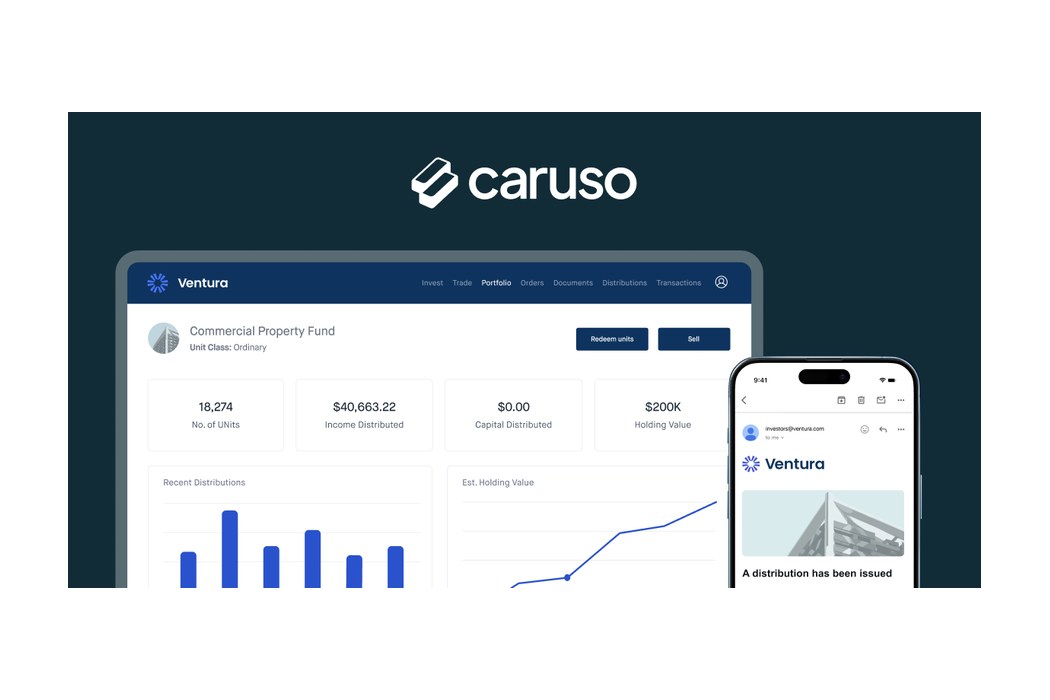
Caruso
Caruso is an AI-native fund administration and registry platform for private markets, built to replace the spreadsheets, manual workflows and fragmented tools that fund managers have long relied on. Founded in 2023 and headquartered in Sydney with offices in Dallas and Auckland, Caruso unifies investor onboarding, capital raising, fund accounting, registry operations and investor reporting into a single system, offered as software, outsourced services, or a hybrid of both. More than 80 fund managers running 900+ funds and $55B+ in assets under administration use the platform, including enterprise clients such as Centuria Capital Group.
DiligenceVault
DiligenceVault is a New York-based fintech company that runs a cloud, AI-native platform for investment due diligence. Founded in 2014 by former Citi risk head Monel Amin, it replaces the manual world of PDFs, spreadsheets and email with a connected system where asset allocators and asset managers exchange DDQs, RFPs, operational due diligence reviews, ESG data and Form ADV monitoring. The platform connects a network of more than 20,000 managers and tens of thousands of users across 150-plus countries, and is backed by Goldman Sachs Growth Equity.

Farther
Farther is a New York-based technology-driven wealth management firm that pairs human financial advisors with a proprietary 'Intelligent Wealth Platform.' Founded in 2019 by Taylor Matthews and Brad Genser, the company gives advisors an all-in-one digital ecosystem for financial planning, investing, tax optimization, and estate planning, while offering clients a family-office-style experience. After a $150 million Series D led by General Atlantic in 2026, Farther has grown to roughly $23 billion in recruited assets and ranks among the fastest-growing financial services firms in the United States.
IMTC
IMTC is a New York-based fintech that builds a cloud-native, AI-enhanced platform for fixed income investing. It combines portfolio construction, optimization, order management, risk and compliance, and reporting into one system, helping asset and wealth managers customize bond portfolios and separately managed accounts at scale while automating manual workflows. Founded in 2017 and led by CEO Russell Feldman, the company raised a $12M Series A in December 2025 led by Nyca Partners.

Nitrogen (formerly Riskalyze)
Nitrogen, formerly Riskalyze, is an Auburn, California wealth-management software company that helps financial advisors grow their firms. It invented the Risk Number, a way to quantify an investor's risk tolerance and align it with their portfolio, and has expanded into a connected suite covering proposal generation, investment research, financial planning, client engagement, compliance and AI-assisted advisor workflows. More than five million investors have received a Risk Number, and the platform snaps into the gap between a firm's marketing, CRM and asset platforms to create a consistent client experience.
Percent
Percent is a New York-based fintech company building the technology infrastructure for the private credit market. Its platform digitizes the full lifecycle of private credit transactions - sourcing, structuring, syndication, surveillance and servicing - connecting corporate and asset-based borrowers, underwriters and accredited investors on a single, transparent marketplace. Founded in 2018 (originally as Cadence) by Nelson Chu, Percent has powered roughly $2 billion in transaction volume and offers short-duration, high-yield private credit deals with lower minimums than traditional channels.