A financial advisor can draft a thoughtful note about a market wobble, send it to the right clients, survive compliance review, notice who clicked, remember to call the interested households and update the CRM. Or the advisor can advise clients. Snappy Kraken exists because doing both, week after week, is the sort of virtuous intention that quietly becomes a folder named “marketing” and dies there.
The Florida company sells a marketing operating system for financial advisors. It bundles prebuilt campaigns, original content, email, social posts, text messages, lead capture, advisor websites, compliance workflows, CRM synchronization, analytics and AI-assisted writing. Solo practices can run it themselves. Larger RIAs, broker-dealers and insurance marketing organizations can centrally approve and distribute work across hundreds or thousands of advisors. A premium tier supplies people to execute the plan.
That sounds like a long feature list because it is. Yet the product makes more sense when viewed as a chain. A prospect encounters an advisor, leaves a signal, receives useful follow-up, visits a credible site, takes another action and eventually talks to a person. Snappy Kraken is trying to keep each handoff from dropping the prospect on the floor.
A service business taught the founders what software had to remember
Before Snappy Kraken, co-founder and CEO Robert Sofia ran Platinum Advisor Strategies, a consulting and coaching business that reached roughly 800 advisors at its peak. The useful part was not a grand theory. His team watched tactics work in real advisory practices. They learned how client events, referrals, niche positioning and regular communication could compound. The limiting part was delivery: it was still a services company.
Snappy Kraken, founded in 2016 by Sofia, marketing leader Angel Gonzalez and technologist Bradley DeLoatche, converted that fieldwork into repeatable software. The principles stayed familiar; the method moved from seminars, manual calendars and one-off execution into triggered sequences. As Sofia has put it, the old process was bricks and mortar. The new one is digital.
“Your contact list is your most powerful asset.”Robert J. Sofia, co-founder and CEO
That line contains both the pitch and the catch. Snappy Kraken is not primarily a lead marketplace. It is strongest after an advisor has a relationship, an audience or a credible way to attract one. The platform can segment a list, send material, notice engagement and prompt action. It cannot make a neglected database accurate, invent a persuasive specialty or place a timely phone call on the advisor's behalf.
A polished campaign still loses when it lands on a beige website
The first version of the company concentrated on campaigns. Then a larger weakness became obvious: an excellent email could deliver a curious prospect to a bland, generic or disconnected advisor website. The campaign had done its job, but the destination had not. Sofia concluded that the company could not serve the whole journey without owning more of its front door.
In 2022, Snappy Kraken acquired Advisor Websites, a business it already knew through an integration partnership. The choice was build or buy. Buying brought an operating website platform, scheduling tools, clients, employees and a compliance review dashboard that larger firms already liked. It also roughly doubled Snappy Kraken's workforce and user base at the time. The purchase price was not disclosed.
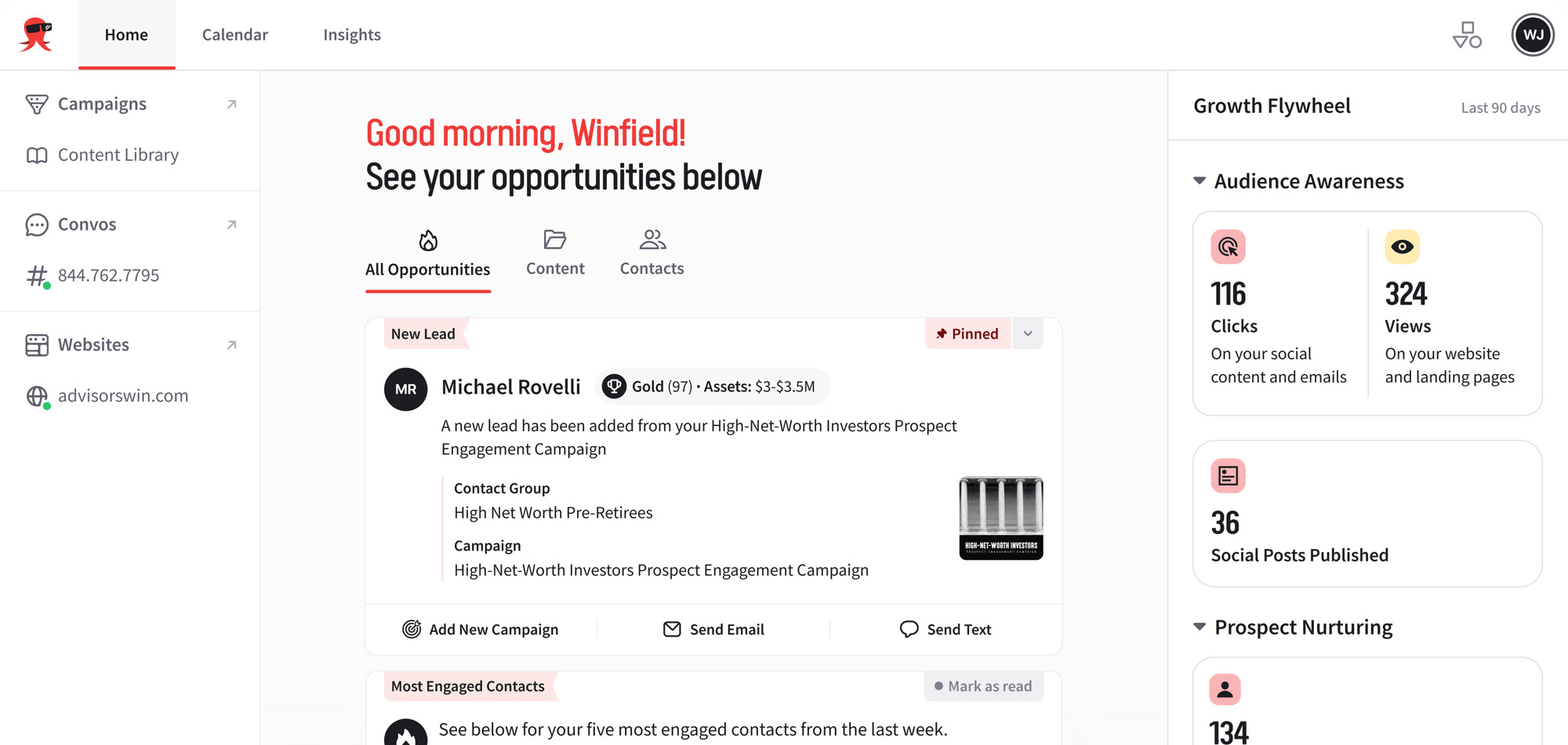
The deal changed the product's center of gravity. Websites and branding were no longer an adjacent referral. They became part of the same path as lead magnets, automated campaigns and client communication. Later additions - Marketing Hub, enterprise administration, Smart Growth Suite, an AUM pipeline dashboard and real-time bidirectional CRM syncing - kept pushing in the same direction: connect the artifacts, then connect the data.
The price ladder separates software buyers from time buyers
Public 2026 annual-term pricing makes the business model unusually legible. Campaigns start at $199 a month with a $199 setup fee. The $299 Grow plan adds premium content, lead capture, texting and larger contact limits, with a $499 setup fee. Freedom360 costs $899 a month plus $499 to start, adding strategy, implementation, quarterly reviews and a dedicated success manager. Website plans and bundles carry separate setup charges; enterprise plans are negotiated.
Published campaign pricing, annual term
Per month. Setup fees, extra seats, message volume and other terms can apply.
The spread between $199 and $899 is not mostly a difference in buttons. It is a difference in labor. Some advisors need a library and an automation engine. Others have bought marketing software before and learned that an untouched tool is merely an expensive icon in a browser tab. Freedom360 sells implementation because time, not access, is often the scarce input.
Snappy Kraken's 2021 Series A followed the same logic. FINTOP Capital led the $6 million round, joined by earlier investors Flyover Capital and 1248 Holdings. Sofia said the company did not need the cash simply to survive; it wanted more capacity for features, channels and integrations. Including two reported seed rounds, disclosed funding totals about $10.5 million. The company has not publicly disclosed its valuation or the terms of the Advisor Websites acquisition.
Generic tools provide the parts. Snappy Kraken packages the exceptions.
An advisor could assemble Mailchimp, HubSpot, a website builder, a texting vendor, a freelance writer and a spreadsheet for compliance. Many do. Direct rivals such as FMG Suite, Broadridge AdvisorStream, Levitate and Wealth I/O also offer combinations of advisor content and marketing software. Snappy Kraken's distinction is less any single channel than the amount of financial-services context already encoded around it.
Campaign material is built for advisor audiences. Compliance approval lives in the workflow. Enterprise administrators can customize and launch programs across networks while preserving brand controls. Integrations with Redtail, Wealthbox, Salesforce, Practifi and other systems connect customer records to activity. Nitrogen can provide a risk questionnaire inside a lead funnel. Hightower and Redtail have offered Snappy Kraken-powered experiences to their advisors.
AI sits inside this machinery rather than floating above it as a chatbot with a sparkle icon. Snappy AI can help create or adapt emails, posts, campaigns and images. The Marketing Hub and lead tools use engagement signals to surface warm households and suggest next actions. The pitch is speed and relevance. The danger is familiar: effortless creation produces effortless sameness unless an advisor adds judgment, examples and an actual voice.
The software can schedule sincerity. It cannot supply it.
Independent advisor comments about the category make that boundary plain. Some users value the regularity and content quality. Others complain that templated marketing feels generic or fails to generate leads. Those views can both be correct. A nurture platform is not an appointment-setting service, and a campaign shared without adaptation is unlikely to express why one advisor deserves attention over the advisor down the street.
Conditions required
There must be a real audience, clean enough data to segment it, a specific advisor point of view, permission to communicate, a workable compliance process and a human ready to respond. Remove two or three of those and automation mostly helps the wrong message travel faster.
Build around the handoffs customers hate owning
The transferable lesson is not “add AI” or “pick a regulated niche.” It is to observe an expensive workflow closely enough to find the abandoned handoffs. Snappy Kraken saw that advisors did not merely lack content. They lacked the time, confidence and operating rhythm to turn content into conversations while moving everything through compliance.
Start with practiced services
Use repeated client work to discover which decisions can become defaults and which still need a person.
Own the adjacent failure
If your output lands in a broken next step, integrate it, partner for it or acquire it.
Price the missing labor
Offer software for operators and a clear service layer for customers whose constraint is implementation.
Measure the business event
Move reporting from opens and clicks toward qualified conversations, pipeline and assets won.
The company has steadily followed that map. A Redtail connection in 2019 reduced manual imports. Texting extended follow-up in 2021. Advisor Websites closed the destination gap in 2022. Enterprise controls arrived in 2024. In 2025, Smart Growth Suite and AUM pipeline reporting aimed closer to the number executives care about. In 2026, a partnership with the Financial Planning Association began applying the same capture-and-nurture logic to PlannerSearch.
Campaign software for advisors
The tested service playbook becomes a vertical platform.
CRM data enters the loop
Redtail integration connects advisor records with campaign execution.
The website becomes part of the product
Advisor Websites adds design, conversion and stronger compliance infrastructure.
Engagement meets pipeline
Lead scoring, routing, live CRM data and AUM reporting move the product closer to revenue.
Discovery becomes less linear
PlannerSearch work and new research address how AI is changing where investors begin.
The branding offers one last clue. Financial-services technology is full of names engineered to sound stable and promptly forgotten. The founders wanted an anomaly, so they chose a mythical sea monster and put sunglasses on it. Silly? Certainly. But it makes the same argument as the product: safe does not have to mean invisible.
Snappy Kraken sits in a useful middle ground. It is more specific than a general marketing cloud and more systematized than a boutique agency. Its customers are buying consistency under constraint. When the data is clean and the advisor has something distinct to say, the platform can turn scattered good intentions into a steady practice. When those ingredients are absent, the octopus has nothing worth carrying.