The prototype for Asset-Map was sitting beneath a much more impressive product. H. Adam Holt, then a financial adviser, had driven to a client's home near Washington with the conventional equipment of expertise: a thick packet, multiple reports and enough detail to reassure anyone who enjoyed reading policy summaries at the kitchen table. His client's wife could not attend. Holt began marking up his own working sheet, a one-page diagram of the household's people, trusts, assets and obligations.
The client pulled that sheet toward himself. The expensive-looking packet could go. The map, he said, was the useful thing - the picture he could copy and show his wife. Holt had designed it to organize his own thinking. The client recognized it as the deliverable.
What is this thing?A client, spotting Holt's working map
That reversal is the whole Asset-Map story in miniature. Financial planning had become very good at calculation and very bad at staging a conversation. A household might receive dozens of pages proving that an adviser had done the work, then understand little about what it owned, owed, earned or protected. Holt's map put the members of the household in the center and arranged financial instruments around them. It was not the plan. It was the shared surface on which planning could begin.
The productThe x-ray, not the radiologist
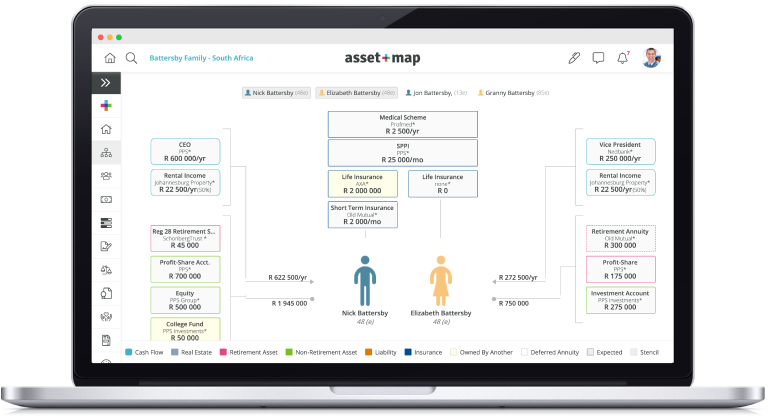
Asset-Map now sells that surface as cloud software to advisers, registered investment advisers, broker-dealers, banks, insurance professionals and tax practitioners. Its core report fits the household on one visual page: family members and entities in the middle; income, assets, liabilities and insurance arranged in colored containers around them. Discovery gathers facts from clients. Stencils prompt advisers to ask about items common to similar households. Target-Maps frame goals and funding gaps. Relationship Maps show the human and legal connections that refuse to behave like a tidy spreadsheet.
The company calls itself a conversation layer, which is more precise than calling it a lightweight financial plan. eMoney, MoneyGuide and RightCapital can perform detailed cash-flow projections, tax analysis and scenario modeling. Asset-Map is meant to sit in the meeting, before and beside those engines. It helps determine what is missing, what matters and which calculation is worth running.
Asset-Map is the x-ray, and the advisor is the radiologist.H. Adam Holt

The metaphor matters. An x-ray exposes structure but does not prescribe treatment. A skilled adviser sees an old retirement account, a business interest outside a trust or a beneficiary that no longer fits the family. The client sees the same picture and can correct it. Blank space becomes productive. People dislike an inaccurate map of themselves, so they point out the warehouse, account or policy that never made it onto the intake form.
Those are company-reported figures, current on its site in 2026. Asset-Map also reported roughly 7,500 advisers using the platform at the start of the year. The number is less interesting than the behavior behind it: the same map can open a prospect meeting, guide onboarding, anchor an annual review and document what changed. That recurrence is what turns a clever diagram into subscription software.
The originThe client changed the product
Holt filed the first copyright for the framework in 2002. He refined it with real households, from simple families to messy arrangements involving companies and trusts. The kitchen-table encounter around 2005 changed his mind about which artifact carried value. He then spent about a year securing compliance approval at his firm. From 2006 through 2008, the company says, the visual-first process helped triple his adviser revenue three years running.

In 2009 Holt paid for the first technology build with his own money and deployed it across an advisory practice serving 1,600 households with 11 advisers and 12 staff. By the formal 2013 launch, Holt said he had invested about $1 million personally and raised $600,000 from friends and family. This was the first difficult transition: a hand-drawn sheet was flexible, immediate and cheap; shared software had to standardize the format without sanding off its conversational looseness. The first build was an internal operating system, not yet a polished venture-backed company.
The copyable loop
The outside pull arrived in 2012. Holt presented the system to 25 high-performing peers; according to Asset-Map's company history, 20 signed up and word of mouth took the user count to 90 by year-end. By 2013 it had reached about 300 advisers. That growth broke the “pet project” version. Holt secured seed investment, rebuilt the technology in the United States and established Asset-Map as a company. A Fortune 150 client followed in 2015.
What failed first, then, was not the map. It was the packet around it. What failed next was the assumption that an internal tool could scale without a ground-up rebuild. Both failures were useful because customers made the next move obvious.
The economicsWhat it costs, and what bought the runway
The subscription is purchased by the adviser or firm, not the household. Professional covers the core workflow. Elite adds white labeling, customized data gathering, relationship management and higher-touch support. Firm plans add practice management, analytics, data migration and volume discounts. Growth Studio, launched in June 2026, extends the model with a separate marketing subscription for advisers.
The capital story is patient by fintech standards. InvestmentNews reported that Asset-Map had raised only about $1.6 million before its 2023 round, meaning subscriptions and a small early investor base supported much of its first decade. The $6 million Series B, announced in February 2023, brought RGAx, SixThirty and 41 industry-connected investors onto the cap table. The company said the money would expand operations, product work, sales and partnerships. Total funding since inception was reported at $7.6 million.
That partnership budget is now visible in the product. Holistiplan sends tax figures and linked analysis into the household view. Orion, Schwab, Addepar and others reduce re-entry of portfolio data. A long-requested eMoney connection launched in 2025, importing members, entities and financials before sending finished reports back to the eMoney Vault. Holt said the integration had been attempted for roughly nine years; APIs and strategic timing finally caught up with adviser demand. In 2026, Jump began extracting meeting insights and suggesting map updates with AI.
The stealMake expert work discussable
The lesson to copy is not “put everything on one page.” That produces very small type. The useful move is to separate an expert's diagnostic machinery from the interface used with a client. Keep the deep model available. Build a shared representation that lets both sides point, question and correct. Asset-Map calls its design rule “simple, rich”: simple enough to consume, technically rich enough to open a complicated discussion when needed.
A second lesson is to watch what the customer physically pulls closer. Holt's client did not complete a satisfaction survey about the plan. He grabbed the scrappy internal artifact and asked for a copy. Later, advisers adopted the tool before it was ready to be a standalone company. In both cases, behavior revealed demand more honestly than compliments would have.
The company also gives entrepreneurs a clean wedge strategy. Do not fight the incumbents on their strongest terrain if customers hate approaching that terrain. Asset-Map left projection engines to eMoney and RightCapital, then owned the opening conversation. Integrations made the boundary an advantage: the more complete the back office becomes, the more useful a clear front door can be.
The limitsWhen the map is the wrong tool
It works when
- The adviser leads collaborative meetings.
- Household complexity needs a shared picture.
- Deep modeling can follow discovery.
- Data is refreshed before reviews.
It strains when
- Projection precision is the main deliverable.
- The client will not engage visually.
- Source records are stale or inconsistent.
- The firm expects a map to give advice itself.
A one-page inventory cannot replace a cash-flow engine, tax model or professional judgment. If a retirement decision depends on precise sequencing, inflation assumptions and conversion scenarios, the calculation layer should lead. Asset-Map's own integration guidance warns that results depend on the quality of source data. A clean picture of bad information is still bad information. Syncing through multiple browsers can also create token problems, and some enterprise integrations depend on firm permissions.
There is a human condition, too. The product assumes the adviser wants a conversation rather than a presentation. Firms that measure value by report thickness, or clients who prefer a private portal and no live discussion, may not feel the advantage. The map also gets weaker if it becomes decorative - a static picture shown once, never corrected and never connected to decisions.
Used as intended, Asset-Map does something modest and commercially sturdy. It gives adviser and household the same page before asking either to agree on a plan. The thick packet still has a job. It just no longer gets the best seat at the kitchen table.