The computer had given its answer. The customer still wanted to ask a person. Before Dynamic Planner, Ben Goss co-founded Sort, an online investment adviser that, he says, was delivering advice to more than a thousand people a day. Yet customers often took its recommendations to their own financial advisers for a second opinion. That extra conversation became the clue to his next business.
Dynamic Planner now sells the software behind those conversations: questionnaires, investment research, cash flow forecasts and reports that help advisers explain what they recommend and why. The company says more than 40% of UK investment advice firms use it. Its wager is that reducing the work around a meeting can make room for more of the meeting itself.
The reassurance business
“People want a trusted advisor to help with big decisions,” Goss told investor FPE in February 2025. A retirement date or a decision to draw down savings involves more than arithmetic. Someone has to explain the uncertainty, hear the hesitation and notice when a technically plausible answer does not fit the person across the table.
Goss co-founded Distribution Technology, the business behind Dynamic Planner, with Adrian Hall and Patrick FitzGerald in 2003. Hall and FitzGerald brought banking technology experience. The origin story includes a pleasingly ordinary detail: Goss and FitzGerald met at a National Childbirth Trust event. Somewhere between preparing for parenthood and talking about babies, they started talking business.

Then the customers changed
The first version of the business relied heavily on large financial institutions and configurable projects. Dynamic Planner launched in early 2004. Insurers wanted planning tools to give advisers, who were accustomed to receiving software free. That helped build demand, but it tied the company’s fortunes to the institutions paying the bill.
By autumn 2009, that customer base was under pressure. In the company’s historical account, banks were retreating from financial advice while insurers consolidated and withdrew free tools. The initial distribution model was becoming less dependable. Dynamic Planner restructured and, by the end of 2010, refocused on independent advisers and recurring licence subscriptions.
That change explains much of the company readers encounter today. A shared service and independent risk model could be sold repeatedly to advice firms, with support to help them adopt it. The lesson for another software business is specific: watch who controls the purchasing decision, especially when the end user has never had to pay.
One meaning of risk
The distinctive part of Dynamic Planner sits beneath the interface. It applies a consistent definition of investment risk across client profiling, portfolio analysis and planning. That sounds like plumbing until a client’s idea of “balanced” meets a fund with a different interpretation. A shared label is useful only if the underlying measurements agree.
Its psychometric questionnaires, developed in partnership with Henley Business School, examine how clients think and feel about investment risk. The wider profiling process also considers capacity for risk, investor experience, sustainability preferences and financial wellbeing. Willingness to take a loss and the ability to live with one deserve separate questions.
On the investment side, Dynamic Planner examines underlying holdings supplied by managers against a model spanning 75 asset classes. Its investment committee reviews benchmark allocations for ten risk profiles each quarter. The company lists more than 1,800 risk-profiled solutions. Those are assessed investments, not funds owned or managed by Dynamic Planner.
A common risk framework connects the stages. Adviser judgement connects them to a life.
There are alternatives. Morningstar offers risk profiling powered by FinaMetrica; Voyant’s AdviserGo serves financial planning and cash flow needs. Dynamic Planner’s competitive argument is the connection between activities. A firm evaluating it should examine how well that connection works with its existing systems, as well as the quality of each individual tool.
Retirement, with the uncertainty left in
Consider an illustrative client who wants to retire five years earlier. The adviser can compare scenarios, adjust spending and inflation assumptions, and explore the effect of taking a lump sum. Dynamic Planner’s cash flow module draws on information already entered elsewhere in the platform, including financial arrangements and income.
The model is stochastic: it represents uncertainty through a range of possible outcomes rather than relying on one fixed projection. The practical benefit is a more useful discussion about trade-offs. A colourful chart cannot promise that savings will last. Its job is to make the assumptions, and the consequences of changing them, easier to see.
This is also where implementation matters. If spending estimates are stale or a pension is missing, the conversation starts from the wrong place. The time saved by automatically moving information between modules depends on that information being worth moving. A smooth demonstration is only the beginning of a buyer’s assessment.
The subscription arithmetic
Dynamic Planner’s published prices, checked in September 2026, put numbers on its pitch. Profiling is advertised at a promotional £60 per adviser per month, reduced from £80. Review costs £124; Review Plus, which adds cash flow planning, costs £179. Larger enterprise arrangements receive bespoke pricing.
The small print changes the arithmetic. Review and Review Plus carry a £130 setup fee per adviser for small and medium firms. Prices are subject to VAT, and extra per-client charges apply above agreed servicing capacity. At the published rate, one Review Plus licence costs £2,148 over twelve months, or £2,278 including that setup fee, before VAT and any extras.
That is a starting budget, not a return-on-investment forecast. A buyer still has to establish which work disappears, what training requires and whether the recovered hours become useful client time. The sensible trial is a complete review of a representative client, including the report, rather than a race through the easiest screen.
A plan in the client’s pocket
Tram extends the platform beyond the adviser’s desk. It is a mobile app that advice firms can offer under their own branding, with portfolio valuations, documents, personalised content and a view of the financial plan. Published pricing is £8 per client annually, subject to VAT, with bundle pricing available.
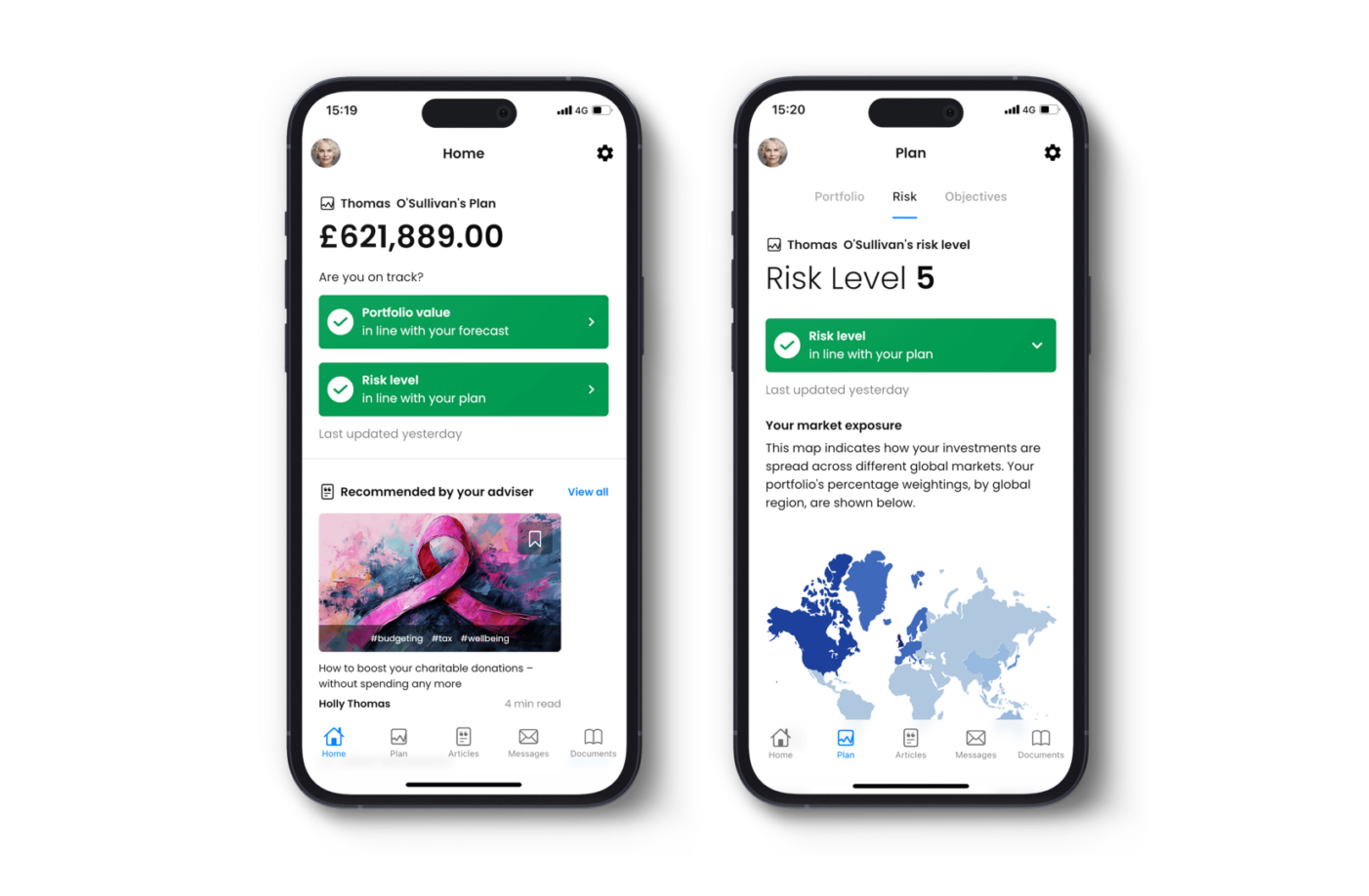
The appeal for an advice firm is straightforward: a branded app without commissioning its own mobile software. For clients, the plan can remain visible between appointments. The test comes after installation. A client who never opens the app still needs an effective way to communicate; a digital channel earns its keep through use.
Behind the phone screens sits less photogenic work. Dynamic Planner offers connections to back-office systems and providers, alongside an Open API. Its developer portal describes capabilities for client records, finances, profiling and notifications. These connections are intended to reduce repeated data entry and keep the advice process supplied with current information.
AI gets the meeting notes
The latest product push applies AI to familiar administrative chores. Dynamic Planner offers live transcription and structured meeting summaries, with those features included in Review and Review Plus. It also presents Smart Meetings for extracting information into client records and Report Companion for assisting review reporting. These are practical places to look for saved time.
The company’s AI charter commits to clearly identifying AI use, allowing users to opt out and retaining human oversight. It says client data sits in Microsoft Azure infrastructure in the UK or European Economic Area. Dynamic Planner also reports ISO/IEC 42001 certification for its AI management system. Governance is part of the product proposition.
Demand is moving in that direction. In its Advice 2026 research, conducted online by Research Without Barriers among almost 700 advice professionals, reported AI use rose from 28% in 2025 to 41% in 2026. Those findings describe survey respondents; they do not prove that installing Dynamic Planner causes higher productivity.
“People want a trusted advisor to help with big decisions.”
BEN GOSS / FEBRUARY 2025
The work behind the software
FPE’s July 2022 investment gave the company institutional backing for its next stage. By February 2025, Goss described a rebuild on Azure, upgraded finance and customer-management systems, and investment in enterprise sales. Winning larger accounts required audit trails, governance and security alongside the financial planning tools.
The organisation has continued to change. In May 2026, Dynamic Planner announced Rory McLaren as chief technology officer and Ian McEwan as chief revenue officer, while longtime technology leader Piers Lawson became chief architect. Its official About page describes a team of more than 130, including behavioural finance, actuarial, advice and investment expertise. Careers material describes hybrid and flexible working.
The useful idea to borrow is the attention to handoffs: from questionnaire to conversation, from holdings to risk assessment, from meeting to report. Each is a place where information can get lost or entered twice. Dynamic Planner has built its business around those joins. The adviser still has to look up from the screen and decide what the person needs.