The most revealing button in financial planning may be a small toggle labeled “retire at 65.” Switch it off, move retirement two years, trim spending, or add part-time consulting, and an abstract life choice becomes a new curve on a screen. For 25 years, eMoney Advisor has been building the machinery behind that moment. It takes the accounts, taxes, goals, debts, documents, and awkward family questions that make up a household’s finances and turns them into something an advisor and client can examine together.
That distinction matters. eMoney is not a consumer investment app and it does not manage the assets represented on its platform. It sells subscription software to financial advisors, registered investment advisers, banks, broker-dealers, and large wealth firms. Those professionals use it to gather data, build plans, test scenarios, store files, monitor a book of business, and invite households into a secure client portal.
Company-reported figures, 2026. “Aggregated assets” describes financial data represented in the software, not assets managed by eMoney.
The plan stopped being a verdict
A traditional financial plan has a theatrical problem. The advisor does the work backstage, then presents a polished answer. The client sees the output but not the choices inside it. eMoney’s defining product, Decision Center, reverses the staging. During a meeting, an advisor can turn planning techniques on and off, compare what-if scenarios, and show how each decision changes cash flow, net worth, retirement longevity, or a probability of success.
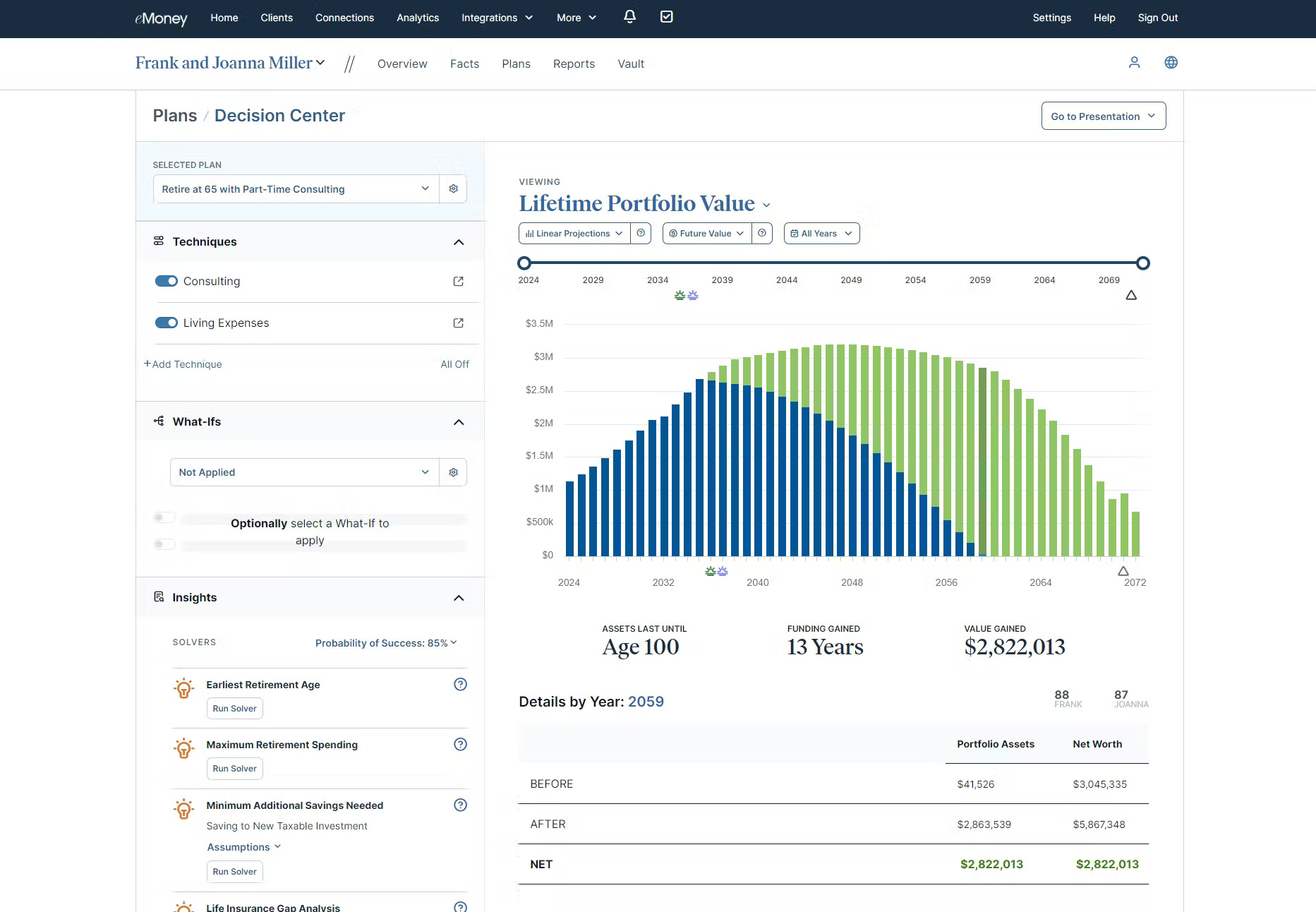
The company launched Decision Center in 2013, but the architecture goes back to its first platform release in 2001. That version already contained an advisor dashboard, a client portal, account aggregation, and a document vault. Founder Edmond Walters, himself an advisor, was not merely digitizing a calculator. He was assembling the shared workspace around the calculation.
“There are no independent financial decisions.”Nolan McClure, Blue Trust
That line explains both the appeal and the bulk. A retirement date touches Social Security, taxes, spending, insurance, charitable gifts, and estate plans. eMoney’s Pro package is built for that tangled version of reality. Plus handles more streamlined, goals-based plans. Premier combines both methods and adds the Premium Client Portal. The product ladder is an answer to a basic market problem: not every household needs a 747, but some families really are carrying that much luggage.
Plus
Guided, goals-based planning for faster delivery and comparatively straightforward client needs.
Best fit: more plans, less machineryPro
Detailed cash-flow planning, interactive presentations, and tools for complicated financial lives.
Best fit: depth and edge casesPremier
Both planning methods in one package, plus the upgraded portal and mobile experience.
Best fit: firms serving the full spectrumThe portal is the client’s side of this architecture. Households can connect outside accounts, see a consolidated financial picture, follow goals, inspect spending, and keep important documents in the vault. The 2025 Premium version added a mobile app, personalized homepages, and an Explore area for testing ideas. This is where eMoney differs from a planning engine that wakes up only before an annual review. The product is meant to remain present between meetings, when a changed salary, new account, or nervous midnight question makes the old plan feel suddenly theoretical.
The business hides the price, not the model
eMoney is business-to-business software sold by subscription. It does not publish a standard price list. Firms request a quote based on their package and organizational needs; enterprise deployments add configuration, APIs, governance, and implementation work. The Premium Client Portal is an add-on for existing planning packages. Onboarding, training, and weekday support come with the products, while data migration, plan development, and other professional services can extend the engagement.
The opacity is a nuisance for a solo advisor doing a quick comparison. It also reflects the company’s center of gravity. eMoney has more than 30 leading integration partners and sells firm-wide systems to organizations that care about single sign-on, data flows, archived plans, compliance review, and whether hundreds of advisors follow a repeatable process. MoneyGuide, RightCapital, and NaviPlan are the broad alternatives; Holistiplan and Income Lab attack narrower tax and retirement jobs. eMoney’s pitch is the connected whole.
From useful tool to industry plumbing
What failed first was the other software
One customer story makes the buying logic unusually vivid. When Jason Howell started his two-person RIA, he initially chose another planning product. Then he opened it during a client meeting and the software crashed. Howell did not have a grand office or a staff of 20 to signal permanence. The tool on screen had to carry some of that weight. He switched to eMoney because, as he put it, he needed software he could “really depend on.”
The failure changed his mind because it exposed what he was actually buying. Accuracy matters, but so do continuity and confidence in the room. His firm later used eMoney as the heart of a “Personal Roadmap” containing dozens of recommendations. Other customers describe a similar effect. Rooted Planning Group says a live illustration of saving an extra $100 a month prompted a young couple to open a brokerage account immediately. Blue Trust began with a few advisor teams in 2015, then watched use spread organically as planners adopted live what-if modeling.
A planning platform earns its keep at the instant a client says, “What if?”
Two sales, then a long Fidelity chapter
eMoney was founded in suburban Philadelphia in 2000. Commerce Bancorp bought it for $32 million in stock in 2006. After Commerce was acquired, eMoney was recapitalized with help from Guardian Life. Fidelity Investments acquired the company in 2015. Fidelity never disclosed the terms; contemporary reports put the purchase above $250 million, with some estimates between $250 million and $300 million. At the time, eMoney had roughly 30,000 financial-professional users and 1.2 million households on the platform.
The attraction was obvious. Custodians hold accounts; eMoney helps advisors explain what those accounts are for. Fidelity gained a planning layer that could sit closer to the client conversation, while eMoney retained its identity and continued selling across the industry. By 2022 it had passed 100,000 users and five million households. The company now reports 138,400 financial professionals, 7.1 million households, and a 96 percent good-or-awesome rating for client service.
Automation walks in, but does not take the chair
In March 2026, eMoney launched CoPlanner. Given complete client data and an advisor-defined target probability of success, it can surface several planning actions in seconds. The claim is not that a machine has become a financial advisor. CoPlanner evaluates income, assets, taxes, retirement timing, and spending, then gives the professional structured options to review, refine, accept, or reject.
That boundary is the interesting part. Financial advice lives under regulation and inside a human relationship. eMoney is automating the analytical slog without pretending trust can be generated on command. Its newer Plan Explorer applies the same philosophy on the client side: households can test scenarios without changing the official plan, then share what they learned with the advisor.
The part worth copying
eMoney’s most portable lesson has little to do with finance: put the customer inside the work. Do not disappear with their inputs and return with a decree. Make assumptions visible. Give important choices handles. Let both sides see how an action changes the outcome, then record the decision in the same place.
The company also shows how to segment a complicated product without amputating its core. Plus, Pro, and Premier support different planning styles, but all preserve aggregation, a portal, secure storage, analytics, and integrations. A firm can start with the conversation it needs while keeping a path to the more elaborate version.
The honest buying test
If clients have layered businesses, trusts, tax questions, stock compensation, estate needs, or linked household decisions, eMoney’s depth can become the point. If the job is a fast retirement projection for straightforward cases, a cheaper, simpler competitor may deliver the answer with less training and overhead.
Implementation is the condition that decides the outcome. Account connections need maintenance. Advisors need training. A firm needs a defined planning process, not merely licenses. The customer examples with the strongest results made eMoney part of the meeting, onboarding, and service model. Buying the platform without changing the workflow risks producing an expensive database that clients rarely open.
A remote company built around an uncomfortable subject
The mission is disarmingly plain: “Helping People Talk About Money.” The vision is “Financial Peace of Mind for All.” Behind it is a remote-first company of more than 600 people working across over 40 states. eMoney reports 1,100 volunteer hours, 65 internal promotions, and 13,000 peer recognitions in 2025. It offers education reimbursement, paid parental leave, financial-wellness support, and even treats an employee’s birthday as one of 13 paid holidays.
There is a neat alignment here. The outward product tries to make intimidating choices discussable; the inward culture keeps finding small ways for a distributed workforce to acknowledge one another. Neither solves the hard problem alone. A chart cannot make a retirement decision, and a recognition badge cannot make a team cohere. Both can give people a better place to begin.