Ritik Malhotra went shopping for something that software could not give him: reassurance. After selling a company to Box, he looked for a financial advisor. He says he spoke with more than a hundred. The advice had value. The machinery around it was another matter: paperwork, mailed documents, information scattered across systems. A profession devoted to making money intelligible had made its own working day unnecessarily complicated.
- Savvy equips independent advisors with software and a supporting team.
- Clients receive human advice on investments, retirement, taxes and estate planning.
- The business grows by attracting advisors and their relationships, then sharing advisory revenue.
That observation became Savvy Wealth, founded in 2021. Its mission has a pleasing lack of ceremony: “Make great financial advice easier to deliver.” The interesting word is deliver. It directs attention to the work surrounding a recommendation. Before anyone discusses a retirement date, somebody must collect the accounts, check the plan and remember what the client said last time.

01 / The advisor has two jobs
There is the job a client sees: listening, explaining, exercising judgment. Then there is the job that consumes the space between appointments. An advisor may assemble a portfolio report in one application, a financial plan in another, and meeting history somewhere else. Each tool can work perfectly while the day becomes absurd. The person hired to interpret a financial life ends up transporting it between windows.
Savvy’s answer combines proprietary technology with people who handle operations, compliance and marketing. The legal distinction matters: Savvy Wealth is the technology parent; Savvy Advisors is the affiliated SEC-registered investment adviser. Together, they offer a supported practice rather than simply another software subscription. Advisors bring relationships. Savvy supplies much of the infrastructure those relationships require.
“Savvy is different because they view me as the client”Joshua Barone, affiliated Savvy advisor
That is a useful clue to the sales pitch. The advisor buys into a way of working; the household experiences the consequences. Savvy says selected advisors report saving up to 19 hours a week on administrative workflows. It is a self-reported figure, not an independently verified average or a promise to every recruit. Still, it identifies the commodity Savvy wants to sell: time.
Up to this much administrative time saved, according to selected advisors’ self-reports. Individual results vary.
02 / The meeting begins before the meeting
The platform brings together a dashboard, customer relationship management, onboarding, task workflows and household reporting. Its client portal offers net worth information, document sharing and requests in one place. The ambition is ordinary enough to be useful: open fewer tabs, ask for the same information fewer times, and make the next step visible.
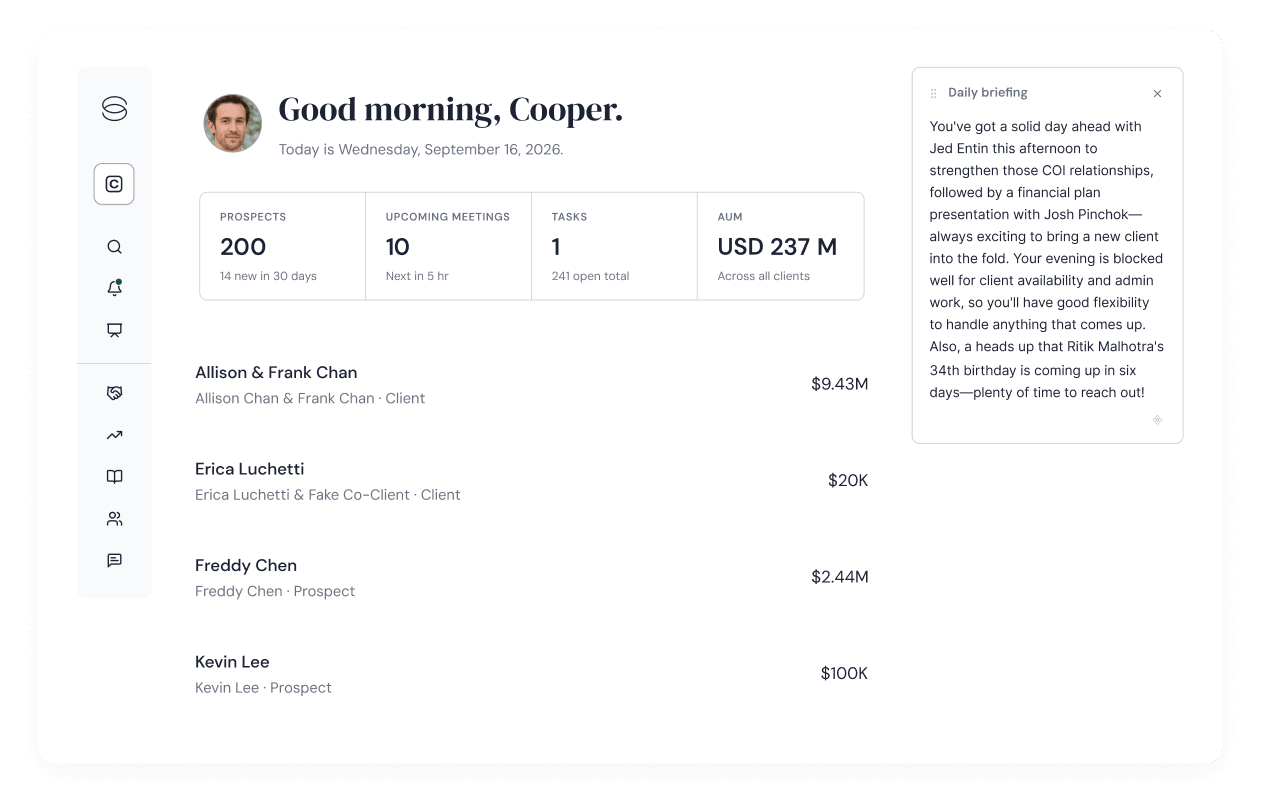
In April 2026, Savvy launched Savvy Intelligence and its Financial Planning Agent. The system uses connected household information to assist with meeting preparation and planning analysis. Its illustrative scenarios include reviewing tax circumstances and comparing planning choices. The advisor reviews the output. AI does not independently supply client-facing investment advice or make investment decisions.
The distinction is practical. A tidy summary can still contain an error, and a planning opportunity depends on circumstances a system may not know. Connected records improve the starting point; professional judgment determines what reaches the client. The useful product is the combination of those two activities.
- 01Household records
- 02Planning preparation
- 03Advisor review
- 04Client conversation
03 / A small practice borrows an investment office
For clients, Savvy’s services extend beyond choosing securities. Advisors offer retirement planning, tax strategy, estate coordination and investment management, including direct indexing and alternative investments. High-net-worth families and business owners are natural customers because several financial decisions can collide at once. An investment account may be simple; the household around it rarely stays that way.
Advisors can also use Savvy Wealth Investment Management, or SWIM. The division supports trading, rebalancing and portfolio construction. Savvy Total Portfolios, launched in January 2026, supplies risk-based core allocations. The Savvy Thematic Portfolio, launched in April, adds targeted exposure to themes such as cybersecurity. Advisors can use custom strategies too. In June, Savvy reported SWIM adoption by more than 80% of its 130-plus advisors.
There is experienced finance talent behind the interface. Chief investment officer Anshul Sharma previously spent nearly two decades at Bank of America. The proposition is access to an investment team without building one inside each practice. It does not establish that Savvy portfolios will outperform; it changes who must do the research and operational work.
04 / Independence has an invoice
Savvy shares advisory revenue with advisors. Client investment-management fees are typically based on assets; planning engagements may use flat or hourly fees. Exact charges vary. A polished portal does not settle the price question: clients should compare the actual engagement, while advisors must weigh the revenue retained against the support received.
Farther offers a close alternative built around technology-enabled advice. Dynasty Financial Partners offers another route to supported independence. An advisor can also assemble a separate software stack. Savvy’s distinguishing wager is that keeping the builders and practitioners inside the same organization makes the whole arrangement easier to improve.
05 / The next bottleneck belongs to someone else
In September 2026, Savvy announced a $100 million Series C at a $600 million valuation. Reporting put client assets above $9 billion and the advisor network above 150. Those assets belong to clients; they are distinct from the company’s valuation. Savvy’s forecast of $100 million in year-end annual recurring revenue was a target, not an achieved annual revenue result.
Later that month came the Savvy Custodial Platform. Savvy Wealth Management supplies the introducing-broker interface; Fidelity’s National Financial Services handles clearing, execution and actual custody. Outside RIAs can join a waitlist, with onboarding expected in early-to-mid 2027. It takes the argument one step further: smoother advice also requires smoother account processing.
The lesson travels beyond wealth management. Watch the whole job before buying another tool. Find where information gets copied, where responsibility changes hands, and where a professional waits. Savvy’s case rests on repairing those gaps. Whether the economics work depends on each practice. The appeal is easy to recognize: an advisor with enough room in the day to advise.