The most important product at US Financial Services is not a fund, an insurance policy, or an impressive dashboard. It is the meeting where all of those things are forced to sit at the same table. A physician's disability coverage affects her ability to keep investing. A business owner's succession plan changes his retirement date. An estate document can quietly disagree with an account beneficiary form. The Fairfield, New Jersey firm makes its living finding those collisions before life does.
That sounds less thrilling than beating the market. It is also closer to how money behaves outside a spreadsheet. Founded in 1989 by Gerard Papetti, Altair Gobo, and Steven Gallo, US Financial Services built its practice around small-business owners, physicians, families, and individuals. Today it offers investment management, retirement strategy, estate coordination, insurance-based risk management, business succession work, and employer pension-plan administration. The organizing idea is not a hot asset class. It is continuity.
01 / The offerA plan for the moments when the plan breaks
USFS markets to people in transition, which is adviser language for the year your tidy financial life becomes a junk drawer. Marriage, children, college, a career change, a company sale, retirement, widowhood, and inheritance all create decisions that cannot be solved one account at a time. The firm starts with cash flow and goals, then coordinates investments, tax considerations, insurance, estate documents, and outside professionals. It does not replace a client's attorney or tax preparer. It tries to stop those advisers from working from different maps.
The customer niches make the model concrete. Physicians may arrive with high income, medical-school debt, liability exposure, and a career path that can move from residency to hospital employment to private practice. Business owners bring two balance sheets - household and company - plus the uncomfortable question of who takes the keys next. Families need retirement income and legacy planning. The firm's women-focused practice speaks directly to clients who want knowledge and an active role in decisions, particularly during major transitions.
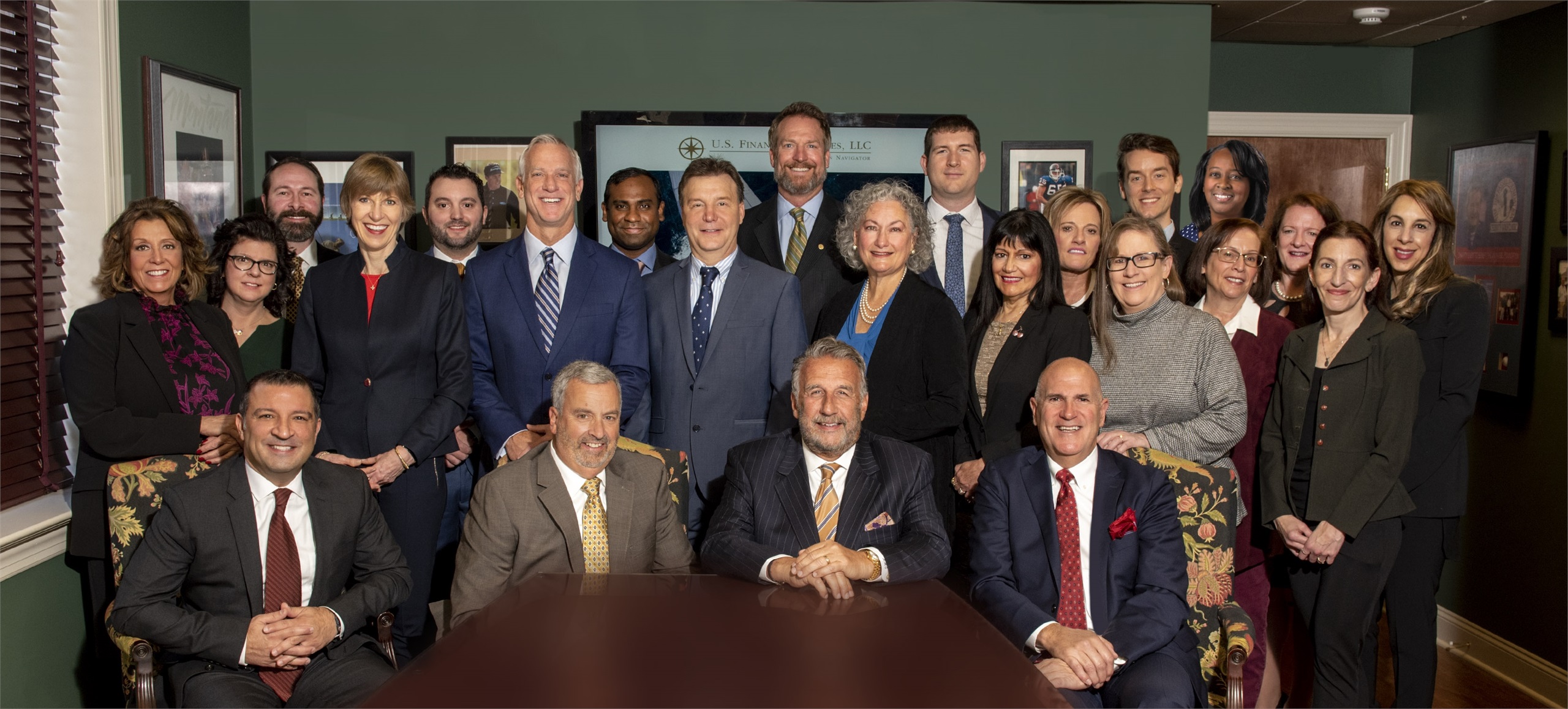
Then there is the less visible B2B operation. After acquiring Preferred Pensions in early 2018, USFS could design and administer qualified retirement plans for employers. Its team works on defined-benefit, cash-balance, profit-sharing, and 401(k) plans; prepares documents and tax filings; educates employees; supports ERISA compliance; and monitors investment options. That turns a familiar consumer advisory shop into something stickier: a firm connected to both the owner and the owner's workforce.
The firm's branded five-step Life Plan Navigator gives this broad promise a spine. It begins with discovery and a current financial picture, moves through goals and alternative strategies, then implementation and recurring review. The exact recommendations vary; the reusable mechanism does not. A founder can copy that: name the process, show the handoffs, and make review a defined stage rather than a vague promise to stay in touch.
02 / The dealSell the plumbing, keep the front door
In 2020, US Financial Services was acquired by Bluespring Wealth Partners, the wealth-firm investment arm inside the Kestra ecosystem. Financial terms were not disclosed. The more interesting currency was control over the client experience. USFS kept its name and day-to-day identity, while Bluespring supplied resources around legal work, accounting, human resources, technology, growth, and succession. Securities and investment-advisory activity runs through Kestra affiliates.
Our staff had some initial reservations, but now they agree the changes have only been for the better.Steven P. Gallo, co-founder, on the Bluespring transition
Gallo's account of the transition is refreshingly free of merger confetti. Employees worried first. Clients had a more existential question: what happens when the founders are no longer around? The deal answered both by keeping the familiar firm in place and funding a path for younger partners. Bluespring's training and support also let the next generation advance without assuming the same acquisition debt that often makes internal succession difficult.
What changed the founders' minds was not a failed portfolio strategy. It was the recognition that independence has a hidden tax. Every hour a partner spends on HR, compliance coordination, accounting, or vendor management is an hour not spent with clients. More important, a founder-dependent firm can look healthy right up to the day succession becomes urgent. USFS treated continuity as infrastructure and bought it before retirement forced the issue.
What happened, what it cost, what bent first
- They did
- Joined Bluespring in 2020, retained the USFS brand, shifted back-office burdens, and developed a next-generation succession route.
- It cost
- An undisclosed acquisition price. No reliable public figure is available, so any precise dollar claim would be theater.
- First friction
- Staff reservations and the natural fear that outside ownership would alter a relationship-led practice.
- The proof
- The firm continued operating locally, added practices, and reached a reported five offices and $1.7 billion in combined assets.
03 / The engineFrom acquired firm to acquiring home
The next move turned the logic outward. In 2022, Hudson Dynamic Retirement, a New York practice reported at $265 million, merged into USFS and created a fourth office. Hudson's founder wanted resources for the next generation and continuity for clients. USFS offered a broader adviser bench and services while the people closest to the relationships kept serving them. The once-acquired firm had become the local operating home for another practice.
In early 2026, Cranford-based Front Porch Financial followed. Trade coverage put the combined USFS practice at about $1.7 billion across five offices. Founder Elizabeth Blanchard framed the combination as a succession plan that gave clients long-term support and a broader team without giving up the personal touch. It is the same proposition USFS accepted in 2020, now packaged for someone else.
not revenue share
The business model is equally blended. Recurring advisory fees tied to managed assets can sit beside financial-planning fees, commissions on eligible securities or insurance products, and fees for retirement-plan design and administration. The firm does not publish a universal price list. Its educational material notes that planners commonly charge hourly or roughly 1 to 2 percent of assets, but that is market context, not a confirmed USFS rate. A prospective client should ask for the specific agreement, conflicts, commission structure, and all-in cost.
That distinction matters because this is not a pure fee-only software service. Human coordination is expensive, and compensation can vary across the work. The value test is not whether an adviser can produce a Monte Carlo chart. It is whether the plan changes behavior, catches mismatches, reduces avoidable taxes or risk where appropriate, and keeps moving when a client or founder cannot.
04 / The copyThe boring parts are the useful parts
The move worth stealing is not “sell your company.” It is to separate the trust layer from the plumbing layer. Clients care who listens, who calls back, who knows the family, and who can explain the decision. They rarely care which team reconciles payroll, negotiates software, or handles internal accounting. A boutique can map every task into those two buckets, protect the first, and decide whether to centralize, automate, outsource, or partner on the second.
A second lesson is to make succession visible before it is necessary. Train the next generation in management, not only advice. Give clients more than one relationship. Document how the planning process works. Create an ownership route younger leaders can finance. And test whether the brand promise survives when a founder misses a meeting. USFS's expansion suggests that continuity can become a product offered to other advisers, not merely an internal insurance policy.
The model has limits. It will not work well if a platform insists on replacing the local voice, if economics push advisers toward products rather than advice, or if founders confuse a signed deal with a completed cultural transition. It also fits poorly when clients hired one celebrity adviser and resist a team. Scale can remove chores; it cannot manufacture trust. Nor does size guarantee better returns, lower fees, or a suitable recommendation for any particular client.
Copy this when...
- Your planning process is repeatable.
- Clients know more than one team member.
- A platform will preserve the local brand.
- Successors need capital and management training.
Skip it when...
- The founder is the entire product.
- Shared operations will weaken service.
- Compensation becomes harder to explain.
- No one owns the cultural integration.
US Financial Services sits in the middle of a consolidating wealth market: more personal than a national call center, broader than a solo planner, and increasingly supported by the machinery of a large platform. Its competitors range from local RIAs and wirehouse teams to national firms such as Mercer Advisors, Creative Planning, Mariner, Edelman Financial Engines, CAPTRUST, and Hightower partners. Robo-advisers can undercut the portfolio component. They are less convincing when the assignment involves a business sale, a disabled partner, an outdated trust, and a nervous family in the same Tuesday.
The firm's recent news is steady rather than cinematic: Front Porch joined, two partners were named finalists for an industry watch list, an operations manager arrived from Bluespring, and the annual charity golf challenge reached its eleventh edition. That last ritual is revealing. Teams play for chosen charities, and the winner directs the firm's support. Even the golf outing is a small coordination system.
Thirty-seven years after the founders opened the door, USFS is selling the same basic promise: someone will remember how the pieces fit when life rearranges them. The 2020 transaction did not abandon that promise. It applied it to the company itself. Plan for the transition, distribute the risk, keep the relationships, and make sure tomorrow has someone trained to answer the phone.