The peculiar thing about selling an annuity is that doing the work and getting paid for the work can occupy different months. The client has signed. The application has gone in. Yet the advisor still has salaries, marketing bills, and an office to run. Somewhere between the sale and the commission check sits a small business financing a large institution’s timetable.
- Signal serves independent financial professionals with insurance distribution, software, and specialist support.
- TruePay advances commissions; deferred marketing terms address the other end of the cash cycle.
- Its broader bet brings annuities, life insurance, and wealth management into a connected working day.
Signal Advisors made that interval part of its business. Its TruePay service advances annuity commissions ahead of carrier payment. Signal advertises payment within one business day of submitting an application. The point is practical: an advisor can put earned business to work sooner.
A sale has its own calendar
Patrick Kelly had occupied the advisor’s chair. He worked at Northwestern Mutual, moved into independent advice at Kelly Capital Partners, and founded RepPro, an electronic-application business acquired by RetireUp in 2018. By Signal’s public debut in August 2020, he was working with technologist Kevin O’Hara and investor Jacob Cohen. They began with the unglamorous machinery surrounding annuities.
There is a useful distinction here. Signal Advisors Insurance is an insurance marketing organization, or IMO. It sits between carriers and licensed agents, providing distribution and support. It does not underwrite the policy. Its customer is the financial professional trying to serve a client while also keeping a business moving.
Signal’s financing tools work on both sides of that business. TruePay pulls a commission forward. Pay-later marketing lets an advisor hold a seminar or workshop and settle the bill later; Signal currently advertises terms of 45 to 75 days after the event. One changes the arrival of cash. The other changes its departure.
Conceptual illustration. Payment eligibility and actual terms govern.
That combination explains why a software screen belongs in the same conversation as working capital. A faster application can save minutes. Earlier payment can affect when the next marketing event becomes affordable. For an advisor whose growth is constrained by cash timing, those are different kinds of improvement.
The window that gave the game away
The software story contains a revealing inconvenience. In Hexure’s account of its work with Signal, advisors already had single sign-on to FireLight, an electronic-application system. But they still left Signal to complete an application, then returned. Office staff helping prepare applications faced awkward handoffs too.
Signal chose to embed FireLight’s functionality in its own interface. The vendor case study describes a beta built in two weeks: one week coding, one testing. Client information could prefill applications, and office staff could prepare a case for the advisor to finish. The familiar forms remained.
“No more multiple windows.”Kevin O’Hara, co-founder and CTO
This was the friction that a login count concealed. Connecting accounts had left the user responsible for crossing between them. Embedding the workflow removed that crossing. The transferable idea is to watch a person complete the entire task, including the moment a colleague takes over.
Follow the household
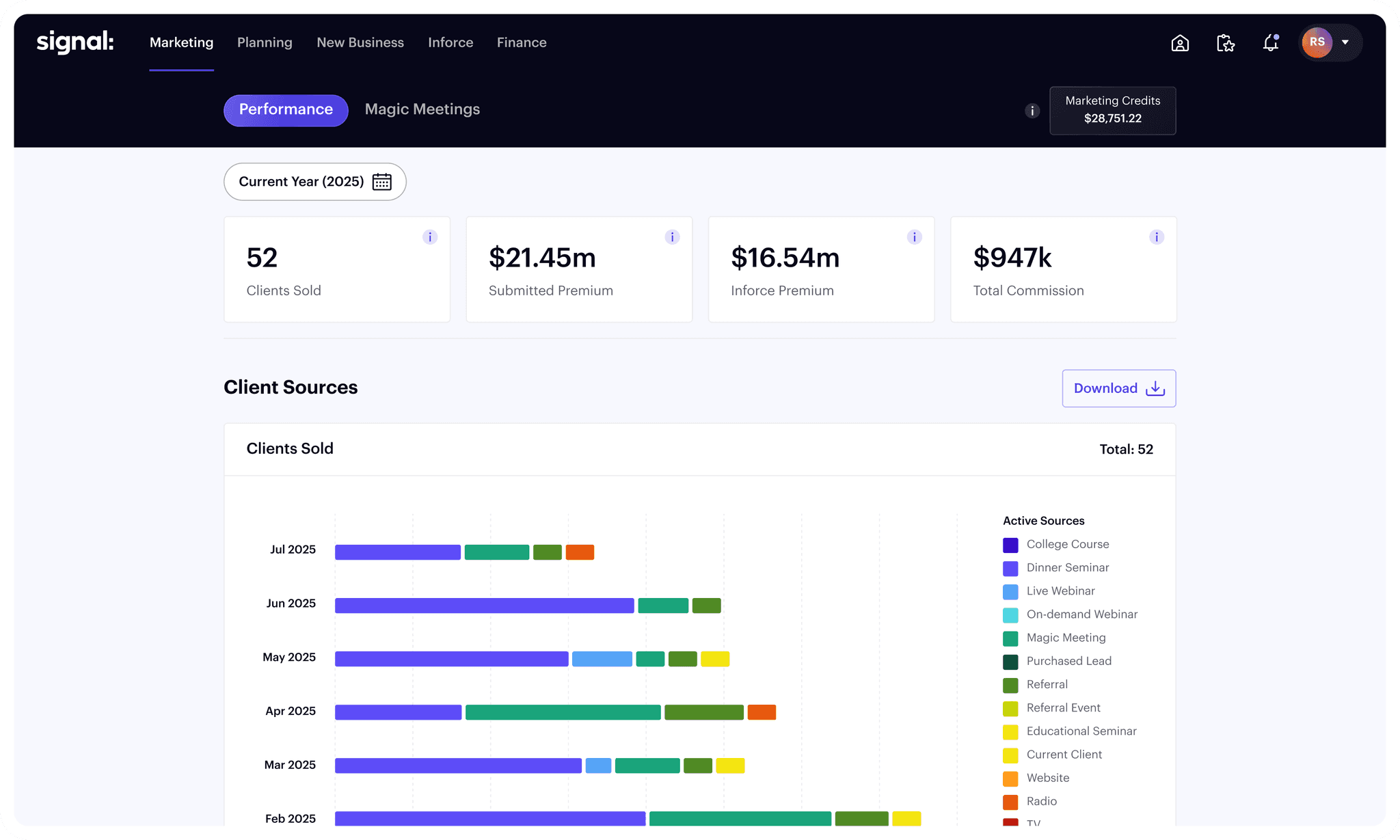
Today the product family includes Signal Annuity, Signal Life, and Signal Wealth. Annuity work spans quoting, case design, applications, and ongoing policy service. Life insurance adds illustrations and underwriting coordination. Wealth brings investment-account workflows, model allocations, and compliance support into the offering.
The organizing unit is the household. A client’s annuity, insurance, managed assets, documents, and unfinished tasks can be viewed together. This reflects a fairly ordinary fact about financial life: the family has one set of concerns even when the industry has given it several systems.
Signal’s expertise also arrives through people. Planning and case-design support help advisors assemble recommendations. Its media team produces campaigns and content. Magic Meetings handles lead follow-up and appointment scheduling. The company describes serving hundreds of advisors, making its audience a network of practices rather than a consumer investing app.
AI sits inside that work. Policy summaries help advisors review details; drafted communications help explain policy performance. In a June 2026 Next Mile interview, Kelly argued for using AI to improve the user experience. That makes a sensible test for these features: does the next client conversation become clearer?

The bill behind the convenience
Signal announced $16 million in funding in April 2021: a $6 million seed round closed in July 2020, and a $10 million Series A closed in December 2020, led by General Catalyst. The investment supported expansion beyond the initial annuity focus.
The economics also extend beyond software subscriptions. Signal operates an insurance-distribution business, while its wealth affiliate charges asset-based fees. Its March 2026 disclosure lists maximum annual Signal Wealth fees of 1% for independent-RIA arrangements and 2% for directly contracted advisory clients. These describe different relationships; other charges can apply. The original TruePay announcement described the advance itself as free.
Approximate combined discretionary and non-discretionary assets reported by Signal Advisors Wealth at December 31, 2025. Client assets, not Signal revenue.
Wealth management launched in 2023. The later asset disclosure shows that this became a substantive part of the operation. Signal competes with traditional IMOs and with the advisor’s alternative of assembling separate technology and service providers. Its proposition is the combination: distribution, operational labor, connected tools, and financing.
A useful question for Monday morning
The fit depends on the practice. A US advisor managing insurance and investment work across several systems has more reason to value this arrangement than a firm with a narrow offering and an already efficient workflow. Faster commissions cannot determine whether a policy suits a client, and integration depends on the connections available.
What another business can copy is the investigation. Follow the paperwork. Follow the money. Count the handoffs between people. Ask how long each step waits for the next. Signal’s interesting move was to treat those intervals as problems worth designing around. The calendar was part of the product all along.