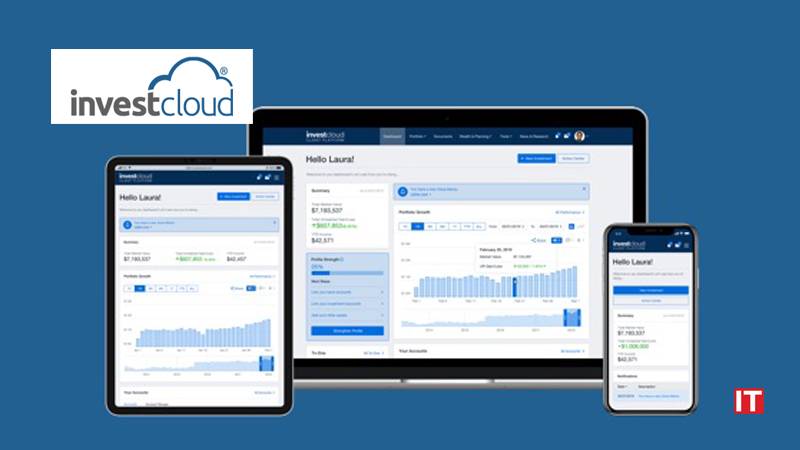
The best way to understand InvestCloud is to ignore the screen for a minute. The screen is pleasant: performance charts, account balances, messages, documents, perhaps a gentle reminder from an advisor. The actual product is the argument happening behind it. One bank stores trust accounts in one system, brokerage assets in another, planning data somewhere else and client notes in a CRM that nobody loves. InvestCloud’s job is to make those systems exchange enough information that the customer sees one coherent financial life.
That is a large, unglamorous promise. Wealth management software must be accurate, permissioned, auditable and available while markets are moving. It must also look modern to an investor who compares every digital service with the apps already on their phone. InvestCloud has spent 16 years living between those demands. The company now sells front-office experiences, managed-account operations, data services, private-market workflows and AI-assisted tools to banks, asset managers, RIAs, insurers, wirehouses and turnkey asset-management platforms.
The product is the mess it hides
InvestCloud began in a Los Angeles garage in 2010. Its early idea was architectural rather than cosmetic: normalize financial data in a cloud warehouse, then assemble client-specific experiences from reusable applets. Instead of coding every portal from scratch, a team could combine portfolio views, document vaults, CRM functions, reporting and communication tools. The firm called its development approach “programs writing programs.” The phrase was clunky. The commercial idea was sharp.
This was modernization without demolition. A private bank did not need to replace every ledger before launching a better client portal. It could put a digital layer on top, join the data and improve one journey at a time. In 2016, JPMorgan Chase chose InvestCloud to speed up online investing, mobile functionality and account opening, then made an equity investment. At the time, InvestCloud said it supported $1.5 trillion across 660 institutions. The customer mattered, but the validation mattered more: a large bank was willing to put a young cloud company between valuable clients and old machinery.
The $1 billion shortcut came with assembly required
Growth was financed in recognizable steps. InvestCloud raised roughly $8.6 million in 2013. FTV Capital led a $45 million round in 2015, when the company employed 118 people and had become profitable. Only $15 million of that round went toward European expansion; $30 million bought stock from founders and early holders. In 2017, InvestCloud paid $20 million for Babel Systems, adding trading, accounting and robo-advice plumbing to its portals. Those are the useful answers to “what did it cost?” The price of a customer deployment remains private and varies with modules, migrations, integrations and service.
Then came the big shortcut. In February 2021, Motive Partners and Clearlake Capital acquired a majority stake, valued InvestCloud at $1 billion and combined it with two Motive portfolio companies. Tegra118 contributed the APL managed-account engine. Finantix brought private-banking technology and an international footprint. The resulting business claimed more than $4 trillion in assets on its platform and more than 500 direct clients. In one transaction, InvestCloud jumped from a modular digital layer toward a front-to-back wealth stack.
What failed first? Not demand. Coherence became the question. Contemporary reporting on a 2023 shakeup said 12 executives departed, including co-founder and CEO John Wise, amid debate about how effectively the acquired businesses had become one product. Interim chief Richard Lumb argued that a company entering its next stage needed a different set of skills. In January 2024, former Fiserv CEO and Motive founding partner Jeff Yabuki took the permanent job.
The dashboard is the showroom. Data normalization, permissions and workflow are the building.
That episode is the hinge in the story. InvestCloud had sold speed through modularity, then acquired breadth through combination. The first model rewards loose coupling: choose the apps you need. The second asks customers to believe the pieces operate as a platform. Buying adjacent capability is faster than building it. Making three codebases, teams and commercial stories feel singular is slower than either.
Private markets are the next integration trap
The strategy under Yabuki has become easier to read. InvestCloud is leaning into the asset-moving machinery of APL, a system used for separate and unified managed accounts, while refreshing the client-facing layer. The company reported that its managed-account operation ran $4 trillion in assets, averaged 2.2 million trades a day and maintained 4.5 million active models as of March 2026. Those numbers make reliability the product. Nobody awards style points for a rebalancer that improvises.
The new edge is private markets. Public stocks settle predictably and can be priced throughout the day. Private credit and other alternatives bring subscriptions, capital calls, distributions, irregular valuations, eligibility rules and limited liquidity. Advisors often handle the exceptions with spreadsheets, email and separate portals. InvestCloud introduced its Private Markets Account in late 2024 - now called PM+ - to place private assets in a dedicated sleeve beside public investments inside a managed account. Apollo became the founding asset-manager partner in 2025, supplying private-market model portfolios. The Altic network is meant to connect managers, wealth firms and service providers with rules that keep orders “in good order.”
This is a sensible extension of the original thesis. Find the swivel-chair work, normalize the information and hide the handoffs. It is also a more consequential test. A stale news feed is annoying. A mishandled capital call is money. The platform must coordinate suitability, liquidity, tax decisions, valuations and reporting without pretending private assets behave like ETFs.
Who pays - and what they are really buying
InvestCloud is enterprise B2B software, not a consumer broker. More than 250 enterprise clients use its front-office technology, according to the company. Named relationships across its history include JPMorgan Chase, Wells Fargo, Truist Wealth, Rathbones, First American Bank, FirstCape, Buckingham Strategic Wealth and Singlife. Investors usually encounter a bank’s branding, not InvestCloud’s. That invisibility is a feature.
There is no public price card. Buyers pay for a configured platform: software access, implementation, data migration, integrations, branded experiences and continuing operations or support. The nearest competitors depend on the layer being purchased. Envestnet and Orion compete in advisor and managed-account technology; SS&C, SEI and Broadridge in operations and portfolio infrastructure; FNZ, Temenos and FIS across broader wealth platforms. A firm can also assemble point solutions. That may produce a better tool in each category, plus a new full-time hobby connecting them.
Modernize at the seam customers feel first. Preserve systems of record, build a governed data layer and ship reusable journeys instead of waiting for a perfect replacement program.
Every connector becomes a promise. Without clean ownership, testing and change management, the overlay inherits the complexity it was hired to conceal.
What a reader can copy - and when not to
The practical lesson is not “build a wealthtech.” It is to treat integration as product design. Start with a painful user journey, identify the systems that own each fact, and create a stable translation layer. Make modules reusable but let the final experience carry the customer’s brand. Measure the time removed from onboarding, trading, reporting or service - not the number of features launched. InvestCloud says its onboarding users report journeys that are 40 to 60 percent faster; that kind of operational result is more persuasive than another dashboard tile.
The model does not work everywhere. A small advisory firm with simple accounts may be better served by a lighter all-in-one system. An enterprise with poor data governance cannot buy its way to a “single source of truth”; it must decide who owns definitions, permissions and corrections. A company unwilling to redesign workflows will merely digitize its old queues. Private-market automation is inappropriate where investors are ineligible, cannot tolerate illiquidity or do not understand the products. And any institution expecting a thin interface to erase decades of technical debt will discover that software can disguise a seam before it can remove one.
InvestCloud’s change of mind was less a reversal than an expansion. The founding company believed the winning layer would sit above the old stack. The post-2021 company also owns more of what happens below it: models, trades, rebalancing, settlement and now private-market events. The wager is that an enterprise buyer wants one accountable platform without surrendering every existing core. That is a narrower claim than “replace everything,” and a harder one to execute well.
The amusing part is that success looks boring. An advisor opens one screen. A client sees one household. A model change reaches the right accounts. A capital call arrives with the right controls. No one applauds the normalized identifiers. No one should have to. For InvestCloud, making $4 trillion visible was the impressive phase. Making the machinery forgettable is the business.