A stock is polite. It has a ticker, a closing price and a custodian willing to send a clean file every night. Great wealth is rarely so considerate. It arrives as private funds with quarterly marks, real estate inside limited-liability companies, trusts that own pieces of other trusts, capital calls, six currencies and an art collection that stubbornly refuses to stream a price. Then someone asks a simple question over lunch: What do we own, and how is it doing?
Addepar is the machinery built to answer without making the investment team disappear into Excel for a week. Founded in 2009 by Joe Lonsdale and Jason Mirra, both with Palantir experience, the company aggregates portfolio, market and client data, reconciles it, models the ownership, and presents the result as analysis, reports and client-facing views. More than 1,500 firms in over 60 countries now use the platform, representing more than $9 trillion in assets.
The original sinFinance kept adding assets. Its software kept pretending they were stocks.
The company began with a sharp observation: portfolio software had been designed around liquid securities, while the people with the most complicated portfolios owned plenty of things that were not liquid securities. A family office could receive accurate statements from every bank and fund administrator and still lack an accurate view of the whole. The failure happened first at the seams - inconsistent names, delayed valuations, currency conversions, ownership layers and calculations that changed from one report to another.
Addepar's founding idea was less glamorous than a trading app and more durable: create a flexible financial data model, preserve the history, and make every result inspectable. Once a holding can be represented correctly, the same record can feed performance analysis, an investment committee book, a client portal, a fee calculation and a compliance review. The firm stops producing five versions of the truth.
fund admins
market data
real estate
nested entities
Trading • Forecasts • AI
Addepar did not make complex wealth simple. It made the complexity legible.
What the customer buysA reporting system that keeps growing extra limbs
The center of the product remains data aggregation, analytics and reporting. Advisors can group a portfolio by asset class, entity, manager, geography or a custom taxonomy; calculate returns; compare benchmarks; and generate client-specific materials. The client portal gives investors a live, branded view of net worth and portfolio evolution. Billing handles fee schedules, asset exclusions and different valuation methods, with the underlying calculations available for review.
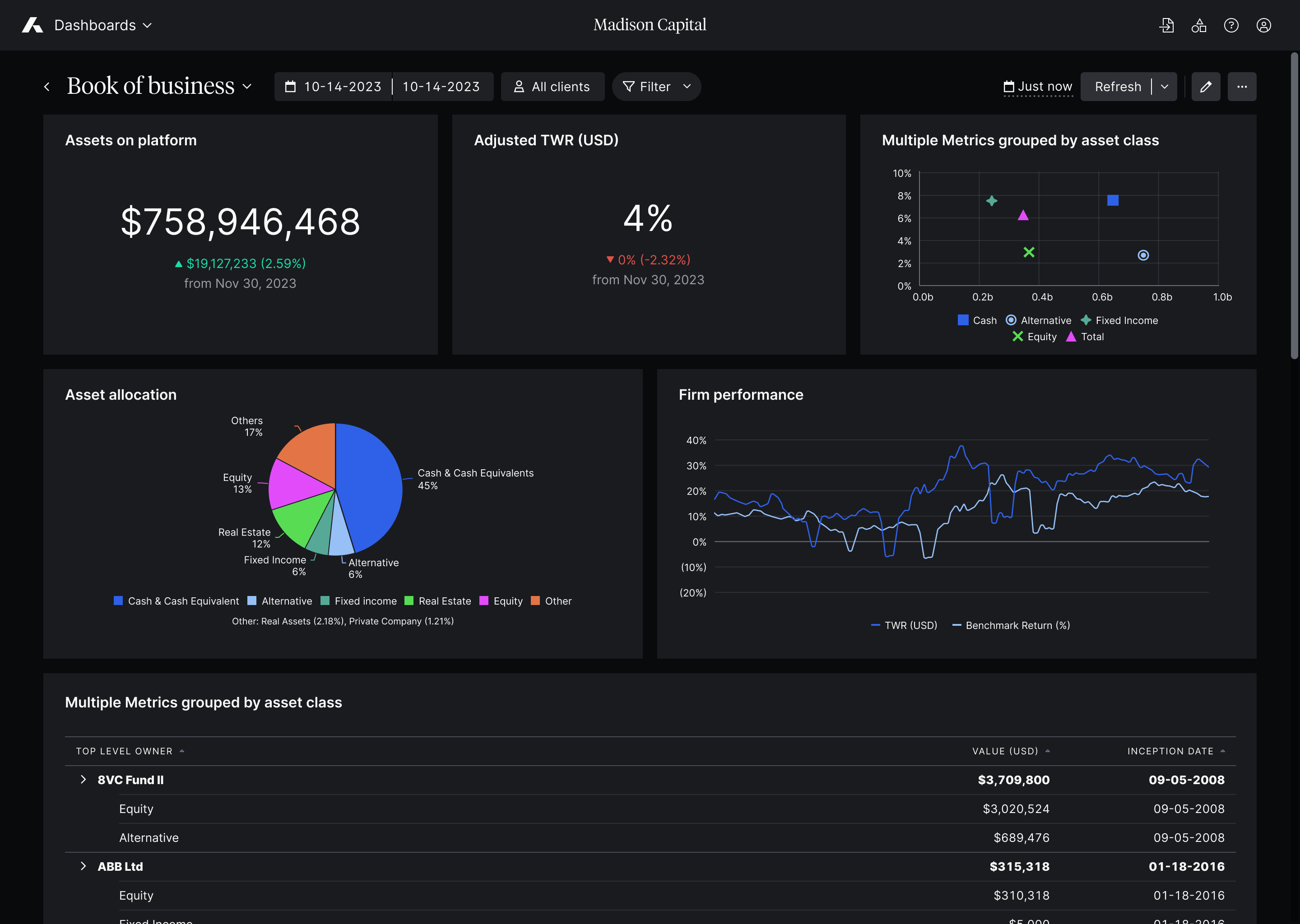
Around that core, Addepar has assembled the rest of the investment office. Navigator projects cash flows, liquidity, returns and portfolio value under different scenarios. Trading supports rebalancing and order workflows, including drift monitoring. Marketplace, offered through its broker-dealer Acervus Securities, lets eligible clients evaluate and initiate transactions in products such as private funds, secondaries and cash equivalents. Professional services cover the uncelebrated work of migration, configuration, validation and training.
The expansion has a logic. If the platform already knows that a trust owns 40 percent of an entity that owns three funds, it is in a better position to forecast liquidity, calculate fees or propose a rebalance. The product does not win each workflow from scratch. It carries the trusted portfolio context with it.
The AI chapterThe assistant came after the data had somewhere to live
In 2026, Addepar released Addison, a native AI experience that lets users ask portfolio questions in natural language. It also introduced ADX, the Addepar Data Exchange, to move unified wealth information into connected systems and AI workflows. The interesting part is not the chat box. Financial answers need permission controls, traceability and a defensible path back to source data. A fluent guess is worse than a slow spreadsheet when a client is asking about millions of dollars.
Addepar's sequence is worth copying: first collect, normalize and govern the data; then add intelligence. Many companies are attempting the reverse. Addison can be useful because it sits over years of portfolio structure and calculation logic. In other words, the AI feature is new, but the reason it may work is old.
The bill and the bargainThere is no public price tag, which is itself useful information
Addepar sells enterprise software through negotiated contracts and does not publish a rate card. Industry analysis describes pricing partly linked to assets represented on the platform, while implementation, data migration and specialist support add to the real cost. Some users and consultants describe it as two or three times the price of alternatives. Public anecdotes include annual spend above $100,000, but that is not an official quote and should not be treated as one.
The more consequential cost may be organizational. Someone must make decisions about classifications, return methodologies, permissions and report definitions. Historical data must be cleaned. Teams must learn a capable but complicated system. Reviews praise its power while warning that integrations and onboarding can take time. A firm buying Addepar to avoid thinking about its data will be disappointed; the software makes those decisions durable, not unnecessary.
What changed buyers' minds in Addepar's published case studies is usually not a sparkling feature. It is a breaking point. Reports take days. Manual data entry creates doubt. Private investments live outside the main system. A growing firm realizes each new client requires more operations staff. One case describes a four-person investment team supporting $3.6 billion. Another highlights an advisory business growing from $10 million to $400 million. At that scale, software stops being an IT purchase and becomes capacity.
The competitive edgeDepth on the way in, gravity on the way out
Addepar competes with Orion, Black Diamond, Envestnet Tamarac, SS&C Advent, SEI Archway, Masttro and FundCount, among others. The category is not a single horse race. Some alternatives are better for conventional RIA portfolios, some specialize in family-office accounting, and some are easier to deploy. Addepar's wedge is the combination of complex ownership, alternative assets, multi-currency reporting, configurable analytics and an open ecosystem.
That depth creates a moat with two sides. A customer may need consultants and patience to encode its world. Once years of classifications, calculations, entity relationships and client reports live inside the platform, moving them is no casual weekend export. Critics call that lock-in. Addepar would call it infrastructure. Both descriptions can be true.
Its customers also explain the unusual economics. A consumer app has to persuade millions of people to care about a few dollars at a time. Addepar can sell to a smaller number of firms for which one reporting error, missed capital call or badly modeled ownership structure carries a serious cost. The buyer is not paying for colorful charts. It is paying to reduce doubt, shorten recurring work and let the same team handle more complexity. That is why a six-figure anecdote can sound absurd to one adviser and reasonable to another.
The company has raised at least $727 million in the major publicly announced rounds since 2011, including $230 million in May 2025 at a $3.25 billion valuation. The latest round, co-led by Vitruvian Partners and WestCap, funded product development and global expansion. Addepar now has offices spanning New York, Mountain View, Salt Lake City, London, Edinburgh, Pune, Dubai, Geneva, São Paulo and Singapore.
Addepar describes its culture in the language of ownership, direct feedback, client focus and continuous learning. The less polished evidence is its spending pattern: the company has publicly said it invests more than $100 million a year in research and development, while its open-source history includes Ember Table, a data-grid project that earned broad use in the JavaScript community. This is a company built around people who find edge cases interesting. That temperament is valuable when the edge case is a trust owning a partnership that owns an asset nobody priced this month.
The useful copyFind the spreadsheet people cannot safely abandon
The lesson is not to build family-office software. It is to look for a valuable workflow where the visible pain is reporting but the underlying problem is representation. Start with the exceptions competitors dislike. Preserve lineage so users can inspect an answer. Make customization systematic rather than a pile of one-off services. Then expand from the system of record into adjacent decisions.
This playbook fails when the underlying data is already standardized, the buyer does not feel the cost of errors, or implementation exceeds the value of the decisions being improved. It also fails if a vendor mistakes configurability for usability. Powerful software still needs a team capable of operating it. For a small adviser with liquid portfolios, a lighter tool can be the smarter choice.
Addepar sits in an unusual place in financial technology: not the custodian, not the accounting ledger, not the CRM, and not merely the reporting layer. It is the connective model that tries to make those systems agree. The company began with a question wealthy investors found embarrassingly hard to answer. Seventeen years later, the question remains good business.