The least glamorous part of sustainable finance may be the most consequential: somebody has to ask a private company how much energy it used, whether workers were injured, who sits on its board and what happened to emissions this year. Then somebody has to check the answers, reconcile the units, preserve the evidence and send the same facts to investors, lenders, customers and regulators. For years, that job mostly happened in spreadsheets and inboxes. Novata was built for the moment when that method stopped being quaint and started being expensive.
The New York company sits between capital providers and the businesses they own or finance. Its software collects sustainability data, guides people through definitions and calculations, flags questionable entries, compares performance with private-market peers and packages the result for reporting. Around that core it has added carbon accounting, regulatory mapping, risk monitoring, due diligence, AI-assisted document ingestion and human advisory work. It is less a single-purpose ESG app than a translation layer for organizations that keep being asked similar questions in slightly different dialects.
A measuring tape for Plato’s cave
Alex Friedman had seen the problem from unusually expensive seats. Before co-founding Novata, he was chief financial officer of the Gates Foundation, global investment chief at UBS and chief executive of asset manager GAM. In a 2023 interview, he described private companies as living in “Plato’s Cave” - isolated from the comparative information public companies take for granted. An emissions number, a turnover rate or a board-diversity percentage tells you little until you can compare it with a relevant peer.
Novata was formed in 2021 as a public benefit corporation by a coalition that looked deliberately unlike a normal cap table: the Ford Foundation, S&P Global, private-markets investor Hamilton Lane and Omidyar Network, plus founders, employees and advisers. That composition did two jobs. It supplied financial-data expertise and access to private-market workflows. It also gave a company asking businesses for sensitive operational information a mission-based answer to the question, “Why should we trust you?” Novata is now a certified B Corp, and says mission-driven organizations and employees retain control.

The first commercial product launched in April 2022 after beta testing with general partners, limited partners and portfolio companies. The opening move was restrained: give firms a clear starting set of metrics, let them customize what matters, attach definitions and guidance, then place the answers in a secure database. The founders were not trying to declare one eternal ESG score. They were trying to reduce the administrative tax created by dozens of standards and one-off questionnaires.
“Investors’ ESG expectations have evolved from a ‘trust me’ approach to a ‘show me’ one.”Erik Hirsch, Hamilton Lane02 / What the machine does
Collect once, answer many times
The basic workflow is pleasantly unromantic. An investor requests metrics from portfolio companies. Those companies assign tasks, enter figures, upload evidence and use calculators or guidance when the definitions get thorny. Novata performs quality checks and keeps an audit trail. The investor then views completion across the portfolio, fills unavoidable gaps with clearly labeled proxy estimates, compares companies with peer benchmarks and produces tables, charts or disclosure-ready outputs.
One record, four jobs
Carbon Navigator handles Scope 1, 2 and 3 calculations, financed emissions and target setting. It can ingest spend data, map suppliers to categories, model reduction scenarios and preserve an investor-grade trail. Regulatory Navigator works out which rules may apply based on company profile and geography. Risk Atlas watches reputational, cyber, geopolitical, physical-climate and transition risk. The acquired Atlas Metrics product adds European reporting workflows, double materiality, an external data-request network and digital sustainability microsites.
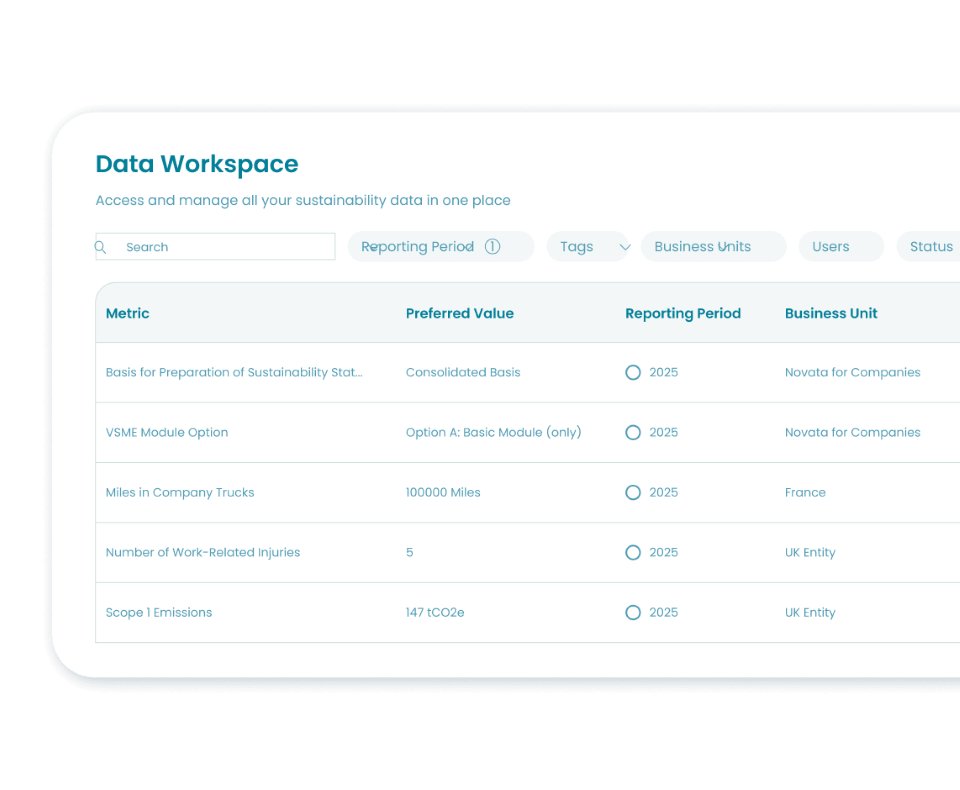
Novata AI is being threaded through those jobs. It turns spreadsheets and documents into structured records, creates an evidence base for questionnaire responses, flags suspect values and drafts reports with claims traced to source material. The important word is traced. Sustainability claims can affect financing, procurement and compliance; a fluent paragraph without provenance is a liability. The company also advertises Model Context Protocol access, allowing clients to query sustainability records from other AI-enabled tools without copying the database into yet another silo.
03 / The compounding advantageThe dashboard is useful. The comparison is the product.
Most competitors can build a questionnaire and a carbon calculator. Novata’s harder-to-copy asset is the network created when thousands of private businesses report through the same system. Its current benchmark library covers more than 300 metrics. The company says it collected, cleaned and analyzed 1.24 million data points, applying sample thresholds, de-identification, outlier removal and statistical review. Users can slice comparisons by industry, geography, company size, revenue or head count.
That context changes the conversation. A fund manager can spot a portfolio company with unusually high emissions per employee. A company can defend a target using a relevant peer group instead of a broad economy-wide average. If primary data is missing, Novata can create a proxy estimate from reported peers and then replace it when the actual number arrives. Proxy data is a bridge, not a permission slip to stop measuring.
“Once you have the data the question becomes: How does this compare to others like me?”Alex Friedman, Novata
The model also benefits the people who do not buy the investor subscription. Portfolio companies get definitions, reusable answers and a place to maintain historical records. That can reduce the aggravation of answering five stakeholders with five templates. It works only if the requesting investor resists turning the platform into a larger questionnaire, of course. Software can standardize a request; it cannot make an undisciplined data appetite disappear.
04 / The moneyNot cheap - and finally priced in public
Novata sells annual B2B subscriptions and advisory engagements. For companies, its public packages are unusually concrete for enterprise software: $20,000, $50,000 and $100,000 a year, scaling with facilities and supplier counts. Every tier includes the Sustainability Hub, investor and regulatory reporting, Carbon Navigator, Regulatory Navigator, Risk Atlas and supply-chain tools. Another 100 suppliers cost $10,000 a year. Investor pricing varies by portfolio size and selected modules; advisory work is an add-on.
That is hard to justify for a tiny company that needs one emissions estimate and has no recurring reporting burden. It becomes easier to justify when a sustainability manager is reconciling multiple facilities, funds, suppliers, frameworks and years - especially when external advisers are already billing to repair the process. Novata raised $21 million in 2021 and $30 million in a 2023 Series B led by Hamilton Lane, with Microsoft’s Climate Innovation Fund joining. Later strategic rounds were undisclosed.
05 / Five years of widening scopeFrom ten common metrics to an operating layer
A public benefit corporation starts with a shared framework and an ambition to prevent private-market reporting from fragmenting.
Metric selection, guided collection, analytics and stakeholder reporting move from beta into commercial use.
A $30 million Series B lands as the benchmark library reaches 50 universal and more than 200 sector comparisons.
Carbon Navigator commercializes Scope 1, 2 and 3 workflows, targets and audit-ready reporting.
A technology and sales collaboration precedes the acquisition of Berlin-based Atlas Metrics.
Supply chains, risk and AI move forward; EcoVadis connects supplier carbon data; Novata reaches No. 244 on the Inc. 5000.
The Atlas Metrics deal is the clearest sign of what changed Novata’s mind about scope. Private-market ESG collection was the wedge, but clients did not experience carbon, regulation, risk and supplier requests as separate products. They experienced one queue. Acquiring a European platform added regional expertise and helped combine two networks at more than 400 clients and 13,000 reporting companies. Microsoft became more than an investor, adding Azure AI Foundry, Azure AI Search and Microsoft Fabric to the collaboration while opening an SME channel. EcoVadis now supplies verified supplier carbon metrics directly into Novata, attacking Scope 3 at the point where it usually breaks: primary data exchange.
What a buyer can copy - and where it breaks
Copy this: choose a small set of decision-useful metrics; assign a named owner; collect evidence with the number; validate before submission; reuse the record across requests; compare only with credible peers; replace estimates when primary data arrives.
Do not expect magic: a platform cannot rescue vague ownership, reluctant portfolio companies or a strategy that collects everything because somebody might ask. It is also excessive for a one-time calculation with no multi-entity workflow.
The boring plumbing may be the durable bit
Novata competes with carbon platforms such as Watershed, Persefoni and Sweep; reporting suites such as Workiva and Diligent; sustainability platforms including Position Green and Novisto; and the incumbent champion, Microsoft Excel. Its differentiation is specific rather than mystical: private-market workflows, a growing body of private-company benchmarks, data requests that span investor and portfolio-company accounts, a public-benefit structure and advisers who can step in when the methodology exceeds the software.
The risk is sprawl. A product that handles ESG data, carbon, regulations, five kinds of risk, due diligence, supply chains, AI and advisory services can become the very complexity it was hired to tame. Integration also raises the stakes for security and data governance. Novata advertises ISO 27001 and SOC 2 Type II compliance, role-based controls and an AWS/Azure infrastructure, but buyers still need to decide who may see portfolio and supplier data.
Still, the company’s growth suggests that the administrative problem is real. Novata says it posted roughly 1,400 percent revenue growth over three years, enough for No. 244 on the 2026 Inc. 5000. Awards are less interesting than the mechanism underneath: every new reporting company can improve the peer dataset; every new framework makes a reusable data layer more valuable; every connected supplier reduces one more email chase. Sustainability software is often sold with a picture of the planet. Novata’s more persuasive image is a clean row in a database - owned, checked, comparable and ready when the next person asks.