A sustainability number has an unusually crowded life. It may begin on a utility bill in one country, pass through a facility manager in another, land in a spreadsheet owned by headquarters, acquire a conversion factor, and finally emerge in a disclosure read by investors, regulators, employees, and auditors. By then it looks very respectable. The awkward question is whether anyone can reconstruct the trip.
Murat Sönmez has built a career around data that cannot afford to arrive late or lose its meaning. In the late 1980s, his work touched the automation of semiconductor factories. In the 1990s and 2000s, he helped scale TIBCO, whose real-time software moved information through financial markets and large companies. Then came six years on the World Economic Forum's Managing Board, including the creation of its Centre for the Fourth Industrial Revolution Global Network. The subjects changed. The systems problem persisted: how do you move consequential information between people, machines, and institutions without surrendering control of it?
Pulsora, the company he co-founded with Inderjeet Singh in 2021, brings that question to sustainability. Its business sounds prosaic because the important parts of enterprise software often do. Collect the data. Validate it. Calculate emissions. Map metrics to reporting frameworks. Preserve evidence. Let the next person see where a figure came from. The result is less a glossy environmental report than the plumbing beneath one. Plumbing gets few standing ovations, but everyone notices when it fails.
The carpet was part of the curriculum
Long before the boardrooms, there was a carpet business. Sönmez graduated from TED Ankara College in 1981, studied industrial engineering at Boğaziçi University, and went to Virginia Tech for a master's degree in industrial engineering and operations research. While there, he began selling Turkish carpets. He later told students at TED University that the trade expanded his network and helped him win the scholarship that allowed him to finish his studies.
The episode is funny in the gentle way that a useful education often is. Operations research teaches optimization. Selling carpets teaches that the map is populated by human beings. Sönmez's later roles demanded both disciplines: the patience to understand a complicated system and the fluency to persuade people with very different incentives to participate in it.
He offered the same students another origin story. An early Indian business partner, he said, entered his life through a chance conversation in a coffee shop. Their Silicon Valley company had an expensive office, so they balanced the books by hiring Stanford students at $10 an hour. Fortune likes a grand narrative; operating history tends to involve rent, coffee, and whoever is willing to do the work.
Real time, then real rules
Sönmez began in Silicon Valley in 1989 as a software engineer at Consilium, working in semiconductor manufacturing automation. He moved to Teknekron Software Systems as a product manager in 1994, helping take a real-time data distribution platform into industries beyond finance. In 1997 he joined the founding team of TIBCO Software. The company went public in 1999; by 2013 it had more than 4,000 customers, offices across 18 countries, and annual revenue above $1 billion.
The lesson of real-time software was not simply speed. A piece of information becomes more valuable when it reaches the correct place while somebody can still act on it. TIBCO sold that premise into markets, logistics, manufacturing, and other complicated operations. Sönmez led customer-facing and global field work, the part of an enterprise company where architecture diagrams encounter procurement committees and production deadlines.
His operating style could be deliberately uncomfortable. In a talk at TED University, he described setting up five separate working groups and creating internal competition so a company could challenge its own products before outsiders did. It is an engineer's version of keeping a fox in the henhouse, except the fox has a product roadmap and a calendar invitation.
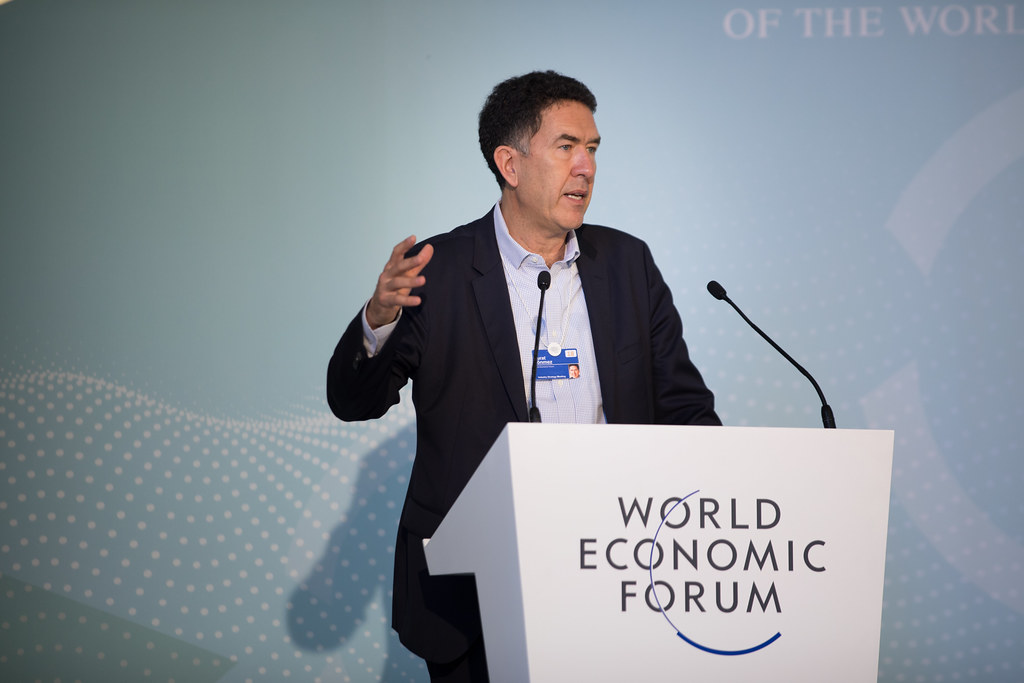
In 2014, Sönmez left TIBCO and joined the World Economic Forum as Chief Business Officer and a member of its Managing Board. Three years later, he returned to San Francisco to establish and lead the Forum's Centre for the Fourth Industrial Revolution Global Network. Its portfolio included artificial intelligence, autonomous vehicles, blockchain, digital currencies, and synthetic biology - technologies famous for moving faster than the rules around them.
That chapter widened the frame. A technical system is never only technical after it reaches society. Someone chooses the permissions, distributes the benefits, absorbs the risks, and answers when the output causes harm. Governance is not decoration applied after invention. Done well, it is part of the architecture.
“Content is good. But context is equally important.”Murat Sönmez, on enterprise sustainability AI
The spreadsheet reaches its natural limit
By 2021, sustainability reporting was becoming an enterprise data problem. Companies faced multiplying disclosure rules and stakeholder requests, but much of the work still relied on annual campaigns across dozens or hundreds of spreadsheets. Sönmez and Singh launched pulsESG as a public benefit corporation with $8.5 million in seed backing. The choice of corporate form made the social purpose explicit while preserving a commercial model.
Their target was the space between the source and the statement. A company might need energy data from many sites, emissions calculations built on documented factors, portfolio metrics collected from separate businesses, and answers translated into several reporting frameworks. If each request begins another email chase, the sustainability team becomes a human integration layer. Humans are excellent at judgment. They are dispiriting middleware.
Pulsora's answer is an integrated system for collection, calculations, workflows, analytics, and reporting. It does not eliminate complexity. It gives complexity an address. A metric can carry its owner, supporting evidence, calculation history, organizational boundary, and destination. When the auditor asks where a Scope 3 figure came from, the answer should not require an archaeological expedition through inboxes.
In September 2023, the company announced a $20 million Series A led by Galvanize Climate Solutions and changed its name from pulsESG to Pulsora. The rebrand mattered because the category had started to outgrow three initials. Sustainability was moving from a specialist reporting exercise toward daily work across procurement, finance, operations, risk, and investment. Sönmez called the funding a mandate to accelerate enterprise sustainability journeys globally. Expansion was part of the plan; so was a broader product.
AI needs a memory before it gets a voice
The latest turn is artificial intelligence. Pulsora now describes a context graph around sustainability AI: the organizational relationships, methodologies, permissions, evidence, obligations, and audit history that give a model bounded knowledge. Sönmez's phrase is compact: content is good, but context is equally important.
This distinction is easy to miss because generative AI is fluent. Fluency resembles certainty from across the room. Inside a regulated company, however, an elegant answer must survive a second question: why? Which data was available? Which method did the system use? Did information cross a boundary it should not have crossed? Can a responsible employee reproduce the result?
For Sönmez, an enterprise's preferred language model can sit inside its own approved environment while Pulsora wraps the relevant sustainability context around it. The architecture aims to keep customer data from training outside models and to make outputs traceable to the governed system. The intriguing product is not a chatbot wearing a green tie. It is the controlled memory behind the conversation.
The prettiest chart is temporary. The audit trail is the product.The operating idea behind Pulsora
A career in connective tissue
Software engineering for semiconductor automation.
TIBCO turns moving data into operational advantage.
The World Economic Forum joins business, government, and emerging tech.
Pulsora gives climate and ESG information a governed system of record.
The arc of Sönmez's career is not a sequence of fashionable sectors. It is a progression through connective tissue. Factory equipment needed software. Markets needed data in motion. Emerging technologies needed governance. Sustainability teams now need reliable information that can cross an organization without becoming anonymous along the way.
Pulsora's current site says more than 500 companies use the platform and lists $33 million in funding raised. In 2025, EY named Sönmez and Singh among its Bay Area Entrepreneur Of The Year finalists. That June, Partners Group selected Pulsora for sustainability data management. In January 2026, the company announced it had been named an Overall Leader and Exemplary Provider in ISG's sustainability guide for emerging providers.
Sönmez has meanwhile pushed the product language from analytics toward agents. At a 2026 sustainability summit, he discussed AI agents as force multipliers and floated a future app store where customers and partners could host sustainability applications. His warning about speed was characteristically plain: it will happen faster than people think. The aspiration is not to automate responsibility away. It is to return time to sustainability professionals while keeping the data, rules, and evidence visible.
The number that can show its work
There is a quiet moral hiding inside data provenance. A company publishes a sustainability claim, and the public is asked to trust it. Better software cannot settle every argument about corporate conduct. It can make evasion harder. A value with an owner, a method, a timestamp, and supporting evidence is a more serious object than a value pasted into a slide.
Sönmez and Singh wrote that they wanted Pulsora to be a labor of love that could leave a better place for their children. The sentiment is large. Their chosen mechanism is granular: workflows, integrations, validations, calculations, and records. Oscar Wilde observed elsewhere that truth is rarely pure and never simple. Enterprise sustainability might add a footnote: truth also needs version control.
This is where the carpet seller, the software operator, and the technology governor meet. Each learned that value travels through relationships. Each learned that trust is built by making the exchange legible. And each, in a different way, depends on remembering how an object arrived in the room. Pulsora's wager is that the future of sustainability belongs to the number that can tell its own life story.