At Putzmeister, the construction-machinery manufacturer, counting emissions used to begin with a telephone call. Then another. The sustainability team held hour-long conversations with more than 30 locations, entered figures into Excel and consolidated the sheets. A company capable of moving concrete around a building site was moving its environmental evidence around by conversation.
- Tracera collects and checks sustainability data from operational documents.
- Manufacturers are its core audience; auditors are part of the workflow.
- Customer cases describe fewer calls, less copying and faster reporting.
- The useful lesson: keep the evidence attached to the number.
The problem was easy to overlook. A spreadsheet could contain a perfectly plausible total without showing whether the underlying figures were correct. Every extra location enlarged the task. Putzmeister considered nearly ten software providers. Several offered attractive screens into which people could type numbers. It chose Tracera for automated collection and sustainability expertise. The distinction was mundane, and consequential: who would do the typing?
01 / The bill is the beginning
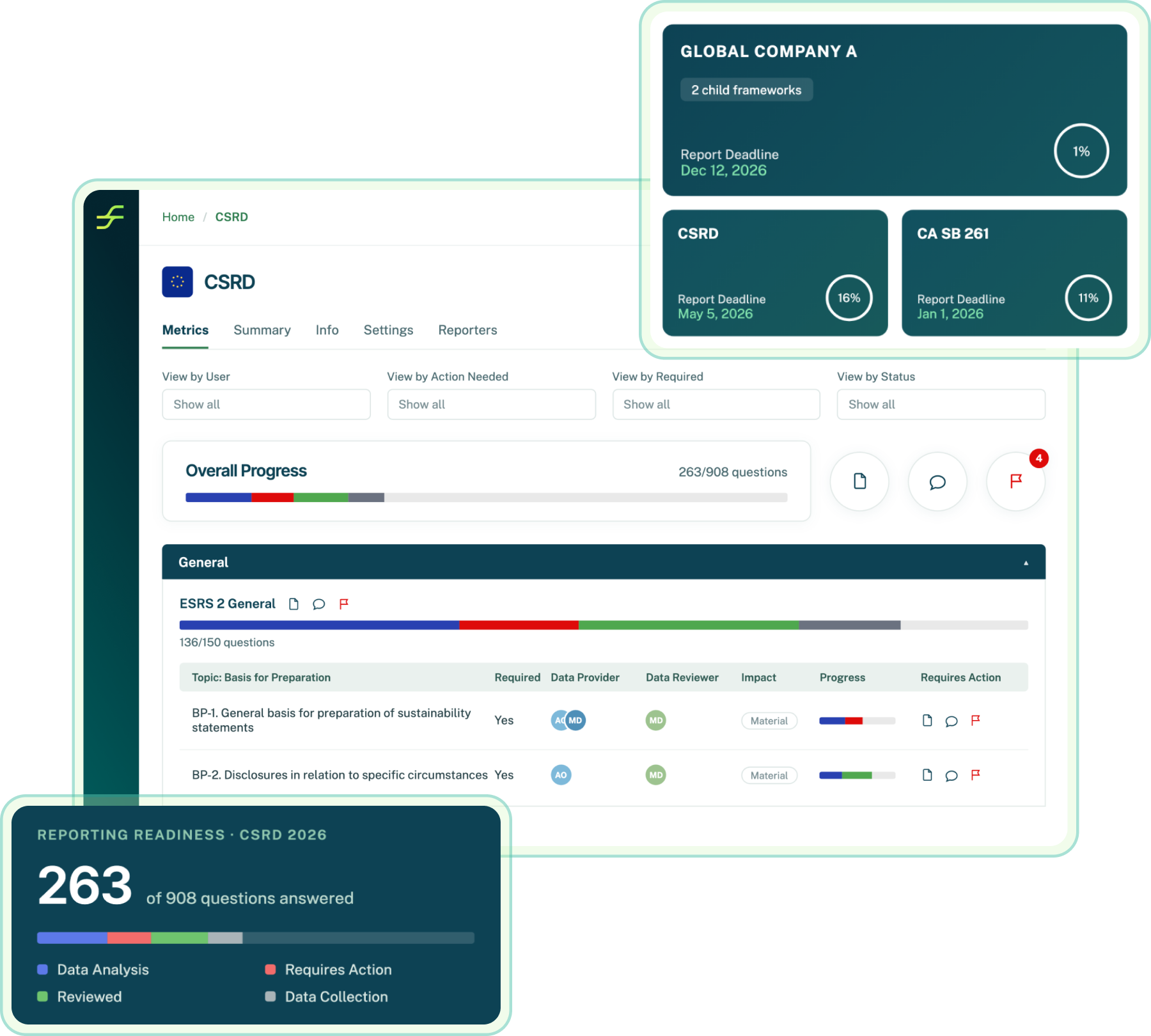
Tracera’s product starts where corporate sustainability often becomes tedious. Utility bills, invoices and other documents contain information that a reporting team needs in a different form. Its AI extracts that information; the platform checks for anomalies and gaps, preserves the route back to the document and lets colleagues review the result. A missing input becomes a task someone can see.
Its collection offering also includes ERP connections and a portal for supplier questionnaires. Carbon accounting adds emissions calculations, intensity metrics and dashboards. The point is to shorten the distance between operations and a defensible report. The software does not make a factory cleaner merely by reading its electricity bill. It makes the factory’s consumption easier to inspect.
02 / A battery maker’s other inventory
EnerSys illustrates the next difficulty. Its case study describes more than 150 sites generating tens of thousands of data points a year. Collecting them was only part of the job. The team also needed a fast way to cross-check the inputs and explain them.
With Tracera, employees could upload bills and let AI extract information from PDFs, then validate it. The source remained alongside the values used for greenhouse-gas and water calculations. The customer described the previous routine as enough work to occupy a full-time employee. That is an avoided staffing burden, rather than a published dollar saving. For a buyer, the distinction matters: saved hours acquire a financial value only within a particular organisation.
03 / The inbox had become a factory
At Sauder Woodworking, data collection once consumed 40 to 60 hours, with another 40 hours spent completing a CDP response. The company had more than 20 sites. Its reporting obligations were growing faster than a small team’s capacity to answer them.
Tracera let individual sites contribute data directly. Sauder could examine entities separately as well as the group total. The change was organisational as much as technical: responsibility moved closer to the people holding the documents.
A later Sauder case describes monthly submissions and a reported 70% reduction in time spent compiling its footprint. It also describes four newly quantified Scope 3 categories. Those cover emissions beyond a company’s own direct operations and purchased energy. Sauder’s Walmart sustainability submission became another use for the same underlying records. One collection process could serve several demanding readers.
“We save 30 calls-or 30 hours-that we used to spend annually.”
Alexander Diez / Putzmeister
In Tracera’s customer case study
04 / Born before the report
The company began inside Bain & Company’s Founder’s Studio in 2022 and launched commercially as ESG Flo in April 2023. Founder Patrick Obeid had encountered the problem while working on environmental projects at Bain. The original proposition was data infrastructure: mapping, gathering and preparing information for verification before anyone worried about its presentation.
A $5.25 million seed round followed in October 2023. In January 2025, ESG Flo became Tracera, putting traceability into the name. That April, it announced a $12 million Series A led by Foundry, bringing announced funding to $17.25 million. The financing backed expansion of the platform. It was company capital, not the price customers paid for a subscription.
In September 2026, co-founder Sandeep Chand succeeded Obeid as CEO after leading product and engineering as CTO. The current pitch retains the emphasis on proof. Tracera says it developed alongside auditors from PwC, KPMG and Grant Thornton. That is a useful description of its design input, rather than a reason to assume every report receives an auditor’s approval.

05 / Buying back the calendar
Tracera sells enterprise software through a demo-led sales process, with advisory services covering subjects such as decarbonization targets and life-cycle assessments. Its market includes carbon-accounting platforms such as Persefoni and broader sustainability systems. For many prospective customers, the incumbent is a mixture of spreadsheets, consultants and patient colleagues.
SPS Global offers a useful comparison. Its previous tool was limited, and collecting information across more than 60 sites could take three months. Its Tracera case reports 92% faster ESG data collection. That is a customer-reported result published by the vendor, not a benchmark every purchaser should expect.
06 / What to borrow before buying
The practical lesson is available without a software contract. Decide which records a report requires. Give each record an owner. Collect it regularly. Keep the original document connected to the extracted value. Reuse verified inputs across questionnaires, and invite reviewers into the process before the deadline.
That approach depends on cooperation: sites must provide records, suppliers must answer and somebody must resolve suspicious values. Automation can flag a gap; it cannot make a missing bill exist. A team with little data and simple reporting needs may gain less from an enterprise system. Tracera’s most persuasive cases involve the opposite condition: information everywhere, proof somewhere, and a calendar filling up with calls.