A tugboat is an inconvenient place to discover the limits of a corporate climate promise. It burns fuel, has a long working life, and cannot be replaced because a slide deck says “net zero.” A port operator has to decide whether to change the fuel, improve the engine, electrify something, or wait for another technology. Each vessel has its own schedule and economics. Wilson Sons, the Brazilian maritime logistics company, faced precisely that tangle. With SINAI Carbon Management, it modeled more than 600 possible decarbonization projects across 14 categories in four weeks. The output was a roadmap for budget conversations, not a claim that 600 projects had been built.
- SINAI joins carbon accounting, supplier data, reporting and project economics in one enterprise platform.
- Its strongest use case is an organization with many facilities, assets or suppliers and a real capital budget to allocate.
- Wilson Sons’ 600-plus modeled options show the method; funding and executing them is the next test.
That distinction is SINAI’s whole argument. Plenty of companies can count emissions. Fewer can put a credible price on a particular reduction, show its likely payback, and persuade the person who controls the capital budget. SINAI sells software for that uncomfortable middle stage. The customer brings the messy reality of sites, suppliers and accounts; SINAI gives sustainability, operations and finance teams a common record and a way to compare choices.
The problem starts before the plan
The first failure is usually mundane: data. Utility bills live in one place, fuel records in another, and supplier figures in an email thread nobody wants to revisit. An inventory assembled in spreadsheets can serve a first reporting cycle, then become harder to audit or repeat as more facilities and emissions categories enter the picture. SINAI’s Measure module gathers activity data, calculation methods, emission factors and evidence trails. Engage tries to replace broad supply-chain estimates with more specific supplier information. Report turns the underlying record into controlled disclosures. Reduce carries the same numbers into the debate over what to fund.
The sequence sounds tidy. Real organizations rarely are. A company may already own accounting, ERP and ESG systems and have no appetite for another grand replacement. SINAI now sells the four modules together or individually, alongside existing systems. It also offers climate advisory services for inventory work, targets, assurance preparation and transition planning. That services layer is a clue to the difficulty of the task: software can organize a method, but it cannot decide which boundary, factor or project assumption is sensible for every customer.
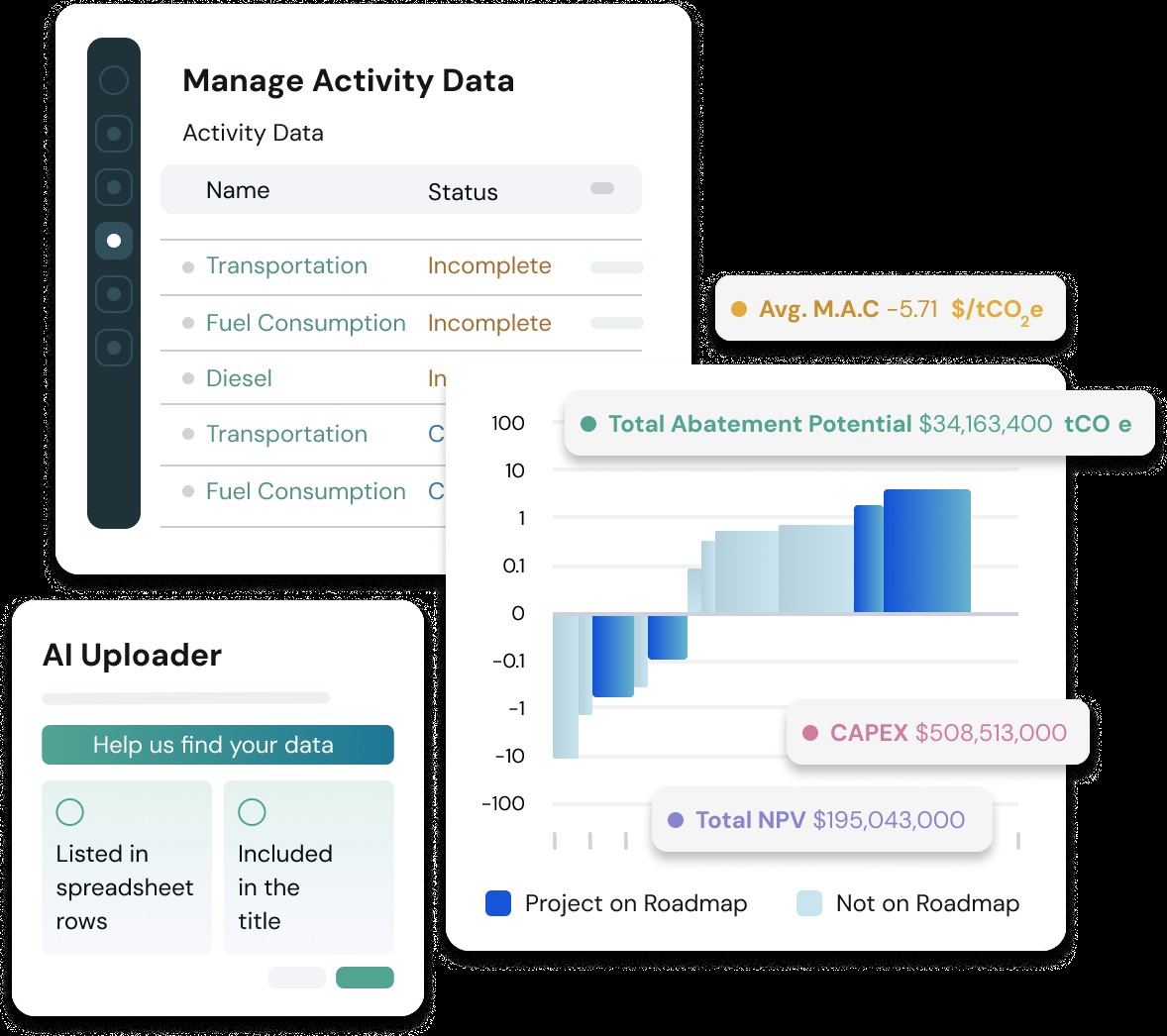
Six hundred answers to one question
Wilson Sons illustrates why the unit of analysis matters. An operator can announce a fleet target, but a tugboat cannot run on an announcement. The company and SINAI considered biofuels, electrification, efficiency, renewables and green fuels against individual vessels and other assets. They weighed operational profiles and financial feasibility with a marginal abatement cost curve, a way of ranking options by cost per unit of emissions avoided. The public case says the modeling took four weeks and saved months of manual analysis. It also says Wilson Sons’ next step was to seek budget approval to implement projects. The clock stopped at a plan, not at measured emissions cuts.
The point is transferable even if the fleet is not. Start with the asset or supplier where a decision will actually be made. Write down current emissions, project cost, expected savings, uncertainty and timing. Compare projects on the same basis. Then let the budget owner see what the climate target asks of the business. A beautiful corporate total does little good if no one can connect it to a machine, a contract or a line of expenditure.
“SINAI’s modules can be used as the company evolves in the climate agenda, providing flexibility to parameters specific to the business.”João Davi / Head of Sustainability, Wilson Sons
A spreadsheet can be a warning sign
At First Sentier Group, a global investment manager, the issue was different. The sustainability team began with Scope 1 and 2 emissions and Scope 3 business travel. As it examined the wider footprint, spreadsheets looked too fragile for a complete, auditable inventory. SINAI’s platform and climate advisers helped extend coverage to waste, water, data centers, and purchased goods and services. The company also used the data to shape a renewable electricity strategy. The public case ties the work to First Sentier’s 80% renewable energy target for 2025, though it presents the outcome in more than one way; the safer conclusion is that the scope of the inventory and the planning process expanded.
That episode says something about the market SINAI inhabits. The alternatives are a spreadsheet, a consultant’s recurring workbook, or one of several enterprise carbon platforms. SINAI’s pitch is most distinctive where the reporting record must also support scenario modeling and investment choices. It is less likely to justify its complexity for a small organization with a few utility accounts and no portfolio of reduction projects. And no software removes the need for dependable source data or the authority to spend money.
When the supplier is the blind spot
Scope 3 emissions invite a special sort of false confidence. A company can apply an industry average to its purchases and produce a number precise to the decimal. The number may be adequate for a rough inventory and still be poor evidence for choosing between actual suppliers. SINAI participated in CarbonPrime, a collaboration involving Sumitomo Corporation of Americas, Bayer, JBS, AMAGGI and Rumo. The participants traced primary emissions data through an agricultural chain from Brazilian production toward global markets. The initial results, published in 2023, showed the practical work behind a deceptively simple ambition: deciding how emissions should be allocated as products pass from one business to another while protecting sensitive operational information.
The collaboration began with a deliberately manageable slice of the chain. That is the useful lesson. A full map of every supplier sounds impressive and can become impossible to verify. Start where the data can be checked and a decision could change. SINAI’s Engage product follows the same logic at software scale, collecting and validating supplier information before handing it to procurement and planning teams.
What the company has become
Maria Fujihara and Alain Rodriguez founded SINAI in 2017. Fujihara served as CEO through its early funding rounds; the company’s current leadership page names Jess Waldeck as CEO and Fujihara as board chair. A nearly $4 million pre-seed round was followed by a $10 million seed round in 2021 and a $22 million Series A led by Energize Ventures in 2022. At that point SINAI said its users spanned more than 60 countries and 20 industries. Its own 2025 review reports 560 million tonnes of CO2 equivalent tracked in the platform and 1,534 reduction projects modeled. Those are company-reported activity figures, not independently measured climate outcomes.
Recent work has moved in two directions at once. The product has gone deeper into the boring mechanics, including utility bill ingestion and AI-assisted matching of uploaded records to emissions factors. The business has gone wider: in 2026 SINAI announced a partnership with Saudi Arabia’s Regional Voluntary Carbon Market Company to offer an enterprise decarbonization platform hosted in the kingdom. Both moves fit the same thesis. A climate plan becomes useful only when a company can trust the input and act on the output.
The cost of SINAI’s software is not public; the company sells through a demo-led enterprise process, with advisory help available. For a buyer, the more interesting cost is organizational. Someone must own the source data, someone must examine the assumptions, and someone with a budget must decide. SINAI can put those people in the same conversation. It cannot make the decision for them. That may be the most honest thing about the product: the final button is still labeled “approve.”