Before the software companies and the international policy meetings, there were Turkish carpets. While studying at Virginia Tech, Murat Sonmez sold them, building a network that helped him obtain a scholarship and complete his graduate education. It is an unusually tangible opening to a career spent largely on things people cannot touch: software, information flows, institutional agreements. A carpet has edges. A business system has rather more opportunities for disagreement about where the edges belong.
Today he is the co-founder and CEO of Pulsora, which helps companies collect, manage and report sustainability information. The distance between those two occupations is considerable. Yet the carpet story offers a useful way into his public career. He was learning a technical discipline while discovering that progress also depends on conversations. Years later, whether working with enterprise customers or governments, he would keep operating at that junction between a system and the people expected to use it.
A degree, a carpet, a conversation
Sonmez completed his school education at TED Ankara College, graduating in 1981. He went on to study industrial engineering at Boğaziçi University in Istanbul, followed by a master’s in industrial engineering and operations research at Virginia Tech. Those subjects concern the organization of work, resources and decisions. They provide a useful background for a career that would cross factories, trading systems, global sales and public policy, without requiring every stop to resemble the previous one.
His early working life began before Silicon Valley. Returning to his old school, he recalled summer work at a hotel during his high-school years, using the English he had learned at the college and earning pocket money. He also told students that his master’s thesis had been rejected eighteen times before acceptance on the nineteenth attempt. The detail puts a little grit into an otherwise smooth executive biography. A finished degree can conceal quite a lot of unfinished drafts.
When speaking to students at TED University, he described opportunity as something they could help create through work, and urged them not to fear mistakes or failure. The carpet business belongs in that account of education. It connected the formal pursuit of a degree with the informal business of meeting people. His advice gives the anecdote its weight: the route through an institution can include useful work well outside its classrooms.
The machinery behind the business
In 1989, Sonmez began his Silicon Valley career at Consilium, working on software for semiconductor-factory automation. Over the following years, his responsibilities moved from engineering toward product marketing. That shift matters in a story about a founder who would eventually spend so much time between technical teams and business leaders. He had worked on building software before taking on the job of helping customers understand what it could do.
He joined Teknekron Software Systems in product management in 1994. The company supplied real-time financial trading systems. In 1997, he became part of the founding team of TIBCO Software in Palo Alto. The progression put him close to enterprise information at moments when timing and coordination mattered. A factory, a market and a multinational company are very different settings. Each gives software a practical test: can the right information reach the right place while it is still useful?
TIBCO went public in 1999. Sonmez stayed until 2014, serving in roles that included chief marketing officer, general manager for Europe, the Middle East and Africa, and head of global field operations. His remit eventually covered worldwide sales, delivery and field operations. In other words, the work extended well beyond demonstrating a product. It included the difficult business of getting software sold, delivered and used across borders.
By 2013, TIBCO had reached roughly $1 billion in revenue, with 38 offices in 18 countries and more than 4,000 customers. Those figures describe the company he helped build and operate, rather than a personal scorecard. They also explain the scale of his next assignment. When the World Economic Forum recruited him, it was bringing in someone who had spent years managing the relationship between a technical organization and a geographically dispersed business world.
From delivery deadlines to policy clocks
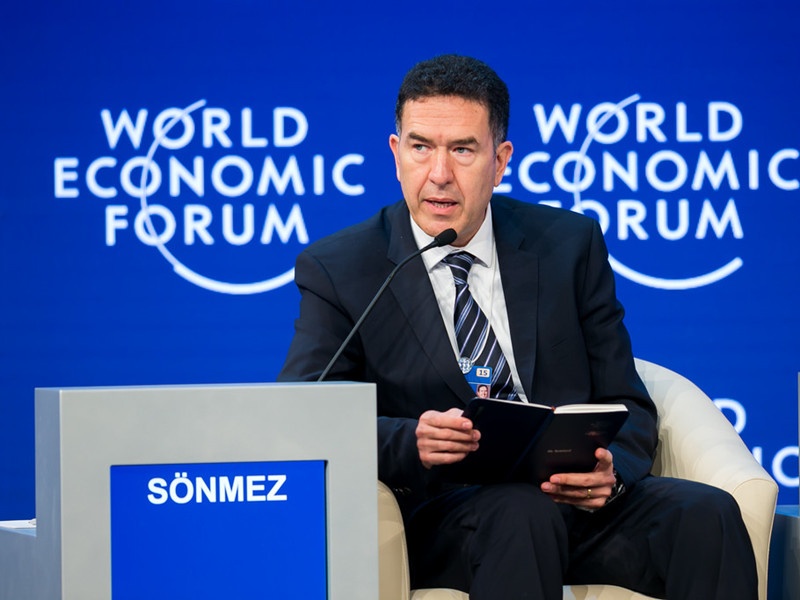
The World Economic Forum announced his appointment as chief business officer and a member of its Managing Board in August 2014. His responsibilities included developing its business communities and partnerships, with attention to geographic diversity. He moved to Geneva. After two decades in enterprise software, his work now involved an institution that brings together businesses, governments and civil society, each with its own interests and its own understanding of an acceptable outcome.
That is a substantial change of working environment. A software customer can decide whether to buy. A public-private collaboration must accommodate people who cannot simply be treated as customers. Sonmez’s appointment placed his commercial and technical experience inside that larger negotiation. The practical question became how organizations with different incentives could work together on technologies whose consequences extended beyond the companies building them.
In 2017, he became the founding head of the Forum’s Centre for the Fourth Industrial Revolution global network, returning to San Francisco. The centre was based at the Presidio. Its remit included governance for emerging technologies such as artificial intelligence, blockchain and autonomous systems. The word governance can sound comfortably abstract until someone has to decide what information a system may use, who is accountable for its decisions, or how a new technology should be tested.
The network’s approach was to bring governments, companies, researchers and civil society into the design and testing of policy frameworks. Hubs in China, India and Japan followed in 2018. Local partners would extend the network further. The method treated policy as something that could be piloted and refined alongside technology. That is an appealing proposition for an engineer: rules, too, should encounter the world before everyone declares the work complete.
Sonmez served on the Forum’s Managing Board from 2014 to 2021. This period supplied a second kind of systems experience. At TIBCO, he had helped a company operate across markets. At the Forum, he worked on cooperation across institutional boundaries. Reading those roles together suggests a continuity in his career, even through the change of employer: useful technology needs arrangements that let people trust it and agree on how it should be used.
A founder again, with a hundred conversations
In 2021, Sonmez and Inderjeet Singh founded the company originally called pulsESG. The enterprise was established as a public benefit corporation, with the aim of helping organizations manage and improve their environmental, social and governance performance. Sonmez’s time at the Forum had helped him recognize the need for such a platform. Returning to entrepreneurship gave him a way to address that need through a product rather than another convening.
The founders spoke with more than 100 sustainability leaders across industries while building the company. Sonmez later described what they learned: regulation was one pressure, but investors, customers, employees and suppliers also shaped expectations. He argued that sustainability was becoming part of business strategy and needed durable infrastructure. The interviews are an important detail. For a founder with a long career behind him, there was still work to do before assuming he understood the customer.
In September 2023, the company announced a $20 million Series A led by Galvanize Climate Solutions and adopted the name Pulsora. The founders said more than 400 companies had integrated the platform at that point. They also described a wish to leave a better world for their children. Alongside that aspiration sat a practical expansion plan, covering North America, Europe, the Middle East, Australia and Asia. Purpose and a sales territory can inhabit the same announcement.
Company figures displayed by Pulsora as of October 2026.
Pulsora’s current company page reports more than 500 companies on its platform and $33 million in funding raised. In 2024, it established a Global Advisory Board co-chaired by Pamela Gill Alabaster and Yale’s Todd Cort. The initial group included sustainability leaders from Workday, Tiffany & Co., Şişecam, Sabancı Holding and CLP. The arrangement continued the listening process, giving the software business regular access to people doing sustainability work inside different kinds of organizations.
Recognition followed, with Sonmez and Singh named finalists for EY’s 2025 Bay Area Entrepreneur Of The Year awards. In January 2026, Pulsora announced that it had been named an Overall Leader in ISG’s 2025 guide for emerging sustainability providers. These are specific milestones, with specific categories. The more interesting test for Sonmez’s business remains the work underneath them: whether a customer can organize its information and use it with greater confidence.
An answer needs its surroundings
His recent writing concentrates on the context around sustainability data. An emissions figure needs a boundary, a calculation method, supporting evidence and a history. Without those relationships, an apparently precise answer can be difficult to interpret. In March 2026, Sonmez described Pulsora’s context graph as a way to connect that information, so an AI system can work with the circumstances behind a number as well as the number itself.
“Content is good. But context is equally important.”
Murat Sonmez, on sustainability AI
The idea has consequences for everyday decisions. A change in reported emissions might reflect a changed organizational boundary, a different methodology or an operational change. Those explanations lead to different actions. Sonmez’s argument is that sustainability software should preserve the connections needed to distinguish them. The administrative detail deserves attention because the alternative is a fluent answer followed by a lengthy search for what it actually means.
In public demonstrations with colleague Jeannie Blackwood, he has discussed how Pulsora can wrap that context around a customer’s approved language model, working within the organization’s existing controls. The company says it keeps customer data from being used to train outside models. Here his software and policy careers meet quite directly. The model’s ability to produce an answer is only one part of the job; permissions, traceability and accountability belong in the design as well.
At a 2026 sustainability workshop, he described ambitions for an app store where customers and partners could host their own sustainability applications. That remains a stated direction, rather than a finished achievement. His interest is in giving practitioners more room to build and use tools around their work. The ambition extends the old enterprise-software question: how much useful capability can be put in the hands of the people closest to the problem?
He also remains connected to education, serving on TED University’s Board of Trustees and speaking to the TED Ankara alumni business community about AI in June 2026. The career has travelled a considerable distance from Ankara, yet it keeps returning to the business of learning from other people. The student who sold carpets needed a network to finish a degree. The founder building sustainability software still needs conversations to discover what the system ought to do next.