The dullest recurring drama in sustainable finance begins with a spreadsheet attachment. A bank asks a company for emissions, workforce and governance data. Another lender asks again, with different column names. A third asks for the same facts rearranged to suit another rulebook. The company hires consultants; the bank receives gaps; everybody calls the result a framework. ESG Book has spent eight years trying to turn that ritual into software.
Its proposition is less philosophical than its name suggests. Collect the underlying facts. Keep the route back to each source document. Standardise the fields. Let companies control non-public information. Then deliver the result by dashboard, API, cloud warehouse or file into the systems where investors and risk officers already work. The output can be a score, a portfolio screen, an emissions estimate, a regulatory report or a disclosure request. The same data should not have to be born again for each use.
01 / The useful accident
It began because an asset manager disliked the available ingredients
ESG Book did not begin with a founder sketching a climate unicorn on a café napkin. It began inside Arabesque Asset Management. The investment firm wanted to use environmental, social and governance information in quantitative portfolios and found the familiar problems: spotty disclosure, incompatible definitions and ratings whose neat certainty hid untidy assumptions. So it built Arabesque S-Ray, its own sustainability data and scoring machinery.
That internal repair job became a separate company in 2018. The crucial move was recognising that the data problem was larger than one fund's investment process. Banks needed it for credit and capital rules. Asset managers needed it for screening and client reports. Corporates needed it to answer investors and regulators. Consultants needed a reliable substrate for advice. The same pipes could serve all of them.
The first model still carried the habits of ESG ratings: scores built from public company reporting, sector materiality and external signals. What changed was the ambition. S-Ray became ESG Book in 2022, separated from Arabesque and presented itself as a platform rather than a private analytical instrument. A $35 million Series B led by Energy Impact Partners, with Meridiam and Allianz X, paid for more staff, product development and expansion in the United States. Earlier Series A shareholders Commerz Real and BMH sold their minority stakes during the round.
“The score is the cover. The defensible product is everything a sceptical user can inspect underneath it.”YesPress analysis
02 / Open the black box
A rating that shows its homework
The ESG ratings industry has an awkward feature: two respectable providers can study the same company and disagree sharply. They choose different topics, weights, estimates and penalties. ESG Book's answer is not to pretend disagreement disappears. Its Performance Score uses sector-specific materiality inspired by SASB, but customers can travel from the headline number through more than 450 standardised and derived metrics to the underlying source material. Companies that fail minimum disclosure requirements do not receive the score.
The product gets more useful as you move beneath the number
Conceptual diagram: ESG Book lets users move from company and portfolio scores toward raw attributes, methodology and original documentation.
There are several lenses because there are several questions. The ESG Performance Score asks how a company performs on financially material sustainability topics. The Risk Score looks for exposure to principles associated with the UN Global Compact. The Decarbonisation Score compares emissions trajectories and targets. Fund scores aggregate signals across thousands of ETFs and mutual funds. “Core” versions rely on company data; “Plus” versions can incorporate news and NGO signals to capture the view from outside the annual report.
Access, the broad public-data product, now covers 76,000 companies across more than 500 metrics with as much as five years of history. It includes reported figures, Scope 1-3 estimates and EU Taxonomy classifications. Customers can receive refreshed data through API, Snowflake, AWS, Google Cloud, SFTP or CSV. This distribution menu matters. A beautiful dashboard is useless when a bank needs the data inside a risk model at 4 a.m.
03 / Report once, answer many
LEO treats repeat questionnaires as a design flaw
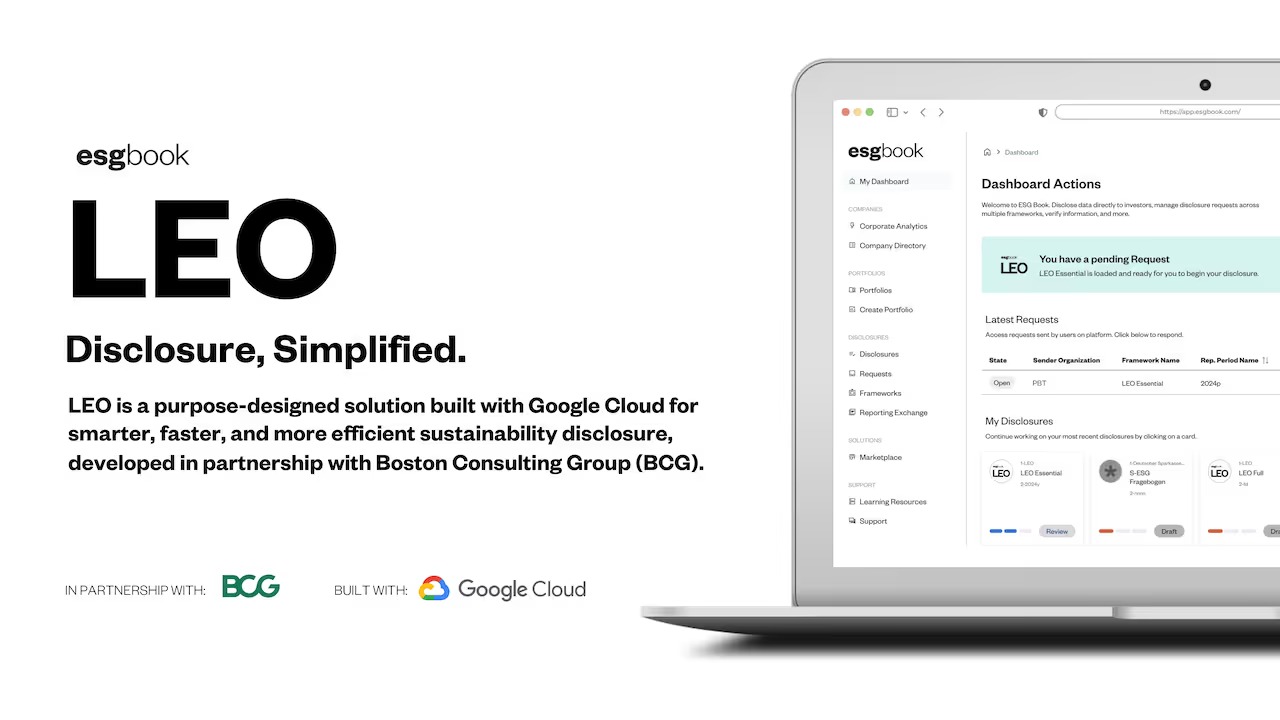
LEO is the cleanest expression of ESG Book's second act. Launched in April 2025, it was developed with Boston Consulting Group and built with Google Cloud. BCG supplied a harmonised disclosure template; Google's cloud and AI tooling supports document extraction, structured data and secure delivery. ESG Book contributes the platform, existing disclosure library and connections between corporate reporters and financial institutions.
The workflow attacks the first failure in sustainability reporting: collection. LEO can pre-fill fields from more than 200,000 public disclosures, leaving a company to confirm, correct or add what is missing. It maps answers across standards including ISSB and GRI, handles multiple incoming requests in one place and lets the company grant permission to private information. Instead of completing a new questionnaire for each bank, a supplier can maintain one governed record and share the relevant slice.
One disclosure, four jobs
ING, Lloyds and NatWest were adopting or piloting LEO at launch. Their use cases reveal the product's real market. This is not only a sustainability report generator. A bank might use client data for transition-risk assessment, supply-chain resilience, due diligence or EBA Pillar 3 preparation. The corporate user gets less repetitive work; the institution gets more consistent responses and better coverage. The system becomes attractive only when both sides participate.
That last condition is important. “Disclose once, share many” works when requested fields overlap, standards can be mapped without erasing important distinctions, and counterparties accept the shared record. It works less well for bespoke diligence, novel indicators, companies with no dependable source material or institutions that insist on their own definitions. Pre-fill can remove keystrokes; it cannot invent a meter reading or settle a contested methodology.
04 / Selling the plumbing
The customers sit on both sides of the form
ESG Book sells enterprise data and software to financial institutions, corporates and advisers. Commercial clients license datasets, scores, analytics, regulatory tools and integrations. Corporate participation in LEO is described as free, which lowers the barrier for the data suppliers and makes the network more useful to paying institutions. Public enterprise prices are replaced by the familiar “book a demo.”
The client list has included Bloomberg, BNY Mellon, Citi, Dow Jones, Glass Lewis, Google, HSBC, JPMorgan and Nikkei. ESG Book says more than 100 institutional clients collectively manage roughly $120 trillion. The logos are impressive, but the distribution partnerships explain how the business travels: Rimes, Arcesium and BNP Paribas subsidiary Manaos put ESG Book data inside established investment-data environments; C3 AI brings it into corporate ESG software; Risk Software Labs supplies regional reach in the Middle East and North Africa.
Other partnerships fill specialised gaps. Vyzrd combines the data with forward-looking climate-risk and valuation models. Asset Impact starts at physical assets and maps emissions to corporate ownership, giving banks financed-emissions coverage across 13 high-emitting sectors and a PCAF data-quality score. The Watch & Jewellery Initiative 2030 spent 18 months with ESG Book building a digital action and disclosure path for an industry full of smaller suppliers. The lesson is consistent: the generic platform becomes valuable when paired with domain expertise, a distribution channel or a community that can persuade companies to participate.
What another data company can copy
- Start with a painful internal workflow. Arabesque built for its own investment process before selling infrastructure to others.
- Separate facts from frameworks. Store the underlying metric once, then map it into the customer's required standard.
- Preserve provenance. Every derived answer should retain a route to the document, estimate and method behind it.
- Use partners for adoption, not decoration. BCG brought template design, Google Cloud brought infrastructure, and banks brought live demand.
- Put the product where work already happens. APIs and data-platform integrations are not accessories for enterprise buyers.
05 / A bigger European book
The next experiment joins sustainability and credit ratings
Leadership changed in July 2024, when software executive Justin Fitzpatrick replaced Daniel Klier as chief executive. Fitzpatrick had co-founded DueDil, FullCircl and Innovate Finance, experience that signalled a focus on regulated-industry software and scale. LEO followed nine months later. Pulse subsequently extended the range into regulatory intelligence, filtering more than 3,300 ESG rules across more than 100 jurisdictions according to an organisation's size, geography and activity.
Then, in July 2026, ESG Book and EthiFinance announced a combination intended to create an independent European provider of both sustainability and credit ratings. ESG Book's social profile now describes the companies as merged. The logic is timely: lenders do not keep climate, sustainability and credit questions in hermetically sealed rooms. A provider that can connect non-financial indicators with conventional risk analysis may offer a more coherent view, especially across European public and private assets.
The risk is equally clear. ESG Book earned its distinction by opening the black box. A larger ratings group must preserve that inspectability as datasets, methodologies and commercial incentives multiply. Transparent inputs do not guarantee a correct conclusion, but they let a customer argue with it intelligently. In ESG data, that is progress.
What ESG Book actually built is not a universal verdict on whether a company is good. It built connective tissue: from filing to metric, metric to score, company to bank, rule to report, physical asset to financed emissions. Its earliest product tried to make better investment decisions from imperfect information. Its newer products try to reduce the amount of imperfection created by the reporting process itself. That is less glamorous than saving the planet by dashboard. It is also a job software can plausibly do.