A bank can have plenty of data and still struggle to answer a modest question: who has reviewed this account? At Synovus, account administration reviews lived in a trust accounting system. Investment and compliance oversight lived in Portfolio Suite. Each arrangement had its own logic. Together, they produced a familiar corporate inconvenience: several teams, several workflows, and a leadership view assembled from the pieces.
- The job: turn investment data into calculations, oversight, and reports that financial firms can use.
- The buyers: wealth managers, banks, trust companies, family offices, and alternative asset managers.
- The distinction: a performance engine available through APIs, alongside reporting software and hands-on services.
- The odd detail: First Rate says it gives away 10% of revenue, before profit enters the conversation.
01 Six thousand accounts, several versions of the truth
First Rate’s February 2026 Synovus case study describes the consequence as operational friction, inconsistent review experiences, and limited visibility. The institution’s case-study scale: more than 6,000 accounts and more than $60 billion in assets under management. Those are Synovus figures in the vendor’s account of the project, not assets belonging to the software company.
A workflow problem at institutional scale.
Synovus moved account administration reviews into Portfolio Suite, where investment and ComplianceEdge workflows were already operating. First Rate reports fewer duplicate tasks and manual handoffs, a centralized review view, and clearer accountability. The published results are qualitative. The useful detail is the decision itself: bring the administrative review to the investment workflow people already use.
That is a good place to meet First Rate. Its business sits in the space between owning financial information and being able to act on it. A percentage on a client report is the finished article. Behind it are data feeds, corrections, calculation rules, review responsibilities, and someone who must answer when a number looks peculiar.
02 First, teach the data some manners
First Rate supplies the machinery for that backstage work. Its Data Services offering gathers information from custodians, alternative investments, and held-away accounts - investments outside the firm’s direct custody. It handles structured feeds and unstructured PDF statements, normalizing them into a dataset that other systems can consume. Automation is paired with human quality assurance. The humble statement still gets a seat at the table.
The company’s Investment Performance as a Service, or IPAAS, adds calculation and auditing through APIs. A firm can use the engine inside its own platform. First Rate describes editors for broad corrections to prices, accruals, and transaction mappings, as well as smaller account-level changes. Apply a correction and performance results are rebuilt; the audit log records what changed.
- 01CollectFeeds + statements
- 02ReconcileValidate + record changes
- 03CalculatePerformance + analytics
- 04ExplainReports + review
This is a consequential product choice. The client-facing screen and the calculation engine can come from different places. A wealth manager with an established portal need not adopt First Rate’s interface merely to use its performance technology. Equally, outsourcing a calculation does not remove the need to decide who resolves an exception. An API is a connection, not a job description.
For oversight teams, ExecView scans account information for risk exposures, trends, and outliers. Firms can set rules around investment policies and benchmarks and document exceptions and their resolutions. Portfolio Suite combines portfolio views and reporting with InvestEdge’s ComplianceEdge monitoring. The emphasis is on making the review process usable across a book of business.
03 The report gets a speaking part
Then comes the piece the investor sees. CORE 2.0 combines analytics, customizable dashboards, and a drag-and-drop report builder. Its published feature list includes more than 120 schedules covering performance, allocation, risk, holdings, and transactions. Firms can arrange accounts and households, apply their branding, and include externally produced commentary. The report can wear the institution’s suit.
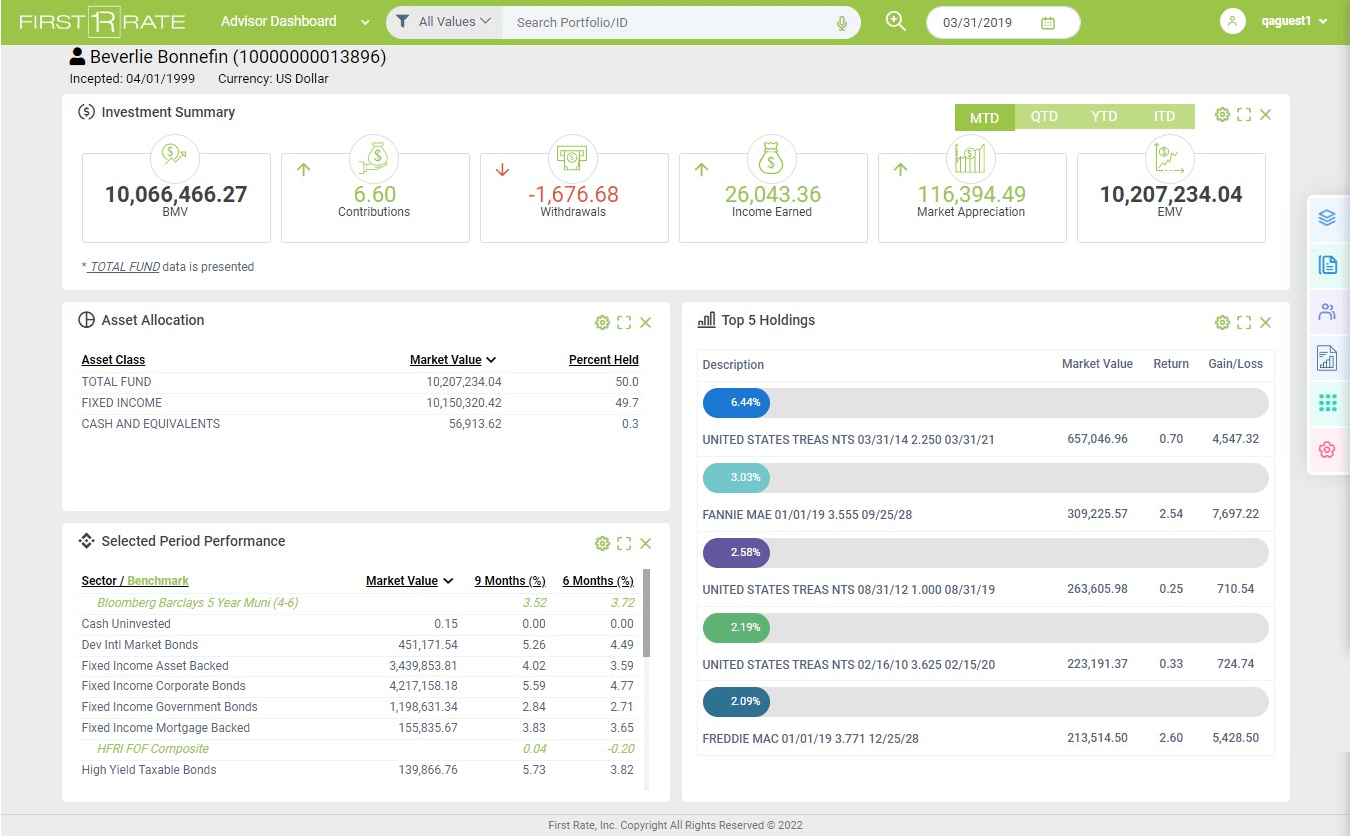
In June 2025, First Rate integrated InvestSuite’s StoryTeller into CORE 2.0. The partnership adds narrative reporting to the calculation platform and uses First Rate’s data engine to keep the underlying numbers consistent. Its API architecture also supports delivery through investor portals or other downstream systems.
The appeal is easy to understand. A chart can display a result without explaining what mattered. Narrative reporting offers another route into the information. But elegant prose makes the data discipline more consequential: the explanation must remain attached to the same calculation the firm is prepared to defend. Otherwise, a friendly report merely becomes a more articulate source of confusion.
04 A long memory in a restless market
First Rate’s company history records PC-based performance software in 1993, web reporting in 1997, multi-currency performance reporting in 2006, and API access in 2008. Those milestones describe a steady migration in delivery. The question underneath them barely moves: how did the investments perform, and can the answer survive scrutiny?
The reporting market includes Addepar and SS&C’s wealth platforms, as well as firms’ own systems. First Rate’s particular combination is a calculation engine, reporting tools, data services, and operational support. Buyers can consider a whole platform or a component. Customization and service are part of the offer, rather than an afterthought to the dashboard.
“We weren’t looking for an off-the-shelf solution.”
Dino Luciano, Chief Operating Officer, James Hambro & Partners
That line comes from the August 2026 renewal announcement for James Hambro & Partners, whose First Rate relationship began in 2020. The renewed work covers centralized performance measurement, attribution, contribution analysis, and consolidated reporting. Luciano’s point was fit: analytics should reflect how the firm works and how its clients consume information.
Expansion has also come through acquisitions. First Rate announced its purchase of Chilean reporting company Finantech in January 2023, describing a strategy of locally run international hubs. In April 2023 it acquired certain InvestEdge wealth-platform assets while partnering on compliance. These moves added capabilities and regional expertise to the existing performance business.
In March 2026, it announced fund administration services through Vantage for alternative asset managers, connecting accounting, reporting, and administrative workflows with the platform. The business model spans software, hosting, APIs, data work, and professional services. A buyer’s commercial discussion therefore needs a scope: which feeds, which workflows, which implementation tasks, and which ongoing responsibilities?
05 The ten percent that comes off the top

David and Trina Stone founded First Rate in 1991. Its public philosophy, First Rate Living, uses four verbs: love, give, serve, enjoy. The unusually concrete part is its stated commitment to donate 10% of revenue to local and global causes, with employees participating in charitable allocations. Revenue is a demanding denominator. Giving does not wait for the accountant to discover a flattering profit.
The founders describe service to clients, coworkers, and communities as their original purpose. The company also says its average customer relationship exceeds 14 years. That is a company-reported tenure measure, not proof that philanthropy causes loyalty. Still, long relationships fit the product: investment reporting depends on accumulated knowledge about both the data and the people interpreting it.

06 Borrow the sequence
There is a practical lesson here for anyone buying financial software. Start with one troublesome account, not a polished dashboard. Ask the vendor to trace the input, surface an exception, correct it, rebuild the return, and show the record of the change. Then ask how the same result reaches an oversight team and a client. This is a suggested evaluation exercise, not a claim about a particular First Rate deployment.
The approach is most useful when data comes from several places and multiple teams must agree on an answer. A firm with straightforward accounts and an adequate existing reporting system may have less reason to add another service. Teams that have not assigned responsibility for exceptions will still need to do that work. The sensible thing to copy is the order: establish the data, settle the review process, then make the answer beautiful.