In 2010, Rob Nance had a banker’s box and a problem. The box contained the documentary sediment of a family’s financial life: an old insurance policy, a house-sale statement, rental agreements specifying how long a bathroom fan could run. In his founding essay, Nance recalls sorting the pile, then facing hours of entry into NaviPlan. Financial planning apparently required a working knowledge of ventilation.
Years later, the software had improved. The repeated typing had survived. That persistence is the premise behind Dispatch, the company Nance founded with Madalyn Armijo and Rafi Lurie. Its chosen territory is the space between the applications an advisory firm already owns, where useful client information becomes somebody’s afternoon.
- Connect the existing stack: client records move between CRMs, planning tools and custodians.
- Prepare and execute: validate data, populate forms, collect signatures and submit supported accounts.
- Bring the workflow closer: the new API lets Wealthbox and Jump embed account opening.
Good tools, bad handoffs
An advisor may like the CRM, the planning software and the custodian individually. Collectively, they can behave like distinguished dinner guests who refuse to speak to one another. A name occupies two fields here and one there. An address changes in one system while another retains its predecessor. Someone becomes the translator, usually without receiving that title.
Dispatch’s job is to normalize those records and keep connected systems synchronized. Its data-syncing product lets firms designate authoritative sources: the CRM for contact details, for example, and the custodian for account status. Identity resolution matches conflicting records; an audit trail records changes. This is expertise in the particulars of advisory operations, including the requirements of institutions holding the assets.

All three founders previously worked at Vise. Nance brought experience as an advisor; Armijo worked in account management and Lurie in product. In January 2024, their company changed its name from OneAdvisory to Dispatch. The new name described the intended behavior: send the data where it belongs, without requiring everyone to abandon their preferred tools.
“We want to operate entirely in the background, sort of like Plaid or Stripe does.”Madalyn Armijo · January 2024
That positioning matters. An all-in-one advisory suite asks firms to accept a package. Custom integrations ask someone to build and maintain individual connections. Dispatch sells coordination across an existing collection. Its competitive proposition is that a shared translation layer can carry more of the maintenance burden than another bespoke connection.
A form is only the beginning
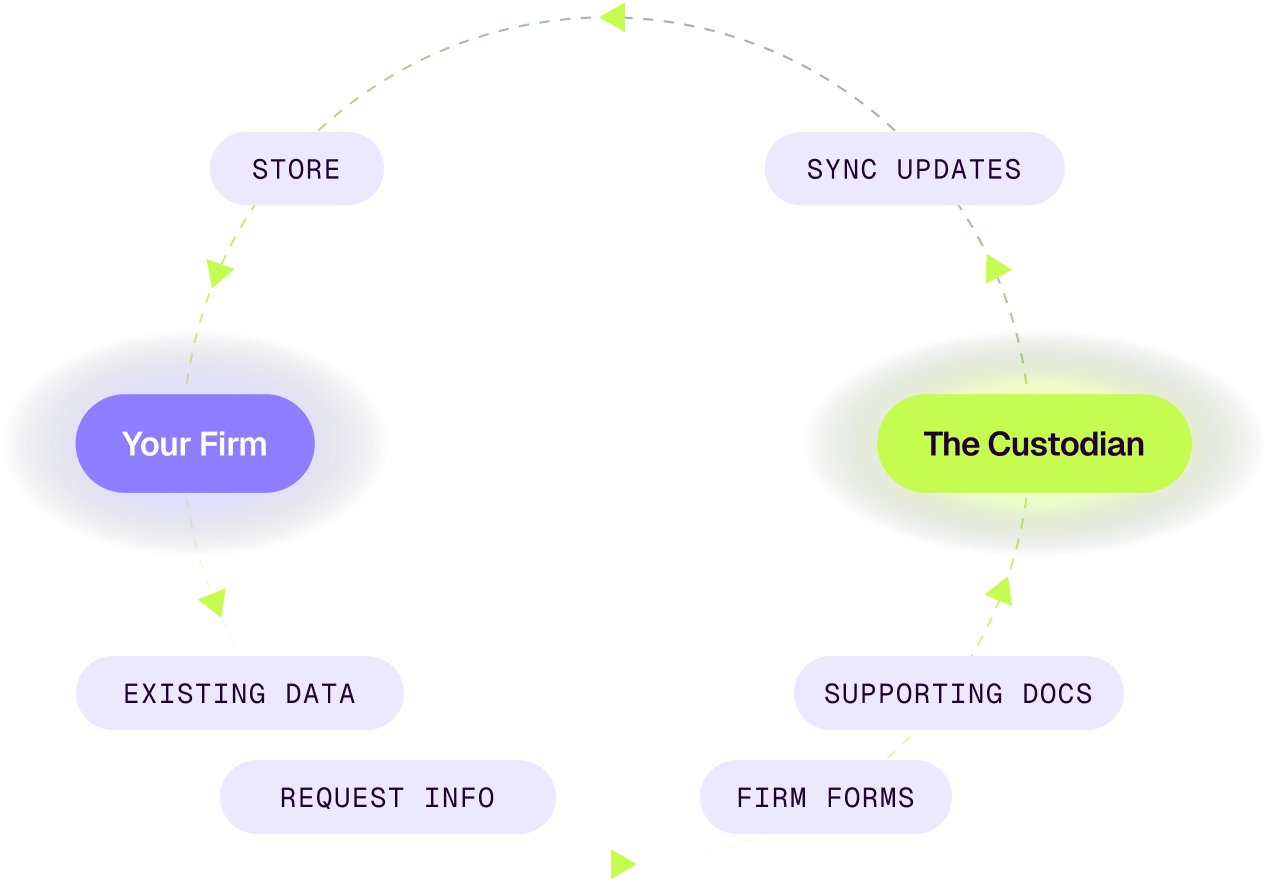
Onboarding turns this abstract plumbing into visible work. Dispatch collects information from existing records or intake, populates supported firm and custodial documents, arranges signatures, then synchronizes records downstream. Account opening adds validation and submission through custodian channels. Fidelity, Charles Schwab and Pershing appear in its supported workflows. Dispatch supplies software; the custodian still holds the account.
- 01Collect & match
- 02Validate & populate
- 03Sign & submit
- 04Track & sync
One coordinated workflow across several systems. Conceptual diagram.
The business model follows the customer: software for advisory firms, larger wealth platforms and fintech vendors. January 2024 reporting put the starting subscription at $99 per user per month. Treat that as a historical price, not today’s quote. The company announced an $18 million Series A in September 2025, led by Brewer Lane Ventures, and reported $30 million in total capital raised.
A February 2026 product explanation describes the practical advance in Schwab account opening. Dispatch can submit eligible applications directly through Schwab’s API, rather than making staff enter them in a portal or rely on document processing. Its preliminary testing reported openings in minutes rather than roughly two days through standard DocuSign processing. Those observations describe a particular execution path, with results that may vary.
Eligibility remains consequential. Some account types cannot use the API; firm paperwork can make DocuSign the sensible route. Dispatch lets firms configure that routing. A client must still sign. An opened account is also different from a funded one. Faster submission removes a bottleneck, rather than abolishing every event between a conversation and invested money.
When an entire book has to move
The same machinery becomes more valuable when an advisor changes firms. A single household’s records are troublesome enough. An entire book brings conflicting identities, different custodians, firm documents and signatures in bulk. Dispatch formally launched Advisor Transitions in May 2026, joining account opening, onboarding and data synchronization as its fourth core workflow.
Client assets moved in under two weeks in a protocol transition, according to Sanctuary Wealth’s operations chief.
ONE CUSTOMER’S REPORTED RESULTThat Sanctuary result illustrates the attraction for aggregators: absorb more work without immediately adding a corresponding number of people. It is a customer testimonial, not a universal timetable. The platform’s usefulness still depends on the records, accounts and processes involved.
Hightower’s August 2026 selection supplies another concrete use case. Its Signature Wealth practice was bringing advisors into a national brand, with Dispatch handling client-data workflows across Fidelity, Schwab and advisory systems. The announcement explicitly describes human approval controls. Standardizing a business requires somebody to decide which information is right before software propagates it.
The button moves next door
On September 14, 2026, Dispatch opened its infrastructure to other software companies through the Dispatch API. Account opening was the first available capability. Wealthbox could begin from the client record; Jump could begin from information gathered in a client conversation. Jump described its experience as a limited beta. Both approaches put execution nearer the work advisors already do.
There is a useful operational lesson here, even for firms using something else. Choose who owns each field. Validate before submission. Track what happened afterward. Keep a record of changes. Purchasing another application will not make those decisions for you.
Dispatch’s ambition is to make those decisions executable across the stack. The account-opening button can be small because the work underneath it is considerable. For an advisor who has already earned a client’s trust, the appeal is wonderfully mundane: fewer opportunities to ask for the same information again.