The Scene
A new client says yes. Then the real work begins.
Somewhere in a wealth management office this morning, a household just signed on. Investments, planning, estate, tax. Five teams, a dozen systems, a hundred small handoffs. For decades that moment - the one that should feel like a beginning - has felt like an apology.
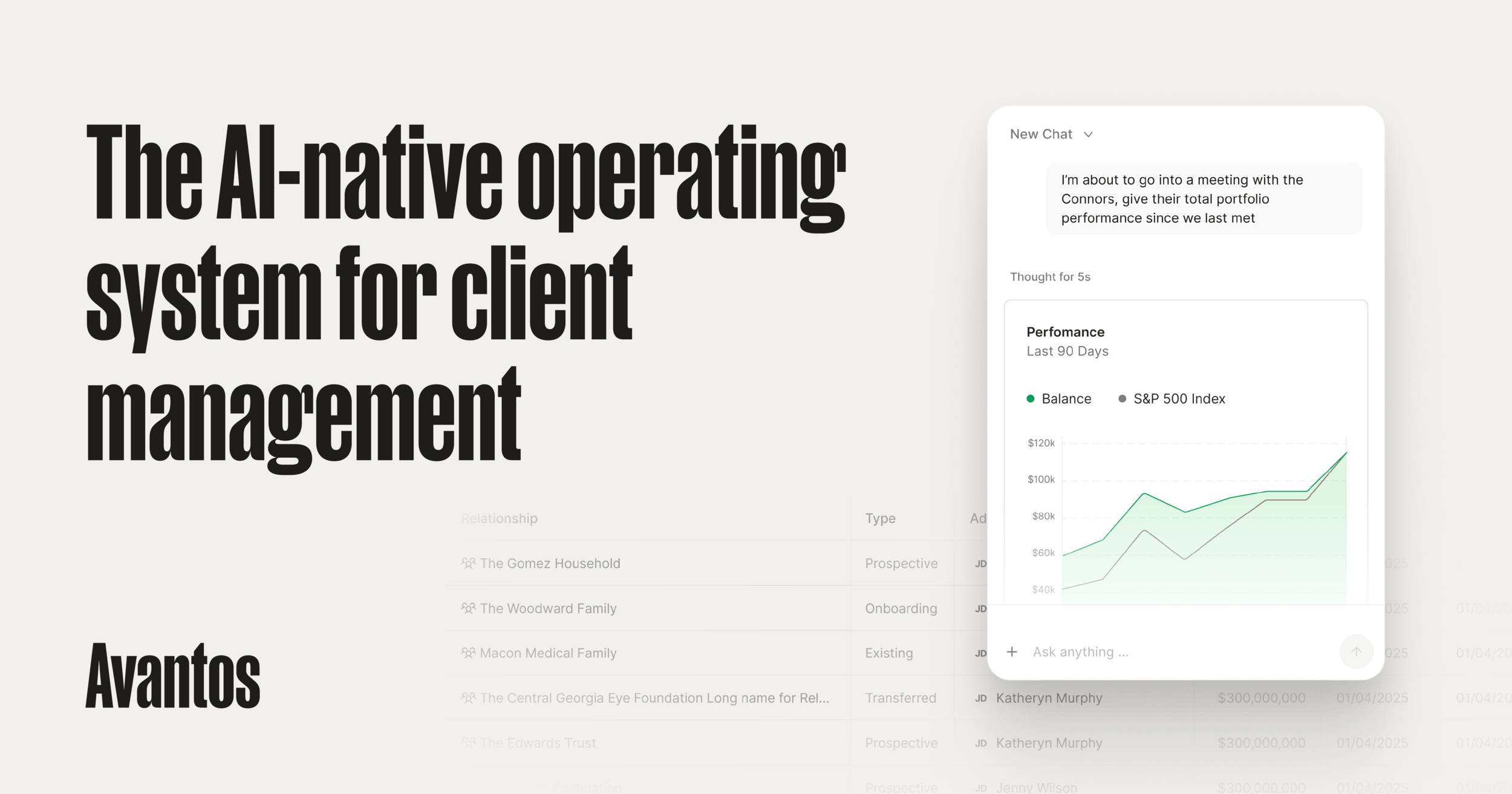
Avantos exists for the part nobody puts in the brochure. Not the pitch, not the close, but the onboarding and the servicing that follow: the forms, the follow-ups, the context that lives in one advisor's head and nowhere else. The company calls itself an AI-native operating system for client management. Translation: it is software that does the work between the systems you already have, so the people can get back to the people.
Founded in 2024 in New York, Avantos is built on a knowledge graph that links client data, products, teams, and work into one continuously updated picture. On top of that picture sit AI agents that prepare onboarding, coordinate across teams, flag opportunities, and execute - while humans keep the wheel. It is, depending on your patience for the phrase, the boring part finally done well.
"Avantos delivers a new operating layer with AI agents that power onboarding, servicing, and growth - while fitting into the technology stacks firms already run."
- Avantos, on what it actually does
The Problem
Onboarding clients was broken. Everyone just agreed not to mention it.
Financial services has spent a generation digitizing the front door and ignoring the hallway. The CRM got slick. The portal got an app. But the work of actually bringing a client in - and keeping them served across investments, insurance, lending, and tax - stayed a relay race run by humans copying fields between tabs.
When Bessemer Venture Partners looked at why this kept failing, it had receipts. Across earlier fintech bets, the firm kept watching the same wall: onboarding and servicing clients, it concluded, is fundamentally broken. Three things finally changed at once - AI got good enough to do real work, clients started expecting more, and financial institutions, at last, agreed to rethink their core operations instead of bolting another tool onto the pile.
"Onboarding and servicing clients is fundamentally broken."
- The thesis Bessemer carried in from its earlier fintech investments
That is the tension Avantos runs on. Not a flashy demo problem. A structural one. The gap between the moment a client says yes and the moment they actually feel served has been measured in weeks. Avantos is a bet that the gap is an engineering problem, not a fact of life.
The Bet
A McKinsey partner and a KPMG partner walk into the back office.
Avantos was founded by two people who had spent their careers diagnosing exactly this problem from the consulting side - and presumably grew tired of writing the recommendation without building the fix.
BC
Bassam Chaptini
Co-Founder & CEO
Holds a PhD in AI from MIT and spent roughly a decade as a McKinsey partner focused on financial services. The rare combination of someone who can both train a model and read a balance sheet.
RR
Co-Founder & President / CEO
A 15-year partner at KPMG who served as lead partner for Goldman Sachs and advised major broker-dealers. Engineering degree from Cornell, MBA from Wharton. He knows where the bodies - and the broken workflows - are buried.
Their bet: that financial servicing needed an operating system, not another app. Something that sits underneath the stack and supplies context to everything above it. The company even shed its first name - it started life as Mosaic IQ - on the way to that conviction.
"Build the operating system for the next generation of client management."
- The Avantos mission, stated without a single exclamation point
The Product
Context first. Conversation second.
Most "AI for X" products are a chatbot wearing a lanyard. Avantos went the other direction. At its core is a knowledge graph - a living map of clients, products, teams, and the work connecting them. Agents read that map before they act, which is a polite way of saying they tend to know what they are doing.
Onboarding
AI agents build dynamic onboarding journeys, coordinate the handoffs, and execute across systems - so the relay race becomes a single, watchable lane.
Servicing
Customizable servicing workflows that track progress and deliver an integrated standard of care across investments, planning, estate, and tax.
Relationship Intelligence
The knowledge graph surfaces proactive client insights and growth opportunities that used to live only in one person's memory.
The point of an operating system is that you stop noticing it. Avantos is at its best when nobody in the office can remember what onboarding felt like before.
"AI agents participate directly in the work - preparing onboarding, coordinating across teams, identifying opportunities, monitoring progress, and executing across systems."
- How the agents earn their keep
The short, expensive history of Avantos
2024
Founded in New York by Bassam Chaptini and Rabih Ramadi, initially as Mosaic IQ.
Sep 2024
$10M seed round led by MIT-affiliated E14 Fund, with M13, Mercer Advisors, and Blue Collective.
2024-25
Launches with Mercer Advisors, a $96B AUM RIA, scaling across tens of thousands of clients.
Feb 2026
$25M Series A led by Bessemer, with Vanguard, SEI, and Guardian Life joining. Total funding reaches $35M.
Jun 2026
CEO Bassam Chaptini takes the message public on the Power Your Advice podcast - "AI built for the real work of client management."
The Proof
When competitors co-invest, somebody noticed something.
It is easy to raise money on a deck. It is harder to get a $96 billion RIA to run your software on real clients - and harder still to get Vanguard and SEI, who are not exactly strangers in the market, onto the same cap table. Avantos did both.
Funding, stacked
USD raised, by round · total $35M
The Series A investor list reads like a who's-who of people with something to protect: Bessemer leading, with Guardian Life, SEI, and Vanguard as strategic backers, alongside returning seed investors E14, M13, Mercer Advisors, and Blue Collective. Strategic money is rarely sentimental. These are firms buying a front-row seat to how their own client operations might work next.
"Tens of thousands of Mercer Advisors clients are already served on Avantos rails - the kind of proof that does not fit in a pitch deck footnote."
- On launch partner traction
Who it's built for
- Independent RIAs and wealth managers
- Asset managers and private banks
- Insurance carriers
- Broker-dealers
- Custodians and the platforms that connect them
The Mission
An operating system, not another browser tab.
Avantos is explicit that it does not want to be the thing you switch to. It wants to be the layer underneath the things you already use - the CRMs, custodians, portfolio tools, underwriting and policy administration systems - quietly supplying context and executing work. The new capital is earmarked for exactly that: deeper integrations, and more capable agents.
It is a less glamorous ambition than "replace your team," and a more durable one. The companies that win infrastructure rarely win by being loud. They win by becoming the thing nobody can remember installing and nobody could imagine removing.
"The goal is not to add a tool. It's to add an operating layer - and then disappear into the work."
- The Avantos premise, paraphrased
Why It Matters Tomorrow
Back to that client who said yes.
Return to the office from the opening. The household has signed. In the old world, that yes triggered weeks of quiet friction - forms re-keyed, teams paged, context lost between the advisor who closed and the people who deliver.
In the world Avantos is building, the yes triggers a system that already knows. The onboarding journey assembles itself. The right teams are looped in. The work gets done, watched, and improved, while the advisor does the one thing software still cannot: sit across from a person and earn their trust.
That is the whole bet. Not that AI replaces the relationship - that it finally clears the desk so the relationship can happen. Avantos is wagering $35 million and two careers' worth of pattern recognition that the back office is where the next decade of financial services gets won. The beginning, at last, gets to feel like one.