The report needed correcting. For Joseph Salegna, chief financial officer of credit manager Livello, that was a problem worth changing software for. His firm traded instruments whose accounting could be awkward, particularly bank debt. Its existing investment platform lacked the integrated general ledger it wanted. Accuracy and timeliness were becoming work the team had to supply itself.
That is a useful place to meet Clearwater Analytics. Forget the trading-floor screens for a moment. Institutional investing also requires someone to establish what was bought, where it sits, what income it earned and whether the records agree. Clearwater built its business around that less photogenic work. It now wants to handle much more of the journey.
The scale is substantial: the group says its platform supports more than $10 trillion in assets. These are customers’ investments recorded and processed through software, not a Clearwater-managed fund. In June 2026, an investor group led by Permira and Warburg Pincus completed an approximately $8.4 billion acquisition of the business. Getting the numbers right has attracted a large number of its own.
Assets supported by the group’s platform.
Not assets managed by Clearwater.
The report that needed correcting
Clearwater sells institutions a way to gather investment information from different sources, reconcile it, apply accounting rules and produce reports. Insurers need records that support their reporting obligations. Corporate treasury teams need a dependable picture of investments and cash. Asset managers need positions, performance and client reporting that tell a consistent story.
The practical difficulty is that the same investment appears in several places. A portfolio manager sees a position; an accountant sees entries; a custodian supplies another record. A discrepancy between them has to be investigated. Put enough instruments, currencies and reporting requirements together and the clerical work becomes an operating constraint.
Clearwater’s pitch is to consolidate that work in cloud software with supporting services. Its expertise sits where accounting, investment data and operational processes overlap. The output can be a regulatory report or a risk view, but the necessary first step is a record that the people using it can trust.
“With our previous provider, we sometimes had to correct information in reports.”Joseph Salegna · CFO, Livello
Livello’s company-published case study gives the problem a face. The firm searched for a replacement in 2022 and chose Enfusion, now part of Clearwater. It wanted an integrated ledger to check its own books against its fund administrator. Enfusion also supplied managed trade-booking support, including bank debt. Salegna reported that the director of operations gained at least an hour a day for other work. That is one customer’s result, not a universal savings rate.
From Boise to the trading desk
The wider Clearwater business began in Boise, Idaho, in 2004, founded by David Boren, Michael Boren and Douglas Bates. The name on this profile, Clearwater Analytics, Ltd, belongs to the UK subsidiary incorporated in 2012. Its registered office is in Staines-upon-Thames. The group is headquartered in Boise, and the global product and financial figures here describe that wider business.
The distinction matters because the story has outgrown the original accounting proposition. In April 2025, Clearwater completed its acquisition of Enfusion in a deal valued at approximately $1.5 billion. The purchase brought portfolio and order management capabilities and a stronger presence among hedge funds. Clearwater could now sell software used nearer the investment decision and trade itself.
It also moved into deeper risk technology. The announced acquisition of Beacon carried an approximately $560 million price. Beacon brought cross-asset modeling and risk analytics, along with development infrastructure. The strategic logic is straightforward: a firm that already knows the portfolio’s records has a reason to help customers analyze what might happen to that portfolio.
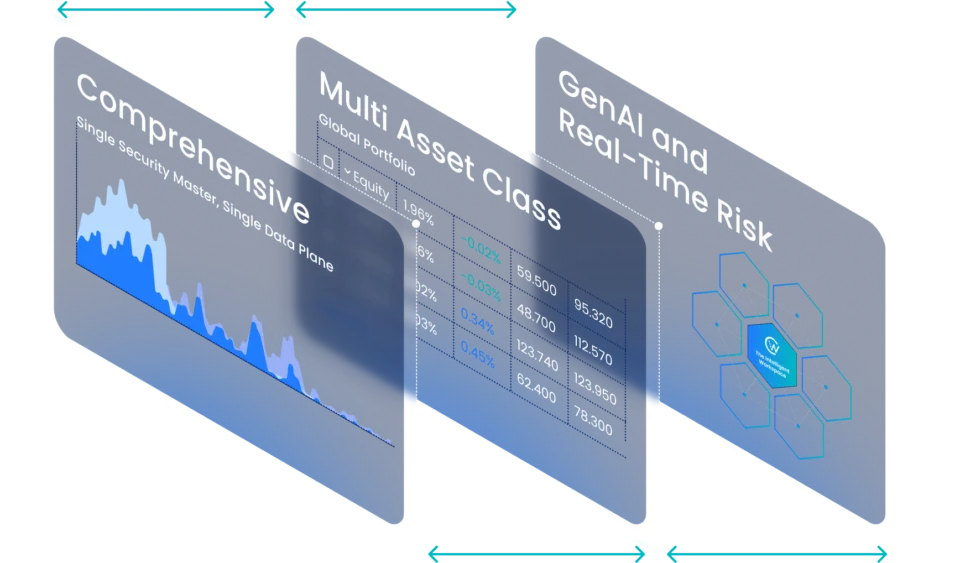
These purchases expanded what Clearwater could offer. They also expanded what it had to deliver. At the Enfusion closing, the company described unified dashboards and other integration milestones as work underway. A signed acquisition agreement can combine ownership overnight; combining customer workflows is a separate engineering and service task.
Construct and assess
Execute and record
Resolve the differences
Explain the result
The customer buys back the calendar
For buyers, the benefit is easier to understand in deadlines than in software architecture. Caledonia Investments, a UK investment trust, wanted to bring ten years of historical data into Enfusion. Clearwater’s customer account says onboarding finished in ten weeks, ahead of schedule. Caledonia then produced its monthly management information pack by the third business day.
The case describes investments across public equities, private capital and private equity funds. It also describes connections to Bloomberg and LP Analyst, plus managed services for daily operational work. The attraction was a more consistent view of the business and less time gathering the material needed to explain it.
There is a useful procurement lesson in those details. “Faster reporting” is difficult to test until someone specifies the report, the historical records it needs and the date it must arrive. Caledonia’s migration scope and reporting deadline make the claim concrete. They are targets a buyer can discuss without assuming every implementation will follow the same schedule.
Clearwater earns subscription and service revenue. Its disclosures say part of revenue depends on assets on the platform, measured in basis points, generally with minimum or base fees. The commercial question therefore extends beyond user seats: what assets, workflows, data and service responsibilities belong in the contract?
A platform that leaves the door open
The competitive field includes BlackRock’s Aladdin, SimCorp Dimension, SS&C products and BNY’s Eagle, among others. These alternatives cover different combinations of investment operations. Clearwater’s positioning emphasizes its shared cloud architecture, reconciled investment data and increasingly broad product range. Buyers still have to compare the actual workflows they need.
One revealing detail is Bloomberg’s position on both sides of the fence. Clearwater identifies Bloomberg AIM among competitors, yet the companies announced a collaboration in July 2025. The offering joins Bloomberg investment tools to Clearwater’s accounting, data aggregation, reconciliation and reporting. Daily cash synchronization and consistent position and trade exchanges are part of the proposition.
BarmeniaGothaer Asset Management supplies a concrete example. Following the 2024 merger of Barmenia and Gothaer, the German insurance asset manager had an opportunity to unite two technology environments. A March 2026 announcement described Bloomberg tools for investment workflows and Clearwater’s selection for middle- and back-office functions. The firm managed more than €50 billion at the time of that announcement.
This is a revealing answer to the all-in-one sales pitch. An institution may want one coherent investment view while retaining tools from more than one provider. Clearwater can pursue a larger share of the workflow through Enfusion and still connect with a customer’s Bloomberg environment. The value depends on how well the pieces exchange information.
A Snowflake integration announced in October 2024 extends that approach into data infrastructure. It covers governed access to Clearwater datasets, including Prism, with direct data sharing and natural-language analysis capabilities. For a firm already using Snowflake, the appeal is being able to use investment information in its existing analytical environment.
An $8.4 billion change of ownership
Clearwater’s expansion shows up in its financials. Group revenue reached $731.4 million in 2025, compared with $451.8 million in 2024. That rise includes an acquisition-heavy year, so it should not be mistaken for growth from the same product and customer base alone. The group recorded an operating loss of approximately $7.7 million in 2025.
Acquisitions affect the comparison. Revenue is not profit.
The ownership change closed on June 25, 2026. Shareholders received $24.55 per share in cash, and the Class A shares stopped trading on the New York Stock Exchange. Francisco Partners supported the Permira and Warburg Pincus-led transaction, with Temasek participating. The two lead firms had first invested in Clearwater in 2020, before its 2021 IPO.

Management presented private ownership as a way to accelerate platform and AI investment. The product argument is that reconciled investment data gives automated tools a useful foundation. That argument has merit as a design principle: an assistant interpreting inconsistent records can reproduce the inconsistency faster. Actual value still depends on the accuracy and control of the work it performs.
People remain part of the proposition. Clearwater’s careers materials emphasize client commitment, execution and continuous improvement, alongside volunteering and employee development. Those are the employer’s stated priorities. The customer stories make the operational role of people more tangible: implementation support and managed services help move records and keep processes running.
The difficult loan belongs in the demo
Recent customer announcements show the range Clearwater is pursuing. MSIG Europe selected its investment operations platform in July 2026. Later that month, Corgi Funds announced it was live on Enfusion for an expanding ETF business, using portfolio and order management alongside operational services. Insurance reporting and ETF operations place different demands on a system; serving both broadens the delivery challenge.
A prospective customer can borrow a practical method from these accounts. Bring a difficult instrument to the demonstration. Follow it from trade capture into the ledger and final report. Specify the historical records that must migrate. Establish who investigates exceptions, and measure the time needed to deliver an actual recurring report.
The economics are less convincing when the operational problem is small, existing systems already serve it well or the required instruments fall outside the agreed scope. Incomplete upstream data and poorly assigned responsibilities can also undermine a polished installation. Clearwater’s opportunity is to remove expensive work between investment decisions and their accounting consequences. The telling moment comes when the next report arrives, and nobody has to fix it.