The least glamorous problem in wealth management may also be the most expensive: a financial advisor finishing one task, opening another application, retyping what the first application already knew, and hoping two versions of the same client still agree. The industry calls it “swivel-chairing.” Advisor360° built a company around making the chair stop.
The Needham, Massachusetts software maker sells a connected workbench for financial advisors, registered investment advisers, broker-dealers, bank wealth divisions and their home offices. CRM, portfolio reporting, financial planning, digital onboarding, trading, fee billing, compliance, documents and a client portal can live on the same foundation. Third-party software can plug in too. The point is not merely to put many tools behind one password. It is to give those tools one governed version of the household.
Those are the company’s current scale figures. They make Advisor360° a strange sort of fintech: only seven years old as an independent business, but carrying the scar tissue of a much older product. Its software was developed over roughly two decades inside Commonwealth Financial Network, with advisors, clients, support staff and the back office supplying the feature requests and edge cases. In April 2019, it became an independent company. A licensing agreement put the suite in front of MassMutual’s advisors and field partners.
A startup born with enterprise baggage - the useful kind
Most founders begin with a theory about a customer. Advisor360° began with years of customers interrupting the theory. Commonwealth’s advisors were not a focus group assembled for an afternoon. They were people opening accounts, preparing reviews, correcting data and answering clients every day. Darren Tedesco, now Advisor360°’s president, oversaw technology and strategy at Commonwealth and helped design the platform that became the spinout.
That history explains the breadth. Advisor360° does not offer a single dazzling calculator. It follows the thread of work: a prospect becomes a client; accounts get opened; assets arrive from different custodians; plans, proposals and trades follow; documents accumulate; fees are calculated; supervisors need visibility; clients want a coherent portal. The company’s expertise lives in the handoffs.
“You became an advisor to serve families, not manage software.”Advisor360° product premise
Its business model is enterprise B2B SaaS. Firms subscribe, select native applications and connect outside tools. Public list pricing is not posted; sales are consultative and quote-based. That makes the buying decision less like installing a note-taking app and more like choosing operating infrastructure. Parrot AI, the company’s meeting assistant, is also available separately and offers a 14-day trial.
The data fabric is the product nobody brags about at dinner
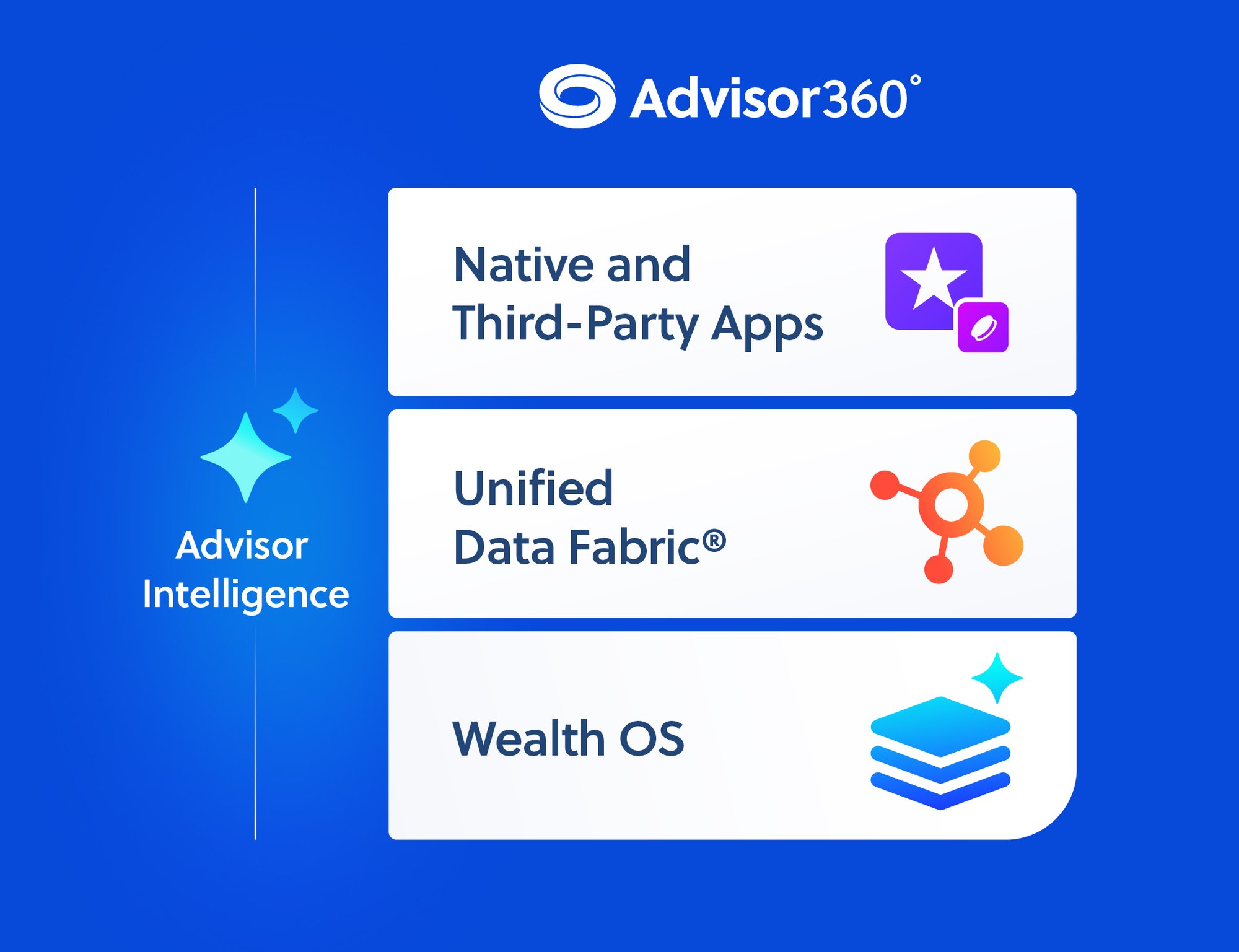
Advisor360° calls its foundation the Unified Data Fabric. It consolidates, cleans and enriches client, account and transaction data from hundreds of sources - custodians, market-data providers, aggregators, insurers and banks. Proprietary householding logic is meant to recognize that an investment account, insurance policy and bank balance can belong to one family even when the records arrive in incompatible shapes.
This is the company’s most credible distinction from both point solutions and all-in-one competitors. A best-of-breed stack can give a firm its favorite CRM, planning tool and reporting engine, but staff may become the integration layer. Other large platforms - Envestnet, Orion, SS&C Black Diamond, InvestCloud, SEI, Addepar and Broadridge among them - attack parts of the same market. Advisor360°’s answer is open architecture without surrendering the shared record: bring outside applications, custodians and business models, but make them speak through one data layer.
What advisors said was broken
The bars come from Advisor360°’s 2022 survey of 300 advisors and executives at large wealth firms. They explain why “one more feature” was not the answer. The first constraint exposed after the spinout was connectivity. The platform was broad, but its custodial and CRM reach could be broader. In December 2022, Advisor360° made its first acquisition: the wealth-management technology assets of Agreement Express. The deal added digital onboarding, multi-custodian support, more CRM integrations, clients and staff in Canada.
Former CEO Rich Napolitano later called 2022 the turning point when the independent company found product-market fit. What changed the company’s posture was not a failed flagship product; it was evidence that breadth without portability still left a ceiling. Buying Agreement Express was a faster route to Schwab, Fidelity, Pershing and other account-opening rails than patiently rebuilding each connection.
Buy the rails. Then teach them to listen.
The second acquisition followed the same logic. In early 2025, Advisor360° acquired Parrot AI, a Boston generative-AI company focused on advisor conversations. Parrot records virtual, in-person and phone meetings; generates transcripts and summaries; organizes documents by household; drafts follow-up; and can update CRM records. Advisor360° says the product can return as much as a full day each week.
Transcription alone is crowded and easy to copy. Household continuity is harder. Parrot can connect what a client said with previous conversations and documents, then make the book searchable. The advisor asks for unresolved follow-ups or planning gaps rather than digging through a folder of meeting notes. Security controls include single sign-on, permissions, retention settings and a promise that customer data is not used to train the model.
“AI prepares the work. The advisor leads the relationship.”Advisor360° on human control
By late 2025, the company bundled this logic into Wealth OS, an “AI-native” foundation for data, applications, workflows and permissions. Advisor Intelligence and its ViDA assistants and agents can prepare a meeting, monitor activity or recommend next steps. The guardrail is explicit: the software runs up to the recommendation; the advisor decides. In a regulated business, human-in-the-loop is not decorative reassurance. It defines who owns the outcome.
Who gets leverage - and who gets a migration project
The natural buyers are firms large enough to feel fragmentation as an operating expense: broker-dealers balancing independence with supervision, RIAs adding advisors or acquiring practices, insurance firms combining protection and investment records, and banks trying to offer a modern client experience without replacing every system at once. Publicly visible relationships include Commonwealth, MassMutual, GWN Securities, King Financial Network and Merit Financial Advisors. A 2026 partnership with Conquest Planning embeds financial planning; Schwab connectivity extends the multi-custodial pitch.
The platform can help an advisor open accounts without rekeying data, assemble reconciled review packages, see beneficiaries across insurance and investments, manage models, bill fees, and give clients one portal for their financial lives. Home offices get permissions, compliance workflows and operational reporting. The client mostly experiences the absence of seams.
There is a tradeoff. A platform this broad asks a firm to standardize definitions, permissions and workflows. Implementation has switching costs. Firms that prize a highly customized collection of point tools may resist a shared operating layer; a small practice needing only a meeting recorder may find the full platform excessive. The strategy works best when fragmented data is already expensive, leadership can govern a migration, and scale justifies the effort. It works poorly when nobody owns data quality or when every office insists its process is sacred.
What another builder can copy
- Live inside the workflow. Edge cases observed for years beat personas invented for a sales deck.
- Normalize before automating. AI cannot rescue conflicting records; it can only make the conflict sound confident.
- Acquire constraints, not ornaments. Both purchases removed a specific ceiling: connectivity first, conversational context second.
- Measure the missing minutes. “One day a week” is a sharper promise than vague digital transformation.
- Keep judgment visible. In regulated work, a clear approval boundary is part of product design.
The bet is continuity
Milind Mehere, the former Yieldstreet CEO who joined Advisor360°’s board in 2024, became chief executive in June 2026. He inherits a company of approximately 600 people, a broader push into RIAs, and a product vocabulary that has moved from integrated platform to autonomous financial platform. The language is ambitious; the advantage beneath it remains satisfyingly prosaic.
Advisor360° is betting that the winner in advisor AI will not be the company with the chattiest interface. It will be the one that knows which account belongs to which household, which meeting changed which plan, which permission governs which action, and how to carry a decision into the next system without asking a human to swivel. The story began as software for a broker-dealer. The payoff, if it works, is software that behaves as if it remembers the whole firm.