Every winter, some of Accurant’s clients left the Midwest for Florida, Texas, or Arizona. Their tax obligations followed them. In TaxDome’s account of the firm’s experience, managing partner Barb Vanags described a useful consequence of its client portal: people could leave town and keep their accountant. Geography stopped deciding whether a working relationship survived.
- TaxDome connects client paperwork, team workflows, signatures, and billing.
- Accounting firms pay per staff seat; clients participate through a portal and mobile app.
- The payoff depends on moving real work into the system and teaching people to use it.
The detail is revealing. Accounting software is usually discussed in the language of efficiency. Here was something more personal: keeping a familiar professional while changing your winter address. TaxDome’s business sits in that gap between the technical work an accountant performs and the small interactions that make the work possible.
01 The return is only half the job
A return needs documents. Documents need requests. Requests need replies. Somewhere along the way come an engagement letter, a signature, a question, and an invoice. Each handoff gives somebody another reason to open an inbox and ask what happened.
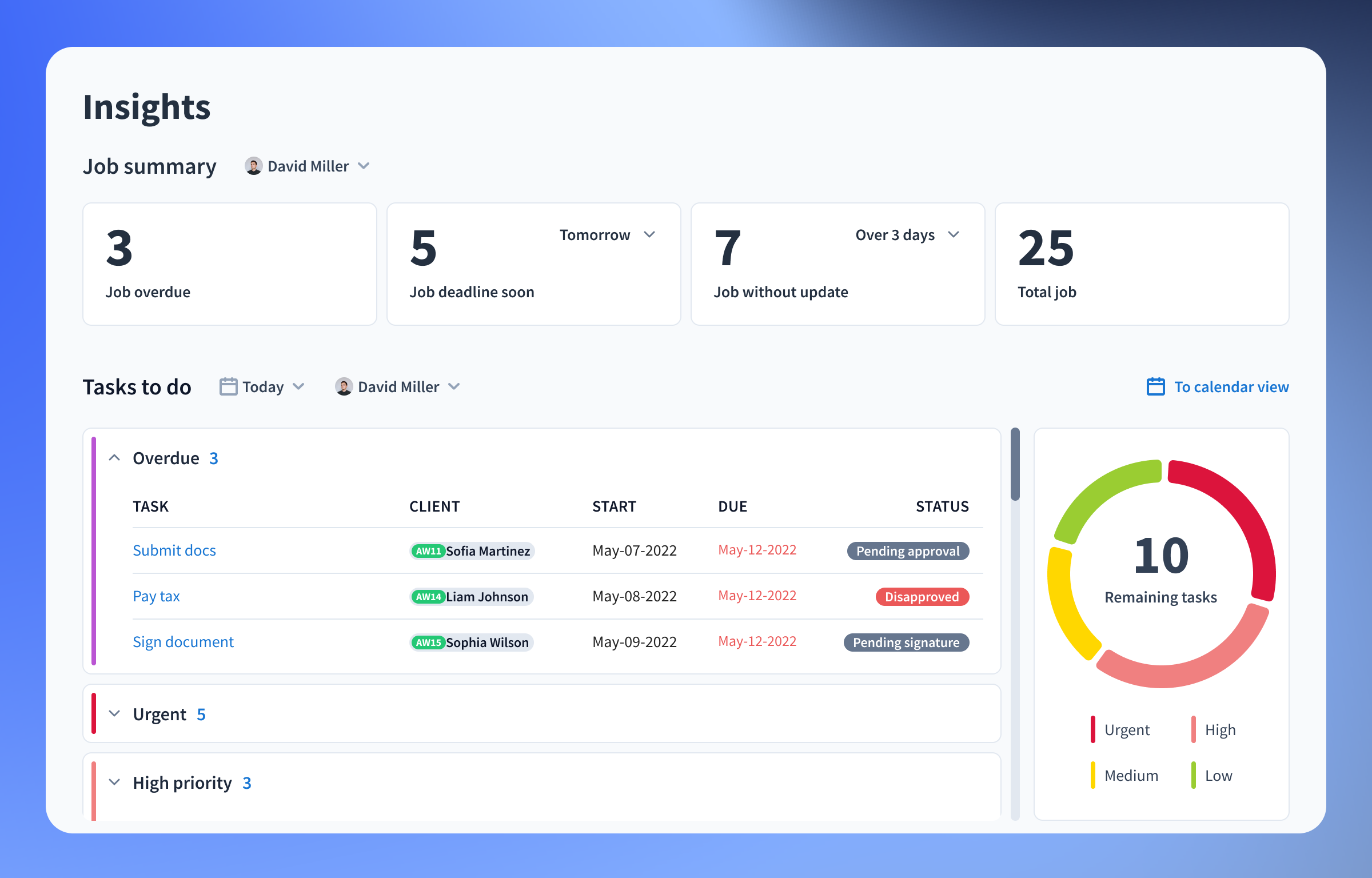
TaxDome puts those interactions inside one practice management platform. A firm can maintain client records, collect information through organizers, assign jobs, store files, request signatures, and bill for work. Pipelines show an engagement’s stage; automations can assign tasks or send reminders when specified conditions are met. The connection between actions is the point.
- 01RequestCollect information
- 02ReviewAssign the work
- 03SignSecure approval
- 04CollectClose the invoice
This is the operating layer around accounting. Firms still use tax preparation and financial software. TaxDome connects to other tools rather than requiring every calculation to happen inside its own walls. Its QuickBooks Online connection and Juno tax preparation integration make that division of labor explicit.
Consider a missing document. A storage folder can hold it after arrival, but the surrounding process must still record who requested it, who owes it, and which job is waiting. TaxDome’s combination of client requests, records, and workflow gives a firm a place to connect those questions.
02 When the spreadsheet stops keeping up
Accurant adopted TaxDome in November 2021 after acquiring two firms. Its case study describes manual status tracking, scattered communication, and an awkward collection of tools. The acquisition created a reason to reconsider familiar habits. The firm consolidated document handling, signatures, and workflow tracking, while retaining separate tax and financial software.
“Right now, we’re down to just our tax and financial software - and TaxDome.”
Barb Vanags · Accurant customer account
The lesson is about visibility. When responsibility lives in someone’s memory, a growing firm must keep asking that person for updates. A shared workflow makes the next step inspectable. That matters when the person answering a client’s question is different from the person preparing the return.
03 Your client is a user, too
Brothers Victor and Ilya Radzinsky founded TaxDome in 2017 in a Brooklyn coworking space. Victor is CEO; Ilya is president. Their stated mission includes both accountants and their clients. That second audience shapes the product: a firm buys the subscription, but its clients must upload files, respond, sign, and pay.


The mobile app lets clients scan documents with a phone, exchange secure messages, and complete those actions away from a desk. A separately priced white-label option puts the firm’s branding on its own app. Aspyr Professional Group announced a TaxDome-powered branded app in December 2025. For clients, the accounting relationship can remain under a familiar name.

It also accommodates the client who comes through the front door. TaxDome announced Kiosk in June 2026, connecting tablet-based, in-office signing to the digital workflow. A practice can serve people at a reception desk and through a phone without building an entirely separate paper process for each.
The company says more than 15,000 firms use its platform across more than 25 countries. Those are vendor-reported adoption figures. Its market includes solo practitioners, bookkeepers, tax specialists, and larger practices with multiple offices. The common problem is coordinating people on both sides of an engagement.
04 The price of putting it together
Published US one-year subscriptions are $800 per seat for Essentials, $1,000 for Pro, and $1,200 for Business. Essentials permits one user. A five-person firm choosing Pro therefore faces $5,000 in annual subscription charges before optional services. Longer commitments lower the annual rate, with plans billed upfront.
Per seat, per year. Essentials is for one user. Prices checked October 23, 2026.
Implementation adds another commitment. TaxDome says most firms complete onboarding in six to eight weeks, and paid onboarding starts at $999. A useful buying calculation includes setup time and the subscriptions actually retired. Counting an old tool as a saving while continuing to pay for it makes the arithmetic flattering and unhelpful.
Karbon, Canopy, and Financial Cents also sell accounting practice management. TaxDome’s argument is the breadth of its connected bundle, particularly the link between internal workflow and client actions. That advantage needs testing against a firm’s existing tools. A specialist product that already fits beautifully may be worth keeping.
05 Automate the handoff you understand
The same practical test applies to AI. TaxDome offers document tagging and renaming today. Its AI page still labels Atlas, MCP connections, and a public API as forthcoming. September 2026 release notes describe more immediate changes, including approval before tax return signing and QuickBooks deposits grouped by payout.
Document AI tackles a particularly mundane irritation: an uploaded file with a meaningless name. Categorization and renaming can make the record easier to navigate before anyone begins the substantive tax work. The sensible evaluation is to test those features on the documents a firm actually receives, including the awkward ones.
Its independence story also rewards careful reading. TaxDome calls itself bootstrapped; Accel-KKR lists a 2024 credit investment. Debt and outside equity are different. The company publishes voluntary annual reports and says it values pragmatic technology. Its durability will depend on making ordinary work dependable.
For a firm evaluating it, start with one recurring engagement. Name each stage, its owner, and the condition that finishes it. Try the process on a client’s phone. Automating unclear instructions only repeats the confusion faster. Where clients resist the portal or staff keep parallel records, the shared picture will stay incomplete. The snowbird test remains useful: can the relationship keep moving when everyone is somewhere else?